University of State of Santa Catarina, Center for Health Sciences and Sports, Adapted Physical Activity Laboratory, Florianópolis, Santa Catarina, Brazil.
University of Brasilia, Faculty of Physical Education, Brasilia, Brazil.
PLoS One. 2018 Feb 27;13(2):e0193113. doi: 10.1371/journal.pone.0193113. eCollection 2018.
Given the relative importance of cognitive impairment, there was considerable interest in identifying the cognitive profile of PD patients, in order to ensure specific and appropriate therapeutic interventions.
To determine the effects of physical exercise programs on cognitive function in PD patients, compared with the control group.
Medline, Cochrane, Scopus, PEDro and Web of Science (last searched in September 2016).
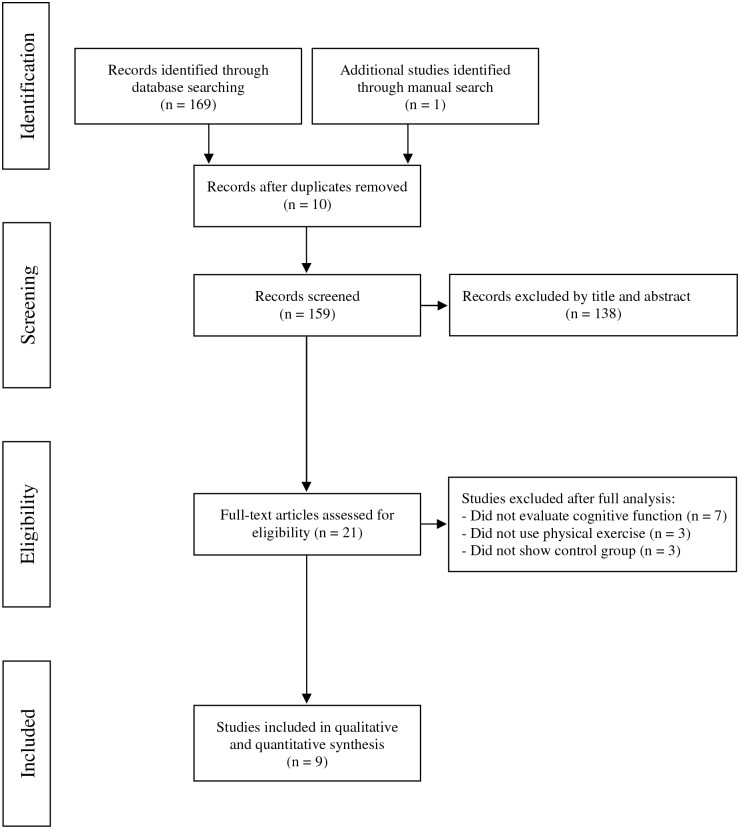
Randomized clinical trials examining the effects of physical exercise programs and cognitive function in PD patients. Nine studies fulfilled the selection criteria and were included in this review.
Characteristics of the publication, characteristics of the participants, test used for cognitive screening, cognitive domain assessed, tools used to assess cognitive function, characteristics of the experimental intervention, characteristics of the control group, mean results and standard deviation of function cognitive. The PEDro score was used to evaluate methodological quality.
Most eligible studies showed good methodological quality based on the PEDro scale. Studies have shown that adapted tango for PD patients, cognitive training combined with motor training, and treadmill training promote the preservation or improvement of cognitive function in PD patients.
The diversity of cognitive tests used to assess cognitive function and the high heterogeneity identified between the physical exercise programs.
Physical exercise programs promote positive and significant effects on global cognitive function, processing speed, sustained attention and mental flexibility in PD patients, at a mild to moderate stage for patients with a 6-year clinical diagnosis of PD. However, treadmill training performed 3 times a week for about 60 minutes and for a period of 24 weeks produced larger improvements in cognition.
鉴于认知障碍的相对重要性,人们对识别 PD 患者的认知特征产生了浓厚的兴趣,以确保进行特定且适当的治疗干预。
确定与对照组相比,体育锻炼方案对 PD 患者认知功能的影响。
Medline、Cochrane、Scopus、PEDro 和 Web of Science(2016 年 9 月最后检索)。
对评估 PD 患者体育锻炼方案和认知功能影响的随机临床试验进行了审查。符合选择标准的有 9 项研究被纳入本综述。
出版物特征、参与者特征、用于认知筛查的测试、评估的认知域、用于评估认知功能的工具、实验干预的特征、对照组的特征、功能认知的平均结果和标准差。PEDro 评分用于评估方法学质量。
根据 PEDro 量表,大多数合格研究显示出良好的方法学质量。研究表明,适应 PD 患者的探戈、认知训练与运动训练相结合以及跑步机训练可促进 PD 患者认知功能的保留或改善。
用于评估认知功能的认知测试的多样性以及所确定的体育锻炼方案之间的高度异质性。
在轻度至中度阶段,对于临床诊断为 PD 且病程为 6 年的患者,体育锻炼方案对 PD 患者的整体认知功能、处理速度、持续注意力和心理灵活性具有积极且显著的影响。然而,每周进行 3 次、每次约 60 分钟、持续 24 周的跑步机训练可使认知功能获得更大的改善。