Faculty of Chemistry, Biotechnology and Food Science, Norwegian University of Life Sciences (NMBU), Post Office Box 5003, 1432, Ås, Norway.
Department of Microbiology, The Ohio State University, Columbus, OH, 43201, USA.
Microbiome. 2018 Mar 1;6(1):44. doi: 10.1186/s40168-018-0421-8.
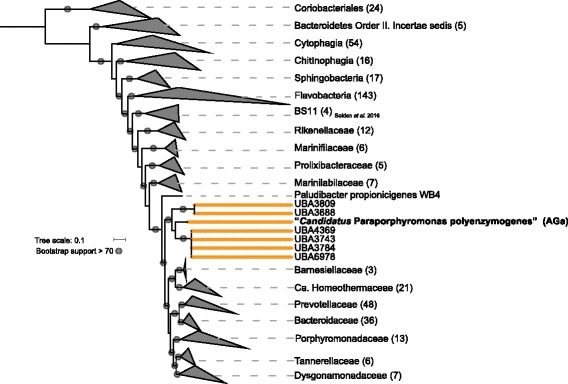
In nature, obligate herbivorous ruminants have a close symbiotic relationship with their gastrointestinal microbiome, which proficiently deconstructs plant biomass. Despite decades of research, lignocellulose degradation in the rumen has thus far been attributed to a limited number of culturable microorganisms. Here, we combine meta-omics and enzymology to identify and describe a novel Bacteroidetes family ("Candidatus MH11") composed entirely of uncultivated strains that are predominant in ruminants and only distantly related to previously characterized taxa.
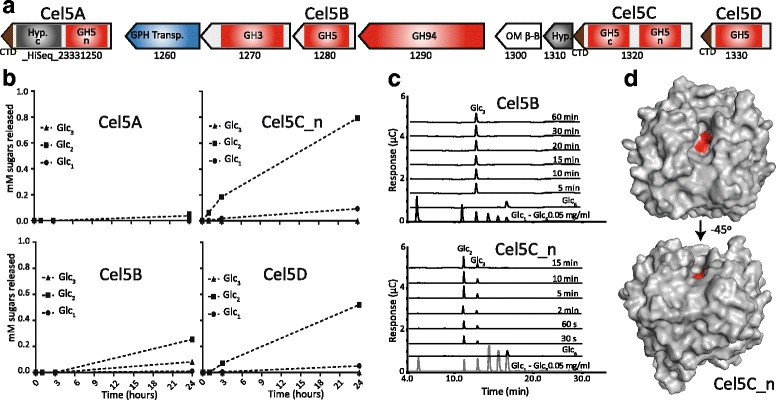
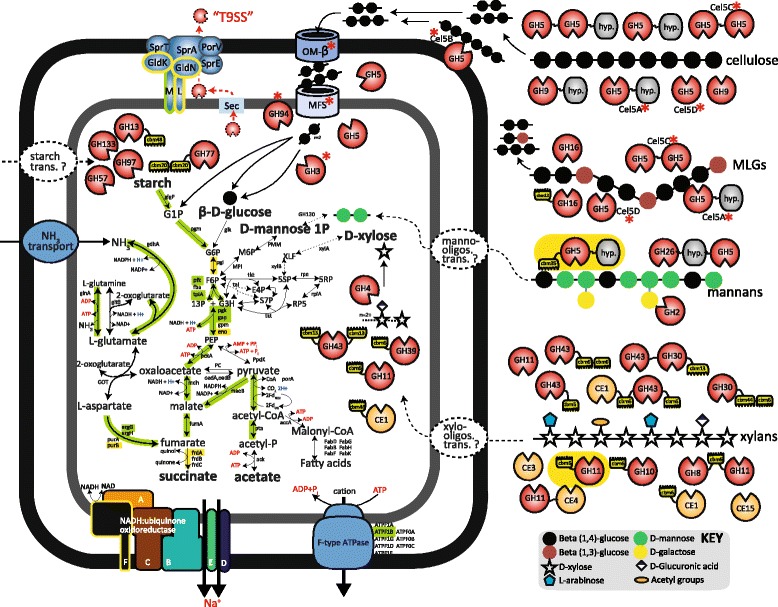
The first metabolic reconstruction of Ca. MH11-affiliated genome bins, with a particular focus on the provisionally named "Candidatus Paraporphyromonas polyenzymogenes", illustrated their capacity to degrade various lignocellulosic substrates via comprehensive inventories of singular and multi-modular carbohydrate active enzymes (CAZymes). Closer examination revealed an absence of archetypical polysaccharide utilization loci found in human gut microbiota. Instead, we identified many multi-modular CAZymes putatively secreted via the Bacteroidetes-specific type IX secretion system (T9SS). This included cellulases with two or more catalytic domains, which are modular arrangements that are unique to Bacteroidetes species studied to date. Core metabolic proteins from Ca. P. polyenzymogenes were detected in metaproteomic data and were enriched in rumen-incubated plant biomass, indicating that active saccharification and fermentation of complex carbohydrates could be assigned to members of this novel family. Biochemical analysis of selected Ca. P. polyenzymogenes CAZymes further iterated the cellulolytic activity of this hitherto uncultured bacterium towards linear polymers, such as amorphous and crystalline cellulose as well as mixed linkage β-glucans.
We propose that Ca. P. polyenzymogene genotypes and other Ca. MH11 members actively degrade plant biomass in the rumen of cows, sheep and most likely other ruminants, utilizing singular and multi-domain catalytic CAZymes secreted through the T9SS. The discovery of a prominent role of multi-modular cellulases in the Gram-negative Bacteroidetes, together with similar findings for Gram-positive cellulosomal bacteria (Ruminococcus flavefaciens) and anaerobic fungi (Orpinomyces sp.), suggests that complex enzymes are essential and have evolved within all major cellulolytic dominions inherent to the rumen.
在自然界中,严格的草食反刍动物与它们的胃肠道微生物群有着密切的共生关系,这些微生物群能够有效地分解植物生物质。尽管经过了几十年的研究,但迄今为止,瘤胃中的木质纤维素降解仍归因于少数可培养的微生物。在这里,我们结合宏基因组学和酶学,鉴定并描述了一个全新的拟杆菌门(“候选 MH11”)家族,该家族完全由未培养的菌株组成,这些菌株在反刍动物中占优势,与先前表征的分类群仅有远亲关系。
对与 Ca. MH11 相关的基因组箱的首次代谢重建,特别关注暂命名为“候选副拟杆菌多酶基因”的基因组箱,说明了它们通过全面的单模块和多模块碳水化合物活性酶(CAZymes)的清单来降解各种木质纤维素底物的能力。更仔细的检查表明,缺乏在人类肠道微生物群中发现的典型多糖利用基因座。相反,我们鉴定了许多多模块 CAZymes,它们可能通过拟杆菌门特有的 IX 型分泌系统(T9SS)分泌。这包括具有两个或更多催化结构域的纤维素酶,这些是迄今为止研究的拟杆菌门物种所特有的模块化排列。在宏蛋白质组学数据中检测到候选副拟杆菌多酶基因的核心代谢蛋白,并在瘤胃孵育的植物生物质中富集,表明复杂碳水化合物的活性糖化和发酵可以归因于这个新家族的成员。对选定的候选副拟杆菌多酶基因 CAZymes 的生化分析进一步迭代了这种迄今未培养的细菌对线性聚合物(如无定形和结晶纤维素以及混合连接β-葡聚糖)的纤维素酶活性。
我们提出候选副拟杆菌多酶基因和其他候选 MH11 成员利用通过 T9SS 分泌的单模块和多结构域催化 CAZymes 积极降解奶牛、绵羊和很可能其他反刍动物瘤胃中的植物生物质。革兰氏阴性拟杆菌门中多模块纤维素酶的突出作用的发现,以及革兰氏阳性纤维体细菌(Flavifactor flavefaciens)和厌氧真菌(Orpinomyces sp.)的类似发现表明,复杂的酶是必不可少的,并在瘤胃中固有的所有主要纤维素分解域中进化。