• 文献检索
  • 文档翻译
  • 深度研究
  • 学术资讯
  • Suppr Zotero 插件Zotero 插件
  • 邀请有礼
  • 套餐&价格
  • 历史记录
应用&插件
Suppr Zotero 插件Zotero 插件浏览器插件Mac 客户端Windows 客户端微信小程序
定价
高级版会员购买积分包购买API积分包
服务
文献检索文档翻译深度研究API 文档MCP 服务
关于我们
关于 Suppr公司介绍联系我们用户协议隐私条款
关注我们

Suppr 超能文献

核心技术专利:CN118964589B侵权必究
粤ICP备2023148730 号-1Suppr @ 2026

文献检索

告别复杂PubMed语法,用中文像聊天一样搜索,搜遍4000万医学文献。AI智能推荐,让科研检索更轻松。

立即免费搜索

文件翻译

保留排版,准确专业,支持PDF/Word/PPT等文件格式,支持 12+语言互译。

免费翻译文档

深度研究

AI帮你快速写综述,25分钟生成高质量综述,智能提取关键信息,辅助科研写作。

立即免费体验

发育中的不良结局途径(AOP):在大脑发育过程中,拮抗剂与 N-甲基-D-天冬氨酸受体(NMDARs)的慢性结合会导致儿童学习和记忆能力受损。

Development of the Adverse Outcome Pathway (AOP): Chronic binding of antagonist to N-methyl-d-aspartate receptors (NMDARs) during brain development induces impairment of learning and memory abilities of children.

机构信息

European Commission, Joint Research Centre, Ispra, Italy.

European Commission, Joint Research Centre, Ispra, Italy.

出版信息

Toxicol Appl Pharmacol. 2018 Sep 1;354:153-175. doi: 10.1016/j.taap.2018.02.024. Epub 2018 Mar 7.

DOI:10.1016/j.taap.2018.02.024
PMID:29524501
原文链接:https://pmc.ncbi.nlm.nih.gov/articles/PMC6095943/
Abstract

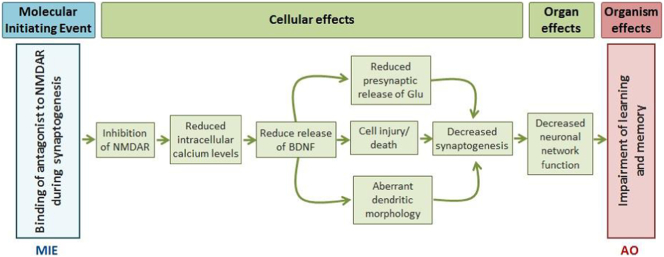
The Adverse Outcome Pathways (AOPs) are designed to provide mechanistic understanding of complex biological systems and pathways of toxicity that result in adverse outcomes (AOs) relevant to regulatory endpoints. AOP concept captures in a structured way the causal relationships resulting from initial chemical interaction with biological target(s) (molecular initiating event) to an AO manifested in individual organisms and/or populations through a sequential series of key events (KEs), which are cellular, anatomical and/or functional changes in biological processes. An AOP provides the mechanistic detail required to support chemical safety assessment, the development of alternative methods and the implementation of an integrated testing strategy. An example of the AOP relevant to developmental neurotoxicity (DNT) is described here following the requirements of information defined by the OECD Users' Handbook Supplement to the Guidance Document for developing and assessing AOPs. In this AOP, the binding of an antagonist to glutamate receptor N-methyl-d-aspartate (NMDAR) receptor is defined as MIE. This MIE triggers a cascade of cellular KEs including reduction of intracellular calcium levels, reduction of brain derived neurotrophic factor release, neuronal cell death, decreased glutamate presynaptic release and aberrant dendritic morphology. At organ level, the above mentioned KEs lead to decreased synaptogenesis and decreased neuronal network formation and function causing learning and memory deficit at organism level, which is defined as the AO. There are in vitro, in vivo and epidemiological data that support the described KEs and their causative relationships rendering this AOP relevant to DNT evaluation in the context of regulatory purposes.

摘要

危害途径(AOP)旨在提供对复杂生物系统和毒性途径的机制理解,这些途径导致与监管终点相关的不良后果(AO)。AOP 概念以结构化的方式捕捉了从与生物靶标(分子起始事件)的初始化学相互作用到个体生物和/或种群中表现出的不良后果(AO)的因果关系,通过一系列关键事件(KEs),这些 KEs 是生物过程中的细胞、解剖和/或功能变化。AOP 提供了支持化学安全评估、替代方法开发和综合测试策略实施所需的机制细节。本文按照 OECD 用户手册对开发和评估 AOP 的指导文件的补充中定义的信息要求,描述了一个与发育神经毒性(DNT)相关的 AOP 示例。在这个 AOP 中,拮抗剂与谷氨酸受体 N-甲基-D-天冬氨酸(NMDAR)受体的结合被定义为 MIE。这种 MIE 引发了一系列细胞 KEs,包括细胞内钙离子水平降低、脑源性神经营养因子释放减少、神经元细胞死亡、谷氨酸突触前释放减少和树突形态异常。在器官水平上,上述 KEs 导致突触发生减少和神经元网络形成和功能减少,从而导致生物体水平的学习和记忆缺陷,这被定义为 AO。有体外、体内和流行病学数据支持所描述的 KEs 及其因果关系,这使得该 AOP 与监管目的背景下的 DNT 评估相关。
https://cdn.ncbi.nlm.nih.gov/pmc/blobs/86b1/6095943/d94d9d004439/gr3a.jpg
https://cdn.ncbi.nlm.nih.gov/pmc/blobs/86b1/6095943/169523c8388d/gr1.jpg
https://cdn.ncbi.nlm.nih.gov/pmc/blobs/86b1/6095943/7b6c0e349796/gr2.jpg
https://cdn.ncbi.nlm.nih.gov/pmc/blobs/86b1/6095943/d94d9d004439/gr3a.jpg
https://cdn.ncbi.nlm.nih.gov/pmc/blobs/86b1/6095943/169523c8388d/gr1.jpg
https://cdn.ncbi.nlm.nih.gov/pmc/blobs/86b1/6095943/7b6c0e349796/gr2.jpg
https://cdn.ncbi.nlm.nih.gov/pmc/blobs/86b1/6095943/d94d9d004439/gr3a.jpg

相似文献

1
Development of the Adverse Outcome Pathway (AOP): Chronic binding of antagonist to N-methyl-d-aspartate receptors (NMDARs) during brain development induces impairment of learning and memory abilities of children.发育中的不良结局途径(AOP):在大脑发育过程中,拮抗剂与 N-甲基-D-天冬氨酸受体(NMDARs)的慢性结合会导致儿童学习和记忆能力受损。
Toxicol Appl Pharmacol. 2018 Sep 1;354:153-175. doi: 10.1016/j.taap.2018.02.024. Epub 2018 Mar 7.
2
A better approach to in vivo developmental neurotoxicity assessment: Alignment of rodent testing with effects seen in children after neurotoxic exposures.一种更好的体内发育神经毒性评估方法:使啮齿动物测试与神经毒性暴露后儿童中观察到的效应保持一致。
Toxicol Appl Pharmacol. 2018 Sep 1;354:176-190. doi: 10.1016/j.taap.2018.03.012. Epub 2018 Mar 12.
3
Adverse outcome pathways: Application to enhance mechanistic understanding of neurotoxicity.不良结局途径:应用于增强神经毒性的机制理解
Pharmacol Ther. 2017 Nov;179:84-95. doi: 10.1016/j.pharmthera.2017.05.006. Epub 2017 May 18.
4
Identification of neurotoxicology (NT)/developmental neurotoxicology (DNT) adverse outcome pathways and key event linkages with in vitro DNT screening assays.鉴定神经毒理学(NT)/发育神经毒理学(DNT)不良结局途径以及与体外 DNT 筛选检测的关键事件关联。
Neurotoxicology. 2023 Dec;99:184-194. doi: 10.1016/j.neuro.2023.10.007. Epub 2023 Oct 20.
5
Putative adverse outcome pathways relevant to neurotoxicity.与神经毒性相关的假定不良结局途径。
Crit Rev Toxicol. 2015 Jan;45(1):83-91. doi: 10.3109/10408444.2014.981331.
6
The potential of mechanistic information organised within the AOP framework to increase regulatory uptake of the developmental neurotoxicity (DNT) in vitro battery of assays.AOP 框架内组织的机制信息在提高体外发育神经毒性 (DNT)检测组合的监管采用方面的潜力。
Reprod Toxicol. 2021 Aug;103:159-170. doi: 10.1016/j.reprotox.2021.06.006. Epub 2021 Jun 17.
7
Assessment of developmental neurotoxicity induced by chemical mixtures using an adverse outcome pathway concept.采用不良结局路径概念评估化学混合物诱导的发育神经毒性。
Environ Health. 2020 Feb 24;19(1):23. doi: 10.1186/s12940-020-00578-x.
8
Application of the adverse outcome pathway concept for investigating developmental neurotoxicity potential of Chinese herbal medicines by using human neural progenitor cells in vitro.应用不良结局途径概念,通过体外人神经祖细胞研究中药的发育神经毒性潜力。
Cell Biol Toxicol. 2023 Feb;39(1):319-343. doi: 10.1007/s10565-022-09730-4. Epub 2022 Jun 15.
9
Development and analysis of an adverse outcome pathway network for human neurotoxicity.开发和分析人类神经毒性不良结局途径网络。
Arch Toxicol. 2019 Oct;93(10):2759-2772. doi: 10.1007/s00204-019-02551-1. Epub 2019 Aug 23.
10
Building a Network of Adverse Outcome Pathways (AOPs) Incorporating the Tau-Driven AOP Toward Memory Loss (AOP429).构建包含tau驱动的记忆丧失不良结局途径(AOP429)的不良结局途径(AOP)网络。
J Alzheimers Dis Rep. 2022 Jun 7;6(1):271-296. doi: 10.3233/ADR-220015. eCollection 2022.

引用本文的文献

1
The Effects of Air Pollution on Neurological Diseases: A Narrative Review on Causes and Mechanisms.空气污染对神经系统疾病的影响:关于病因和机制的叙述性综述
Toxics. 2025 Mar 13;13(3):207. doi: 10.3390/toxics13030207.
2
MicroRNA-195-5p Inhibits Intracerebral Hemorrhage-Induced Inflammatory Response and Neuron Cell Apoptosis.微小 RNA-195-5p 抑制脑出血诱导的炎症反应和神经元细胞凋亡。
Int J Mol Sci. 2024 Sep 25;25(19):10321. doi: 10.3390/ijms251910321.
3
Long Noncoding RNA NR_030777 Alleviates Cobalt Nanoparticles-Induced Neurodegenerative Damage by Promoting Autophagosome-Lysosome Fusion.

本文引用的文献

1
NMDA Receptors in the Central Nervous System.中枢神经系统中的N-甲基-D-天冬氨酸受体
Methods Mol Biol. 2017;1677:1-80. doi: 10.1007/978-1-4939-7321-7_1.
2
Adverse outcome pathways: a concise introduction for toxicologists.不良结局途径:毒理学家简明指南。
Arch Toxicol. 2017 Nov;91(11):3697-3707. doi: 10.1007/s00204-017-2020-z. Epub 2017 Jun 28.
3
Adverse outcome pathways: Application to enhance mechanistic understanding of neurotoxicity.不良结局途径:应用于增强神经毒性的机制理解
长非编码 RNA NR_030777 通过促进自噬体-溶酶体融合来减轻钴纳米颗粒诱导的神经退行性损伤。
ACS Nano. 2024 Sep 10;18(36):24872-24897. doi: 10.1021/acsnano.4c05249. Epub 2024 Aug 28.
4
N-Methyl-D-Aspartate (NMDA) Receptor Antagonists and their Pharmacological Implication: A Medicinal Chemistry-oriented Perspective Outline.N-甲基-D-天冬氨酸(NMDA)受体拮抗剂及其药理学意义:基于药物化学的观点概述。
Curr Med Chem. 2024;31(29):4725-4744. doi: 10.2174/0109298673288031240405061759.
5
ROS/mtROS promotes TNTs formation via the PI3K/AKT/mTOR pathway to protect against mitochondrial damages in glial cells induced by engineered nanomaterials.活性氧(ROS)/线粒体来源的活性氧(mtROS)通过 PI3K/AKT/mTOR 通路促进神经突棘形成,以保护神经胶质细胞免受工程纳米材料诱导的线粒体损伤。
Part Fibre Toxicol. 2024 Jan 15;21(1):1. doi: 10.1186/s12989-024-00562-0.
6
Identification of neurotoxicology (NT)/developmental neurotoxicology (DNT) adverse outcome pathways and key event linkages with in vitro DNT screening assays.鉴定神经毒理学(NT)/发育神经毒理学(DNT)不良结局途径以及与体外 DNT 筛选检测的关键事件关联。
Neurotoxicology. 2023 Dec;99:184-194. doi: 10.1016/j.neuro.2023.10.007. Epub 2023 Oct 20.
7
Human-Based New Approach Methodologies in Developmental Toxicity Testing: A Step Ahead from the State of the Art with a Feto-Placental Organ-on-Chip Platform.基于人体的发育毒性测试新方法学:从胎-胎盘器官芯片平台的现有技术向前迈进的一步。
Int J Environ Res Public Health. 2022 Nov 28;19(23):15828. doi: 10.3390/ijerph192315828.
8
Current status and future directions for a neurotoxicity hazard assessment framework that integrates approaches.整合多种方法的神经毒性危害评估框架的现状与未来方向
Comput Toxicol. 2022 May;22. doi: 10.1016/j.comtox.2022.100223. Epub 2022 Mar 17.
9
Probabilistic modelling of developmental neurotoxicity based on a simplified adverse outcome pathway network.基于简化不良结局途径网络的发育神经毒性概率建模
Comput Toxicol. 2022 Feb;21:100206. doi: 10.1016/j.comtox.2021.100206.
10
Integrated Omic Analyses Identify Pathways and Transcriptomic Regulators Associated With Chemical Alterations of In Vitro Neural Network Formation.整合组学分析鉴定与体外神经网络形成的化学改变相关的途径和转录组调控因子。
Toxicol Sci. 2022 Feb 28;186(1):118-133. doi: 10.1093/toxsci/kfab151.
Pharmacol Ther. 2017 Nov;179:84-95. doi: 10.1016/j.pharmthera.2017.05.006. Epub 2017 May 18.
4
BDNF and Hippocampal Synaptic Plasticity.脑源性神经营养因子与海马突触可塑性
Vitam Horm. 2017;104:153-195. doi: 10.1016/bs.vh.2016.10.004. Epub 2016 Nov 29.
5
The adverse outcome pathway concept: A basis for developing regulatory decision-making tools.不良结局途径概念:开发监管决策工具的基础。
Altern Lab Anim. 2016 Oct;44(5):417-429. doi: 10.1177/026119291604400504.
6
Basic roles of key molecules connected with NMDAR signaling pathway on regulating learning and memory and synaptic plasticity.与 NMDA 受体信号通路相关的关键分子在调节学习记忆和突触可塑性中的基本作用。
Mil Med Res. 2016 Aug 31;3(1):26. doi: 10.1186/s40779-016-0095-0. eCollection 2016.
7
Dendritic spines: Morphological building blocks of memory.树突棘:记忆的形态学构建单元。
Neurobiol Learn Mem. 2017 Feb;138:3-9. doi: 10.1016/j.nlm.2016.06.007. Epub 2016 Jun 14.
8
Developing and applying the adverse outcome pathway concept for understanding and predicting neurotoxicity.开发并应用不良结局途径概念以理解和预测神经毒性。
Neurotoxicology. 2017 Mar;59:240-255. doi: 10.1016/j.neuro.2016.05.010. Epub 2016 May 17.
9
Regulation of neurogenesis by calcium signaling.钙信号对神经发生的调控。
Cell Calcium. 2016 Mar;59(2-3):124-34. doi: 10.1016/j.ceca.2016.02.011. Epub 2016 Mar 15.
10
Neural plasticity and behavior - sixty years of conceptual advances.神经可塑性与行为——六十年的概念进展
J Neurochem. 2016 Oct;139 Suppl 2:179-199. doi: 10.1111/jnc.13580. Epub 2016 Mar 10.