Department of Political Science and Division of Community Health and Humanities, Memorial University, St. John's, NL, Canada.
Newfoundland and Labrador Centre for Applied Health Research, St. John's, NL, Canada.
Health Serv Res. 2018 Oct;53 Suppl 2(Suppl Suppl 2):4004-4023. doi: 10.1111/1475-6773.12847. Epub 2018 Mar 11.
To develop an enriched set of core competencies for health services and policy research (HSPR) doctoral training that will help graduates maximize their impact across a range of academic and nonacademic work environments and roles.
DATA SOURCES/STUDY SETTING: Data were obtained from multiple sources, including literature reviews, key informant interviews, stakeholder consultations, and Expert Working Group (EWG) meetings between January 2015 and March 2016. The study setting is Canada.
The study used qualitative methods and an iterative development process with significant stakeholder engagement throughout.
DATA COLLECTION/EXTRACTION METHODS: The literature reviews, key informant interviews, existing data on graduate career trajectories, and EWG deliberations informed the identification of career profiles for HSPR graduates and the competencies required to succeed in these roles. Stakeholder consultations were held to vet, refine, and validate the competencies.
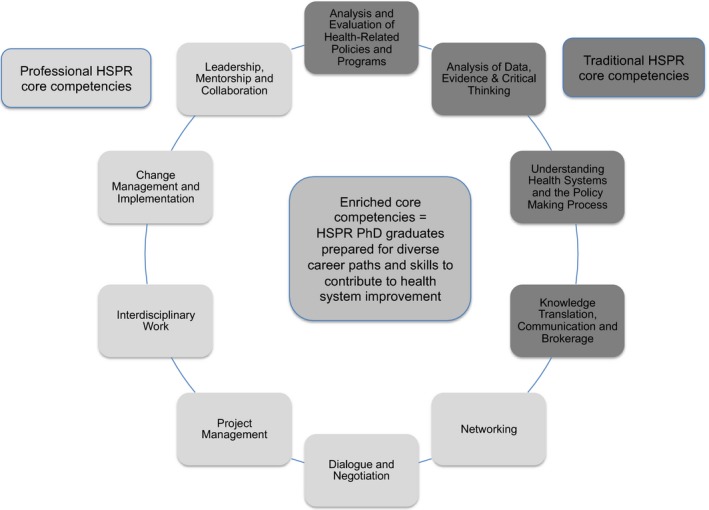
The EWG reached consensus on six sectors and eight primary roles in which HSPR doctoral graduates can bring value to employers and the health system. Additionally, 10 core competencies were identified that should be included or further emphasized in the training of HSPR doctoral students to increase their preparedness and potential for impact in a variety of roles within and outside of traditional academic workplaces.
The results offer an expanded view of potential career paths for HSPR doctoral graduates and provide recommendations for an expanded set of core competencies that will better equip graduates to maximize their impact on the health system.
制定一套丰富的卫生服务和政策研究(HSPR)博士培训核心能力,帮助毕业生在各种学术和非学术工作环境和角色中最大限度地发挥影响力。
资料来源/研究地点:数据来自多个来源,包括文献综述、关键知情人访谈、利益相关者磋商以及 2015 年 1 月至 2016 年 3 月期间的专家工作组(EWG)会议。研究地点为加拿大。
该研究采用定性方法和迭代开发过程,并在整个过程中进行了大量的利益相关者参与。
资料收集/提取方法:文献综述、关键知情人访谈、研究生职业轨迹的现有数据以及 EWG 的审议为确定 HSPR 毕业生的职业概况和在这些角色中取得成功所需的能力提供了信息。进行了利益相关者磋商,以验证、完善和验证能力。
EWG 就 HSPR 博士毕业生能够为雇主和卫生系统带来价值的六个部门和八个主要角色达成了共识。此外,确定了 10 项核心能力,这些能力应包含在或进一步强调 HSPR 博士生的培训中,以提高他们在传统学术工作场所内外的各种角色中的准备程度和影响力。
研究结果提供了 HSPR 博士毕业生潜在职业道路的扩展视图,并提出了扩展核心能力的建议,这将使毕业生更好地发挥对卫生系统的影响力。