Department of Sociology, University of Nebraska-Lincoln, Lincoln, NE, United States of America.
PLoS One. 2018 Mar 12;13(3):e0193759. doi: 10.1371/journal.pone.0193759. eCollection 2018.
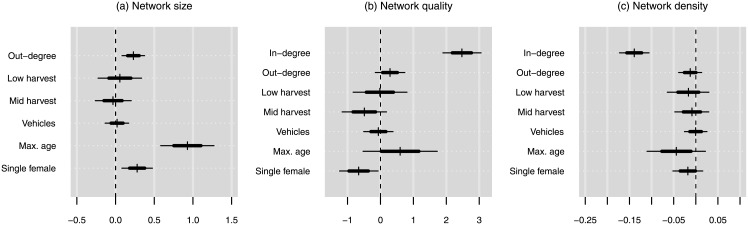
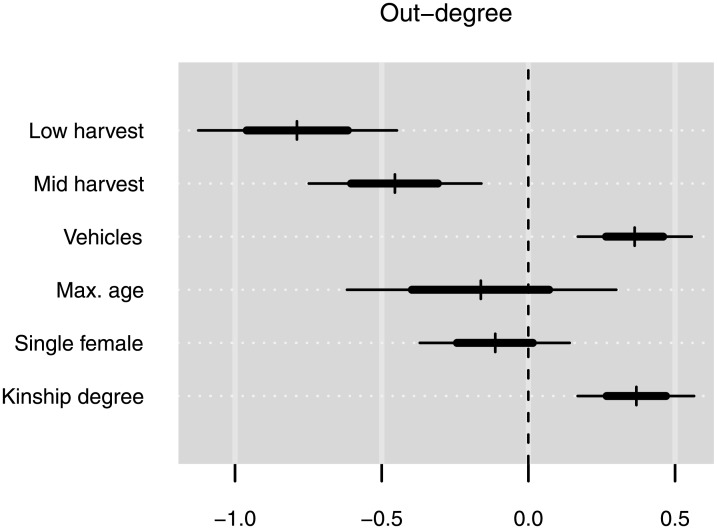
Social institutions that facilitate sharing and redistribution may help mitigate the impact of resource shocks. In the North American Arctic, traditional food sharing may direct food to those who need it and provide a form of natural insurance against temporal variability in hunting returns within households. Here, network properties that facilitate resource flow (network size, quality, and density) are examined in a country food sharing network comprising 109 Inuit households from a village in Nunavik (Canada), using regressions to investigate the relationships between these network measures and household socioeconomic attributes. The results show that although single women and elders have larger networks, the sharing network is not structured to prioritize sharing towards households with low food availability. Rather, much food sharing appears to be driven by reciprocity between high-harvest households, meaning that poor, low-harvest households tend to have less sharing-based social capital than more affluent, high-harvest households. This suggests that poor, low-harvest households may be more vulnerable to disruptions in the availability of country food.
促进分享和再分配的社会制度可能有助于减轻资源冲击的影响。在北美北极地区,传统的食物分享可以将食物分配给有需要的人,并为家庭内部狩猎回报的时间变化提供一种自然的保险形式。在这里,利用回归分析,研究了由努纳武特(加拿大)一个村庄的 109 户因纽特家庭组成的国菜分享网络中的促进资源流动的网络属性(网络规模、质量和密度),调查了这些网络措施与家庭社会经济属性之间的关系。结果表明,尽管单身女性和老年人的网络规模较大,但分享网络的结构并不是优先向食物供应不足的家庭分配食物。相反,许多食物分享似乎是由高收获家庭之间的互惠关系驱动的,这意味着贫穷、低收获的家庭拥有的基于分享的社会资本比富裕、高收获的家庭要少。这表明,贫穷、低收获的家庭可能更容易受到国菜供应中断的影响。