Department of Archaeology and History, La Trobe University, Melbourne, VIC 3086, Australia;
Department of Organismal Biology, Uppsala University, 75236 Uppsala, Sweden.
Proc Natl Acad Sci U S A. 2018 Mar 27;115(13):3428-3433. doi: 10.1073/pnas.1717762115. Epub 2018 Mar 12.
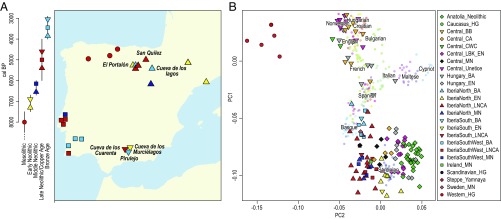
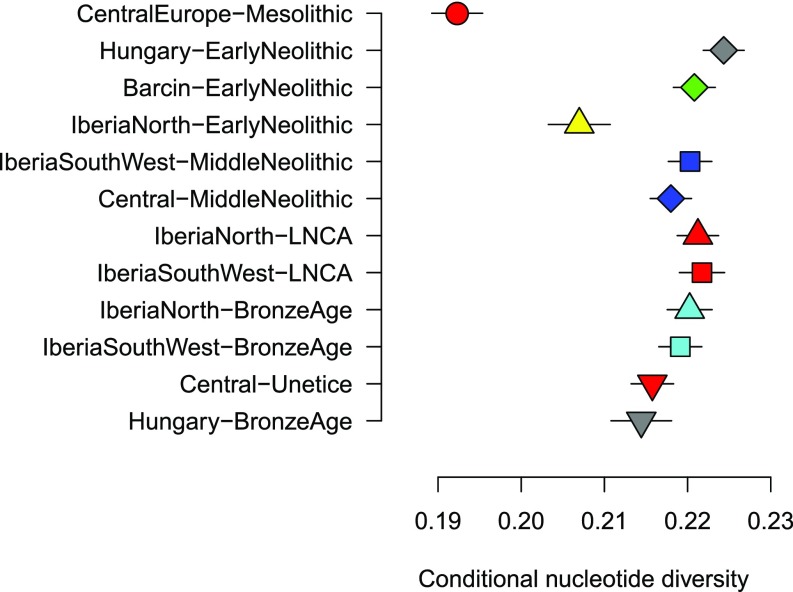
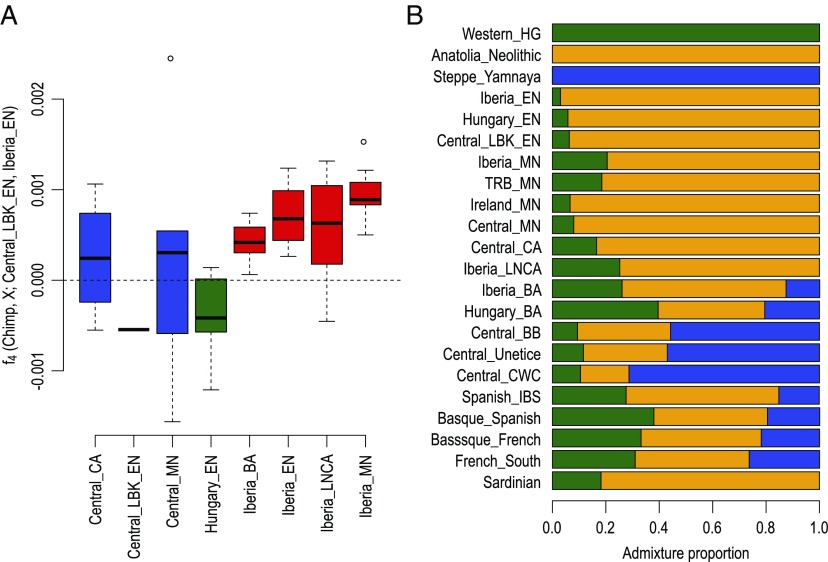
Population genomic studies of ancient human remains have shown how modern-day European population structure has been shaped by a number of prehistoric migrations. The Neolithization of Europe has been associated with large-scale migrations from Anatolia, which was followed by migrations of herders from the Pontic steppe at the onset of the Bronze Age. Southwestern Europe was one of the last parts of the continent reached by these migrations, and modern-day populations from this region show intriguing similarities to the initial Neolithic migrants. Partly due to climatic conditions that are unfavorable for DNA preservation, regional studies on the Mediterranean remain challenging. Here, we present genome-wide sequence data from 13 individuals combined with stable isotope analysis from the north and south of Iberia covering a four-millennial temporal transect (7,500-3,500 BP). Early Iberian farmers and Early Central European farmers exhibit significant genetic differences, suggesting two independent fronts of the Neolithic expansion. The first Neolithic migrants that arrived in Iberia had low levels of genetic diversity, potentially reflecting a small number of individuals; this diversity gradually increased over time from mixing with local hunter-gatherers and potential population expansion. The impact of post-Neolithic migrations on Iberia was much smaller than for the rest of the continent, showing little external influence from the Neolithic to the Bronze Age. Paleodietary reconstruction shows that these populations have a remarkable degree of dietary homogeneity across space and time, suggesting a strong reliance on terrestrial food resources despite changing culture and genetic make-up.
对古人类遗骸的群体基因组研究表明,现代欧洲的人口结构是如何受到史前多次迁徙的影响而形成的。欧洲的新石器时代与来自安纳托利亚的大规模迁徙有关,随后在青铜时代初期,来自Pontic 草原的牧民也开始迁徙。伊比利亚半岛是欧洲最后被这些迁徙者到达的地区之一,该地区的现代人口与最初的新石器时代移民有着有趣的相似之处。部分由于不利于 DNA 保存的气候条件,对地中海地区的区域性研究仍然具有挑战性。在这里,我们展示了来自伊比利亚半岛北部和南部的 13 个人的全基因组序列数据,以及跨越四千年时间跨度(7500-3500 BP)的稳定同位素分析。早期伊比利亚农民和早期中欧农民表现出显著的遗传差异,表明新石器时代扩张有两个独立的前沿。第一批到达伊比利亚的新石器时代移民遗传多样性水平较低,可能反映出个体数量较少;随着与当地狩猎采集者的混合以及潜在的人口扩张,这种多样性逐渐增加。与欧洲其他地区相比,新石器时代后迁徙对伊比利亚的影响要小得多,表明从新石器时代到青铜时代,伊比利亚半岛几乎没有受到外部影响。古饮食重建表明,这些人口在空间和时间上的饮食具有显著的同质性,尽管文化和遗传结构发生了变化,但仍强烈依赖于陆地食物资源。