College of Medicine and Medical Research Institute, Chungbuk National University, Cheongju, KS001, Korea.
College of Veterinary Medicine, Chungbuk National University, Cheongju, KS001, Korea.
Emerg Microbes Infect. 2018 Mar 14;7(1):29. doi: 10.1038/s41426-018-0029-x.
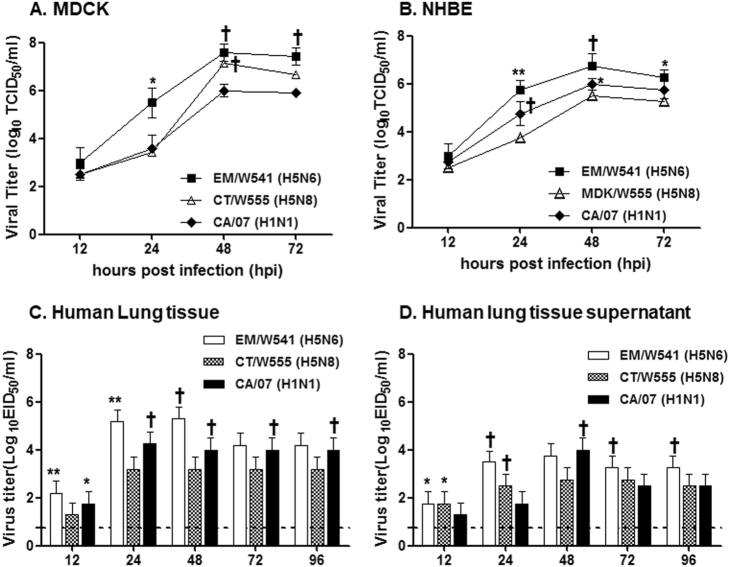
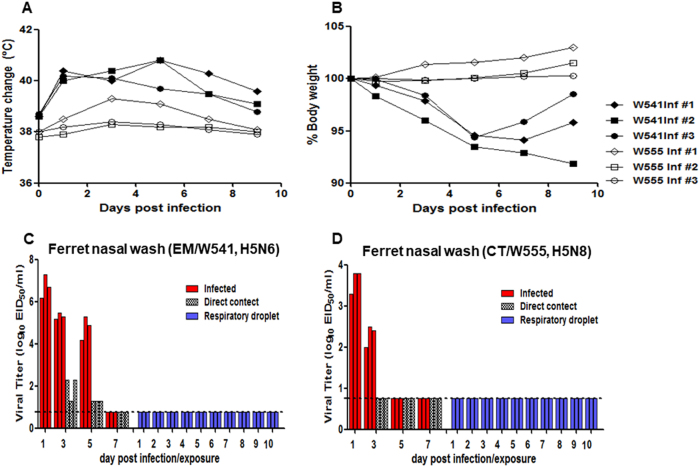
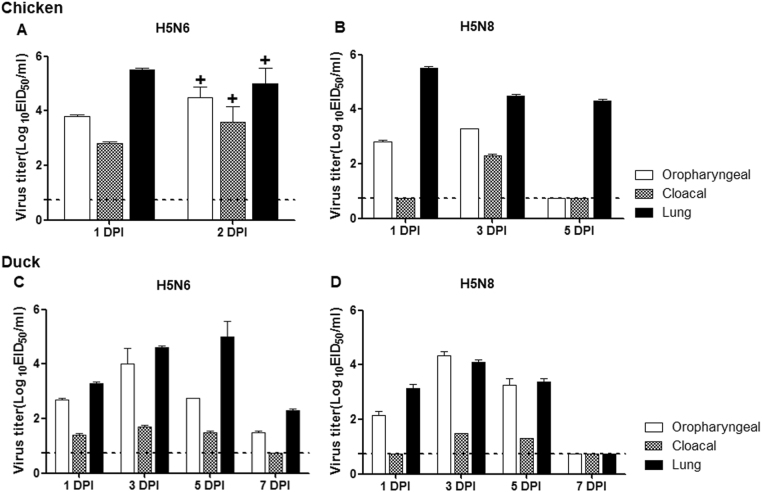
Highly pathogenic avian influenza (HPAI) A(H5N6) and A(H5N8) virus infections resulted in the culling of more than 37 million poultry in the Republic of Korea during the 2016/17 winter season. Here we characterize two representative viruses, A/Environment/Korea/W541/2016 [Em/W541(H5N6)] and A/Common Teal/Korea/W555/2017 [CT/W555(H5N8)], and evaluate their zoonotic potential in various animal models. Both Em/W541(H5N6) and CT /W555(H5N8) are novel reassortants derived from various gene pools of wild bird viruses present in migratory waterfowl arising from eastern China. Despite strong preferential binding to avian virus-type receptors, the viruses were able to grow in human respiratory tract tissues. Em/W541(H5N6) was found to be highly pathogenic in both chickens and ducks, while CT/W555(H5N8) caused lethal infections in chickens but did not induce remarkable clinical illness in ducks. In mice, both viruses appeared to be moderately pathogenic and displayed limited tissue tropism relative to HPAI H5N1 viruses. Em/W541(H5N6) replicated to moderate levels in the upper respiratory tract of ferrets and was detected in the lungs, brain, spleen, liver, and colon. Unexpectedly, two of three ferrets in direct contact with Em/W541(H5N6)-infected animals shed virus and seroconverted at 14 dpi. CT/W555(H5N8) was less pathogenic than the H5N6 virus in ferrets and no transmission was detected. Given the co-circulation of different, phenotypically distinct, subtypes of HPAI H5Nx viruses for the first time in South Korea, detailed virologic investigations are imperative given the capacity of these viruses to evolve and cause human infections.
高致病性禽流感(HPAI)A(H5N6)和 A(H5N8)病毒感染导致韩国在 2016/17 年冬季宰杀了超过 3700 万只家禽。在这里,我们对两种具有代表性的病毒进行了描述,即 A/环境/韩国/W541/2016[Em/W541(H5N6)]和 A/普通秋沙鸭/韩国/W555/2017[CT/W555(H5N8)],并在各种动物模型中评估了它们的人畜共患潜力。Em/W541(H5N6)和 CT/W555(H5N8)均源自源自中国东部迁徙水禽中的野生鸟类病毒的各种基因库,是新型的重组病毒。尽管它们与禽病毒型受体具有强烈的优先结合性,但仍能在人呼吸道组织中生长。Em/W541(H5N6)在鸡和鸭中均表现出高度致病性,而 CT/W555(H5N8)在鸡中引起致死性感染,但在鸭中未引起明显的临床疾病。在小鼠中,两种病毒的致病性均为中等,相对于高致病性禽流感 H5N1 病毒,其组织嗜性有限。Em/W541(H5N6)在上呼吸道中的复制水平适中,并可在肺部、大脑、脾脏、肝脏和结肠中检测到。出乎意料的是,与 Em/W541(H5N6)感染动物直接接触的三只雪貂中有两只在 14dpi 时排毒并发生血清转换。CT/W555(H5N8)在雪貂中的致病性低于 H5N6 病毒,未检测到传播。鉴于韩国首次同时出现不同表型特征的 HPAI H5Nx 病毒,鉴于这些病毒具有进化和引起人类感染的能力,详细的病毒学研究至关重要。