Song Byung-Min, Lee Eun-Kyoung, Lee Yu-Na, Heo Gyeong-Beom, Lee Hee-Soo, Lee Youn-Jeong
Avian Disease Research Division, Animal and Plant Quarantine Agency, Gimcheon 39660, Korea.
J Vet Sci. 2017 Mar 30;18(1):89-94. doi: 10.4142/jvs.2017.18.1.89.
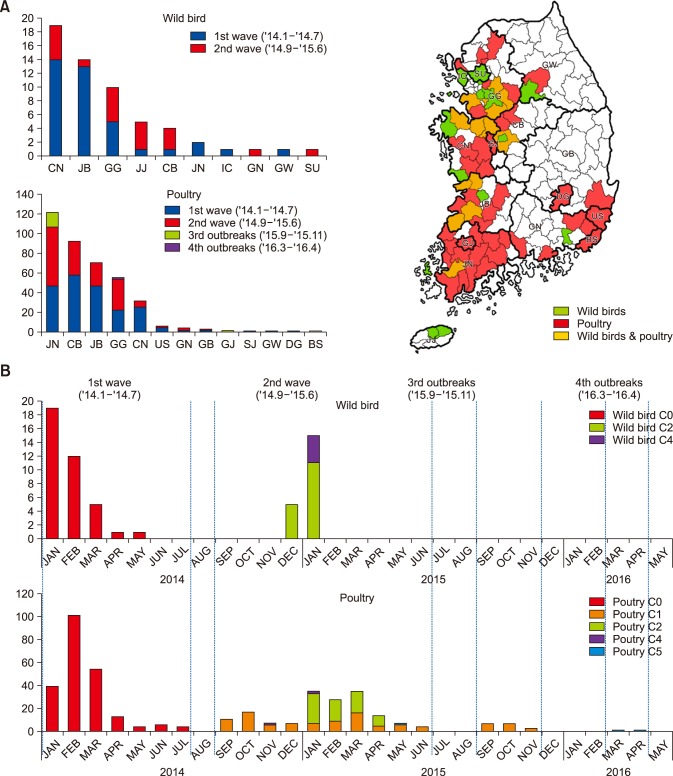
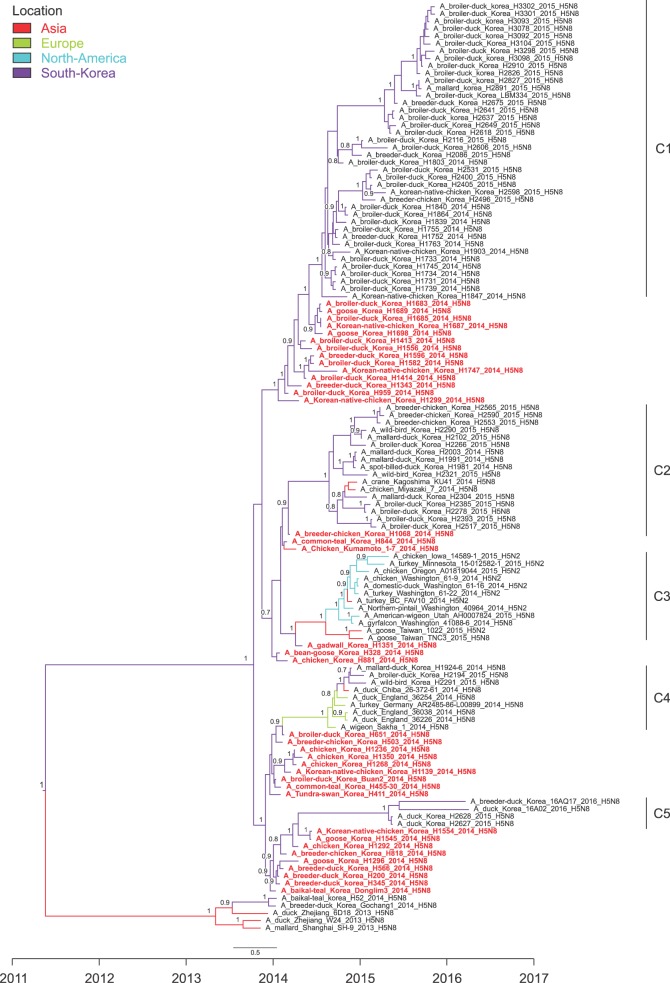
During 2014–2016 HPAI outbreak in South Korea, H5N8 viruses have been mostly isolated in western areas of the country, which provide wintering habitats for wild birds and have a high density of poultry. Analysis of a total of 101 Korean isolates revealed that primitive H5N8 viruses (C0 group) have evolved into multiple genetic subgroups appearing from various epidemiological sources, namely, the viruses circulating in poultry farms (C1 and C5) and those reintroduced by migratory birds in late 2014 (C2 and C4). No C3 groups were detected. The results may explain the possible reasons of the recent long-term persistence of H5N8 viruses in South Korea, and help to develop the effective measures in controlling HPAI viruses.
在2014 - 2016年韩国高致病性禽流感(HPAI)疫情期间,H5N8病毒大多在该国西部地区被分离出来,该地区为野生鸟类提供越冬栖息地且家禽密度高。对总共101株韩国分离株的分析表明,原始H5N8病毒(C0组)已演变成多个遗传亚组,这些亚组来自各种流行病学来源,即家禽养殖场中传播的病毒(C1和C5)以及2014年末候鸟重新引入的病毒(C2和C4)。未检测到C3组。这些结果可能解释了H5N8病毒近期在韩国长期持续存在的可能原因,并有助于制定控制高致病性禽流感病毒的有效措施。