González-Rivas Juan P, Nieto-Martínez Ramfis, Brajkovich Imperia, Ugel Eunice, Rísquez Alejandro
The Andes Clinic of Cardio-Metabolic Studies, Miami, FL - USA.
Geriatric Research, Education and Clinical Center (GRECC) and South Florida Veterans Affairs Foundation for Research & Education, Miami VA Healthcare System, Miami, FL - USA.
Arq Bras Cardiol. 2018 Jan;110(1):30-35. doi: 10.5935/abc.20170180.
The prevalence of dyslipidemia in multiple regions of Venezuela is unknown. The Venezuelan Metabolic Syndrome, Obesity and Lifestyle Study (VEMSOLS) was undertaken to evaluate cardiometabolic risk factors in Venezuela.
To determine the prevalence of dyslipidemia in five populations from three regions of Venezuela.
During the years 2006 to 2010, 1320 subjects aged 20 years or older were selected by multistage stratified random sampling from all households in five municipalities from 3 regions of Venezuela: Lara State (Western region), Merida State (Andean region), and Capital District (Capital region). Anthropometric measurements and biochemical analysis were obtained from each participant. Dyslipidemia was defined according to the NCEP/ATPIII definitions.
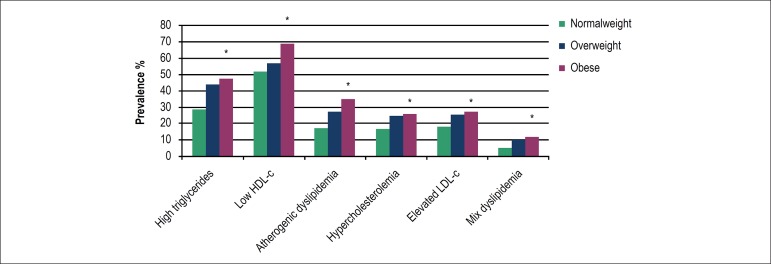
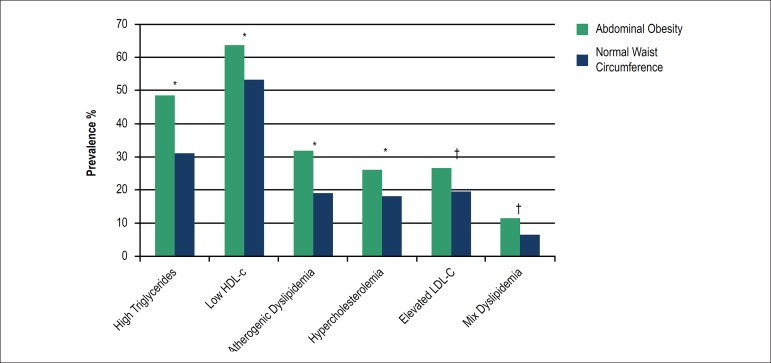
Mean age was 44.8 ± 0.39 years and 68.5% were females. The prevalence of lipids abnormalities related to the metabolic syndrome (low HDL-c [58.6%; 95% CI 54.9 - 62.1] and elevated triglycerides [39.7%; 36.1 - 43.2]) were the most prevalent lipid alterations, followed by atherogenic dyslipidemia (25.9%; 22.7 - 29.1), elevated LDL-c (23.3%; 20.2 - 26.4), hypercholesterolemia (22.2%; 19.2 - 25.2), and mix dyslipidemia (8.9%; 6.8 - 11.0). Dyslipidemia was more prevalent with increasing body mass index.
Dyslipidemias are prevalent cardiometabolic risk factors in Venezuela. Among these, a higher prevalence of low HDL is a condition also consistently reported in Latin America.
委内瑞拉多个地区血脂异常的患病率尚不清楚。开展委内瑞拉代谢综合征、肥胖与生活方式研究(VEMSOLS)以评估委内瑞拉的心血管代谢危险因素。
确定委内瑞拉三个地区五个人群中血脂异常的患病率。
在2006年至2010年期间,通过多阶段分层随机抽样从委内瑞拉三个地区(拉腊州(西部地区)、梅里达州(安第斯地区)和首都区(首都地区))五个市的所有家庭中选取了1320名20岁及以上的受试者。对每位参与者进行了人体测量和生化分析。血脂异常根据美国国家胆固醇教育计划成人治疗组第三次报告(NCEP/ATPIII)的定义来确定。
平均年龄为44.8±0.39岁,女性占68.5%。与代谢综合征相关的血脂异常(低高密度脂蛋白胆固醇[58.6%;95%可信区间54.9 - 62.1]和甘油三酯升高[39.7%;36.1 - 43.2])是最常见的血脂异常,其次是致动脉粥样硬化性血脂异常(25.9%;22.7 - 29.1)、低密度脂蛋白胆固醇升高(23.3%;20.2 - 26.4)、高胆固醇血症(22.2%;19.2 - 25.2)和混合型血脂异常(8.9%;6.8 - 11.0)。随着体重指数的增加,血脂异常更为普遍。
血脂异常是委内瑞拉普遍存在的心血管代谢危险因素。其中,低高密度脂蛋白胆固醇的较高患病率也是拉丁美洲一直报告的一种情况。