Lai Chih-Cheng, Wang Ya-Hui, Wang Cheng-Yi, Wang Hao-Chien, Yu Chong-Jen, Chen Likwang
Department of Intensive Care Medicine, Chi Mei Medical Center, Liouying, Taiwan.
Medical Research Center, Cardinal Tien Hospital and School of Medicine, College of Medicine, Fu Jen Catholic University, New Taipei City, Taiwan.
Int J Chron Obstruct Pulmon Dis. 2018 Mar 8;13:867-874. doi: 10.2147/COPD.S158634. eCollection 2018.
This study aimed to compare the effects of angiotensin-converting-enzyme inhibitors (ACEis) and angiotensin receptor blockers (ARBs) on the risk of pneumonia and severe exacerbations in patients with COPD.
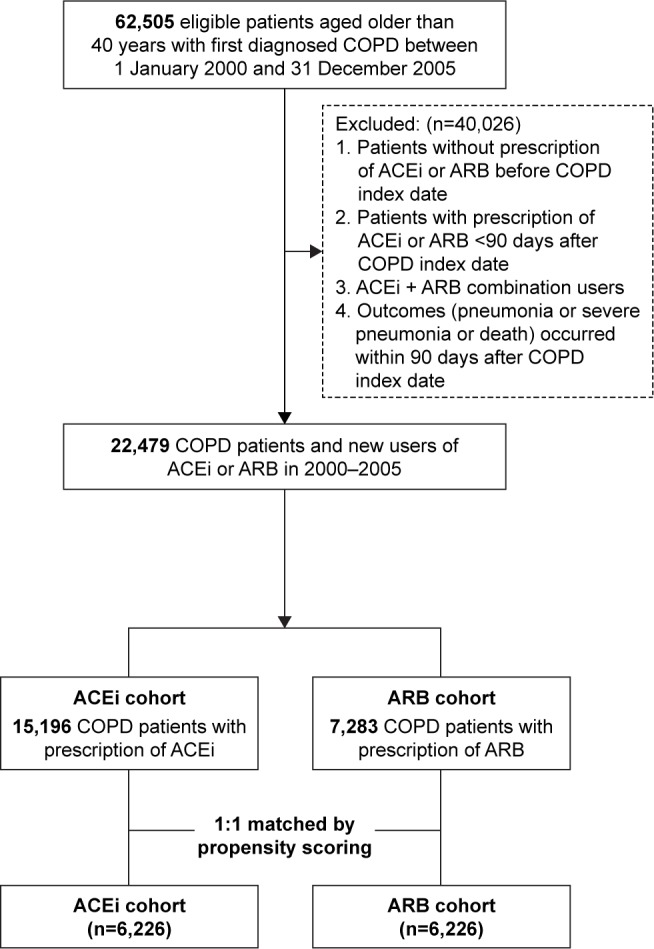
All patients with COPD who used ACEis and ARBs for >90 days between 2000 and 2005 were recruited. Pairwise matching (1:1) of the ACEi and ARB groups resulted in two similar subgroups, with 6,226 patients in each. The primary outcomes were pneumonia and COPD exacerbations, and the secondary outcome was death.
During the follow-up period, the incidence of pneumonia was 7.20 per 100 person-years in the ACEi group and 5.89 per 100 person-years in the ARB group. The ACEi group had a higher risk of pneumonia (adjusted hazard ratio [aHR], 1.22; 95% CI, 1.15-1.29) than the ARB group. The incidence of severe exacerbations was 0.65 per person-year for the patients receiving ACEis and 0.52 per person-year for those receiving ARBs. The patients receiving ACEis had a higher risk of severe exacerbations (aHR, 1.19; 95% CI, 1.16-1.21) than those receiving ARBs. Similar trends were noted in terms of severe exacerbations requiring hospitalization (aHR, 1.24; 95% CI, 1.21-1.28) or emergency department visits (aHR, 1.16; 95% CI, 1.13-1.18), pneumonia requiring mechanical ventilation (aHR, 1.35; 95% CI, 1.24-1.47), and mortality (aHR, 1.33; 95% CI, 1.26-1.42).
ARBs were associated with lower rates of pneumonia, severe pneumonia, and mortality than ACEis in patients with COPD.
本研究旨在比较血管紧张素转换酶抑制剂(ACEI)和血管紧张素受体阻滞剂(ARB)对慢性阻塞性肺疾病(COPD)患者肺炎风险和严重急性加重的影响。
纳入2000年至2005年间使用ACEI和ARB超过90天的所有COPD患者。对ACEI组和ARB组进行1:1配对匹配,形成两个相似的亚组,每组6226例患者。主要结局为肺炎和COPD急性加重,次要结局为死亡。
在随访期间,ACEI组肺炎发病率为每100人年7.20例,ARB组为每100人年5.89例。ACEI组肺炎风险高于ARB组(调整后风险比[aHR],1.22;95%置信区间[CI],1.15 - 1.29)。接受ACEI治疗的患者严重急性加重发病率为每人年0.65例,接受ARB治疗的患者为每人年0.52例。接受ACEI治疗的患者严重急性加重风险高于接受ARB治疗的患者(aHR,1.19;95% CI,1.16 - 1.21)。在需要住院治疗的严重急性加重(aHR,1.24;95% CI,1.21 - 1.28)或急诊就诊(aHR,1.16;95% CI,1.13 - 1.18)、需要机械通气的肺炎(aHR,1.35;95% CI,1.24 - 1.47)以及死亡率(aHR,1.33;95% CI,1.26 - 1.42)方面也观察到类似趋势。
在COPD患者中,与ACEI相比,ARB与较低的肺炎、严重肺炎和死亡率相关。