• 文献检索
  • 文档翻译
  • 深度研究
  • 学术资讯
  • Suppr Zotero 插件Zotero 插件
  • 邀请有礼
  • 套餐&价格
  • 历史记录
应用&插件
Suppr Zotero 插件Zotero 插件浏览器插件Mac 客户端Windows 客户端微信小程序
定价
高级版会员购买积分包购买API积分包
服务
文献检索文档翻译深度研究API 文档MCP 服务
关于我们
关于 Suppr公司介绍联系我们用户协议隐私条款
关注我们

Suppr 超能文献

核心技术专利:CN118964589B侵权必究
粤ICP备2023148730 号-1Suppr @ 2026

文献检索

告别复杂PubMed语法,用中文像聊天一样搜索,搜遍4000万医学文献。AI智能推荐,让科研检索更轻松。

立即免费搜索

文件翻译

保留排版,准确专业,支持PDF/Word/PPT等文件格式,支持 12+语言互译。

免费翻译文档

深度研究

AI帮你快速写综述,25分钟生成高质量综述,智能提取关键信息,辅助科研写作。

立即免费体验

慢性鼻-鼻窦炎患者的味觉障碍。

Taste impairment in chronic rhinosinusitis.

机构信息

Division of Rhinology and Sinus Surgery, Department of Otolaryngology-Head and Neck Surgery, Medical University of South Carolina, Charleston, SC.

Department of Surgery, Ralph H. Johnson VA Medical Center, Charleston, SC.

出版信息

Int Forum Allergy Rhinol. 2018 Jul;8(7):783-789. doi: 10.1002/alr.22113. Epub 2018 Mar 23.

DOI:10.1002/alr.22113
PMID:29569385
原文链接:https://pmc.ncbi.nlm.nih.gov/articles/PMC6582951/
Abstract

BACKGROUND

Though many patients with chronic rhinosinusitis (CRS) describe disturbances in smell and taste, there have been no studies specifically assessing taste impairment in CRS. This study sought to objectively assess taste dysfunction in CRS patients and determine whether taste impairment correlates with olfactory dysfunction. Additionally, this investigation sought to determine the impact of taste dysfunction on quality of life (QOL) in CRS and identify the clinical factors that influence taste.

METHODS

Sixty-eight CRS patients were prospectively enrolled and completed several QOL surveys in relation to taste, smell, overall sinus-specific QOL, and depression. Validated taste strips were used to determine gustatory dysfunction pertaining to sweet, sour, salty, and bitter. Olfactory testing was assessed using the Sniffin' Sticks Test while both Lund-Kennedy and Olfactory Cleft Endoscopy Scoring (OCES) systems were used for endoscopic evaluation.

RESULTS

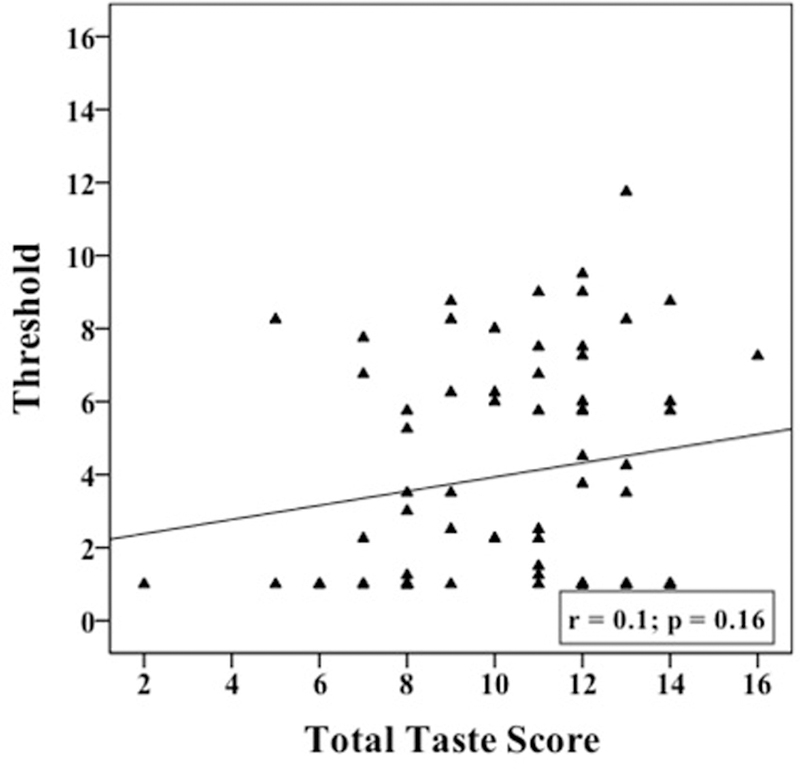
The overall prevalence of dysgeusia was 28%, with scores significantly lower for sour compared to other subgroups. No correlation was observed between taste scores and objective olfactory metrics including olfaction tests and OCES. Taste scores were better in younger patients (r = 0.28, p = 0.02), female patients (p = 0.004), and never smokers compared to former smokers (p = 0.01). Taste scores did not correlate with patient-reported outcome measures or CRS disease severity metrics.

CONCLUSION

Taste dysfunction is a common complaint in CRS. This cohort shows prevalence of gustatory loss to be about 28% using ideal normative values. This dysfunction correlated with male gender, smoking history, and older age. Taste dysfunction did not correlate with measured olfactory outcomes.

摘要

背景

尽管许多慢性鼻-鼻窦炎(CRS)患者都描述了嗅觉和味觉障碍,但目前尚无专门评估 CRS 患者味觉障碍的研究。本研究旨在客观评估 CRS 患者的味觉功能障碍,并确定味觉障碍是否与嗅觉功能障碍相关。此外,本研究还旨在确定味觉障碍对 CRS 患者生活质量(QOL)的影响,并确定影响味觉的临床因素。

方法

68 例 CRS 患者前瞻性入组,并完成了多项与味觉、嗅觉、整体鼻窦特异性 QOL 和抑郁相关的 QOL 调查。使用经过验证的味觉条来确定与甜味、酸味、咸味和苦味相关的味觉功能障碍。使用嗅觉棒测试评估嗅觉测试,同时使用 Lund-Kennedy 和嗅觉裂隙内镜评分(OCES)系统进行内镜评估。

结果

味觉障碍的总体患病率为 28%,酸味的评分明显低于其他亚组。味觉评分与嗅觉测试和 OCES 等客观嗅觉指标之间未观察到相关性。味觉评分在年轻患者(r = 0.28,p = 0.02)、女性患者(p = 0.004)和从不吸烟者中(与前吸烟者相比,p = 0.01)更好。味觉评分与患者报告的结果测量或 CRS 疾病严重程度指标无关。

结论

味觉障碍是 CRS 的常见主诉。本队列研究使用理想的正常参考值显示味觉丧失的患病率约为 28%。这种功能障碍与性别、吸烟史和年龄有关。味觉障碍与测量的嗅觉结果无关。

https://cdn.ncbi.nlm.nih.gov/pmc/blobs/7be7/6582951/fb0462cf4404/nihms-1027727-f0002.jpg
https://cdn.ncbi.nlm.nih.gov/pmc/blobs/7be7/6582951/763dfa0a56ba/nihms-1027727-f0001.jpg
https://cdn.ncbi.nlm.nih.gov/pmc/blobs/7be7/6582951/fb0462cf4404/nihms-1027727-f0002.jpg
https://cdn.ncbi.nlm.nih.gov/pmc/blobs/7be7/6582951/763dfa0a56ba/nihms-1027727-f0001.jpg
https://cdn.ncbi.nlm.nih.gov/pmc/blobs/7be7/6582951/fb0462cf4404/nihms-1027727-f0002.jpg

相似文献

1
Taste impairment in chronic rhinosinusitis.慢性鼻-鼻窦炎患者的味觉障碍。
Int Forum Allergy Rhinol. 2018 Jul;8(7):783-789. doi: 10.1002/alr.22113. Epub 2018 Mar 23.
2
Understanding the relationship between olfactory-specific quality of life, objective olfactory loss, and patient factors in chronic rhinosinusitis.了解慢性鼻-鼻窦炎患者嗅觉特异性生活质量、客观嗅觉减退与患者因素之间的关系。
Int Forum Allergy Rhinol. 2017 Jul;7(7):734-740. doi: 10.1002/alr.21940. Epub 2017 May 18.
3
Impaired eating-related quality of life in chronic rhinosinusitis.慢性鼻-鼻窦炎患者的进食相关生活质量受损。
Int Forum Allergy Rhinol. 2019 Mar;9(3):240-247. doi: 10.1002/alr.22242. Epub 2018 Nov 28.
4
The Olfactory Cleft Endoscopy Scale correlates with olfactory metrics in patients with chronic rhinosinusitis.嗅觉裂内镜检查量表与慢性鼻-鼻窦炎患者的嗅觉指标相关。
Int Forum Allergy Rhinol. 2016 Mar;6(3):293-8. doi: 10.1002/alr.21655. Epub 2015 Dec 31.
5
Impact of bitter taste receptor phenotype upon clinical presentation in chronic rhinosinusitis.苦味受体表型对慢性鼻-鼻窦炎临床表现的影响。
Int Forum Allergy Rhinol. 2018 Sep;8(9):1013-1020. doi: 10.1002/alr.22138. Epub 2018 Jul 4.
6
Retronasal olfaction in chronic rhinosinusitis.慢性鼻-鼻窦炎中的鼻后嗅觉
Laryngoscope. 2018 Nov;128(11):2437-2442. doi: 10.1002/lary.27187. Epub 2018 Apr 10.
7
A Systematic Review and Meta-Analysis of Taste Dysfunction in Chronic Rhinosinusitis.慢性鼻-鼻窦炎味觉障碍的系统评价和荟萃分析。
Laryngoscope. 2021 Mar;131(3):482-489. doi: 10.1002/lary.28827. Epub 2020 Jul 1.
8
Chemosensory function before and after multimodal treatment in chronic rhinosinusitis patients.慢性鼻窦炎患者多模式治疗前后的化学感觉功能
Laryngoscope. 2018 Mar;128(3):E86-E90. doi: 10.1002/lary.26873. Epub 2017 Sep 12.
9
Quality-of-life and olfaction changes observed with short-term medical management of chronic rhinosinusitis.慢性鼻-鼻窦炎短期药物治疗中观察到的生活质量和嗅觉变化。
Int Forum Allergy Rhinol. 2020 May;10(5):656-664. doi: 10.1002/alr.22532. Epub 2020 Feb 3.
10
Predictive significance of the questionnaire of olfactory disorders-negative statements for olfactory loss in patients with chronic rhinosinusitis.嗅觉障碍阴性陈述问卷对慢性鼻-鼻窦炎患者嗅觉丧失的预测意义。
Eur Arch Otorhinolaryngol. 2022 Nov;279(11):5253-5262. doi: 10.1007/s00405-022-07438-z. Epub 2022 Jun 19.

引用本文的文献

1
Exploring E-Vape Aerosol Penetration into Paranasal Sinuses: Insights from Patient-Specific Models.探索电子烟烟雾微粒进入鼻窦的情况:来自个体化模型的见解
Pharmaceuticals (Basel). 2025 Jan 22;18(2):142. doi: 10.3390/ph18020142.
2
Assessment of Gustatory Function in Patients of Chronic Rhinosinusitis: A Case Control Study.慢性鼻窦炎患者味觉功能评估:一项病例对照研究。
Indian J Otolaryngol Head Neck Surg. 2024 Dec;76(6):5364-5368. doi: 10.1007/s12070-024-04978-0. Epub 2024 Aug 24.
3
Analysis of olfactory function in patients with chronic rhinosinusitis and Staphylococcus aureus enterotoxin positivity.

本文引用的文献

1
Factor analysis of the questionnaire of olfactory disorders in patients with chronic rhinosinusitis.慢性鼻-鼻窦炎患者嗅觉障碍问卷的因子分析。
Int Forum Allergy Rhinol. 2018 Jul;8(7):777-782. doi: 10.1002/alr.22112. Epub 2018 Apr 6.
2
The Olfactory Cleft Endoscopy Scale correlates with olfactory metrics in patients with chronic rhinosinusitis.嗅觉裂内镜检查量表与慢性鼻-鼻窦炎患者的嗅觉指标相关。
Int Forum Allergy Rhinol. 2016 Mar;6(3):293-8. doi: 10.1002/alr.21655. Epub 2015 Dec 31.
3
Clinical practice guideline (update): adult sinusitis.
分析慢性鼻-鼻窦炎伴金黄色葡萄球菌肠毒素阳性患者的嗅觉功能。
Sci Rep. 2024 Oct 30;14(1):26138. doi: 10.1038/s41598-024-77459-7.
4
Evaluation of Gustatory Function in Patients with Chronic Rhinosinusitis.慢性鼻窦炎患者味觉功能的评估
Indian J Otolaryngol Head Neck Surg. 2024 Jun;76(3):2404-2410. doi: 10.1007/s12070-024-04512-2. Epub 2024 Feb 1.
5
Optimized gravity-driven intranasal drop administration delivers significant doses to the ostiomeatal complex and maxillary sinus.优化的重力驱动鼻内滴剂给药可将显著剂量递送至鼻旁窦口复合体和上颌窦。
Drug Deliv Transl Res. 2024 Jul;14(7):1839-1859. doi: 10.1007/s13346-023-01488-4. Epub 2023 Dec 4.
6
Exhaled Nitric Oxide and Olfactory Dysfunction in Patients with Asthma: Association with Chronic Rhinosinusitis.哮喘患者呼出气一氧化氮与嗅觉功能障碍:与慢性鼻-鼻窦炎的关系。
Medicina (Kaunas). 2023 Oct 5;59(10):1776. doi: 10.3390/medicina59101776.
7
Improvement in patient-reported "taste" and association with smell in dupilumab-treated patients with severe chronic rhinosinusitis with nasal polyps from the SINUS-24 and SINUS-52 trials.在SINUS - 24和SINUS - 52试验中,接受度普利尤单抗治疗的重度慢性鼻-鼻窦炎伴鼻息肉患者自我报告的“味觉”改善及其与嗅觉的关联。
Clin Exp Allergy. 2022 Sep;52(9):1105-1109. doi: 10.1111/cea.14194. Epub 2022 Jul 12.
8
Use of the Diet History Questionnaire III to determine the impact of dysosmia on dietary quality.使用饮食史问卷 III 来确定嗅觉障碍对饮食质量的影响。
Int Forum Allergy Rhinol. 2022 Jun;12(6):849-858. doi: 10.1002/alr.22926. Epub 2021 Dec 18.
9
Clinical, virological and immunological evolution of the olfactory and gustatory dysfunction in COVID-19.新型冠状病毒肺炎患者嗅觉和味觉功能障碍的临床、病毒学和免疫学演变。
Am J Otolaryngol. 2022 Jan-Feb;43(1):103170. doi: 10.1016/j.amjoto.2021.103170. Epub 2021 Aug 8.
10
Smell and Taste Impairment in a Nationwide Sample of US Adults With Chronic Rhinosinusitis Symptoms.美国有慢性鼻窦炎症状的成年人群全国性样本中的嗅觉和味觉障碍
OTO Open. 2021 Feb 2;5(1):2473974X20986756. doi: 10.1177/2473974X20986756. eCollection 2021 Jan-Mar.
临床实践指南(更新版):成人鼻窦炎
Otolaryngol Head Neck Surg. 2015 Apr;152(2 Suppl):S1-S39. doi: 10.1177/0194599815572097.
4
Olfaction-associated quality of life in chronic rhinosinusitis: adaptation and validation of an olfaction-specific questionnaire.慢性鼻-鼻窦炎嗅觉相关生活质量:嗅觉特异性问卷的适应性和验证。
Laryngoscope. 2012 Jul;122(7):1450-4. doi: 10.1002/lary.23349. Epub 2012 May 7.
5
EPOS 2012: European position paper on rhinosinusitis and nasal polyps 2012. A summary for otorhinolaryngologists.EPOS 2012:欧洲鼻窦炎和鼻息肉诊治指南 2012。供耳鼻喉科医生使用的摘要。
Rhinology. 2012 Mar;50(1):1-12. doi: 10.4193/Rhino12.000.
6
A study about the frequency of taste disorders.一项关于味觉障碍频率的研究。
J Neurol. 2011 Mar;258(3):386-92. doi: 10.1007/s00415-010-5763-5. Epub 2010 Oct 1.
7
Chemosensory interaction: acquired olfactory impairment is associated with decreased taste function.化学感觉相互作用:获得性嗅觉障碍与味觉功能下降有关。
J Neurol. 2010 Aug;257(8):1303-8. doi: 10.1007/s00415-010-5513-8. Epub 2010 Mar 11.
8
Measuring taste impairment in epidemiologic studies: the Beaver Dam Offspring Study.在流行病学研究中测量味觉障碍:比弗代姆后代研究
Ann N Y Acad Sci. 2009 Jul;1170:543-52. doi: 10.1111/j.1749-6632.2009.04103.x.
9
Assessment of sensory function in the National Social Life, Health, and Aging Project.国家社会生活、健康与老龄化项目中的感觉功能评估。
J Gerontol B Psychol Sci Soc Sci. 2009 Nov;64 Suppl 1(Suppl 1):i76-85. doi: 10.1093/geronb/gbp048. Epub 2009 Jun 23.
10
Olfactory function and disease severity in chronic rhinosinusitis.慢性鼻-鼻窦炎的嗅觉功能与疾病严重程度
Am J Rhinol Allergy. 2009 Mar-Apr;23(2):139-44. doi: 10.2500/ajra.2009.23.3286.