Center of Geriatrics and Gerontology, Medical Center - University of Freiburg, Faculty of Medicine, University of Freiburg, Germany.
Freiburg Brain Imaging, Medical Center - University of Freiburg, Faculty of Medicine, University of Freiburg, Germany.
J Alzheimers Dis. 2018;63(1):353-363. doi: 10.3233/JAD-170964.
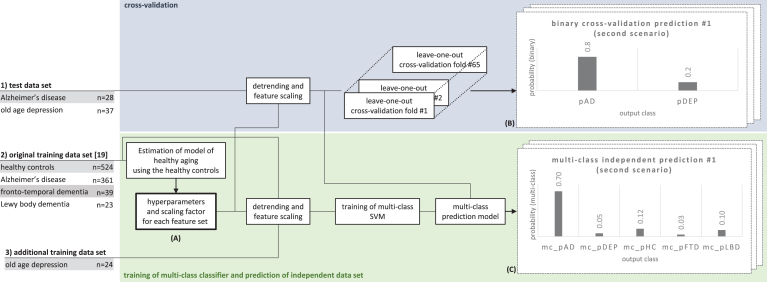
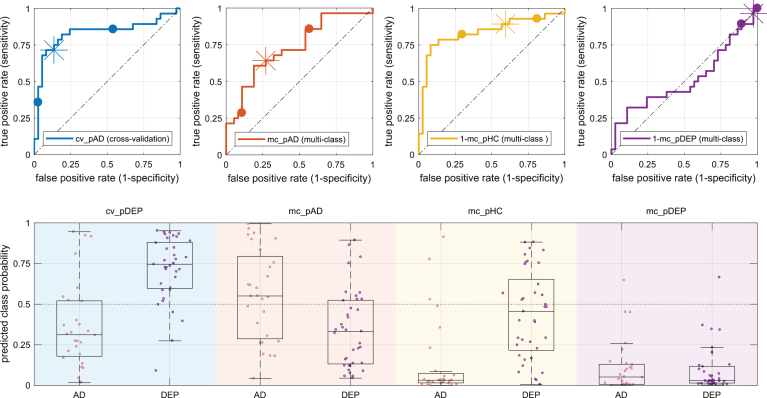
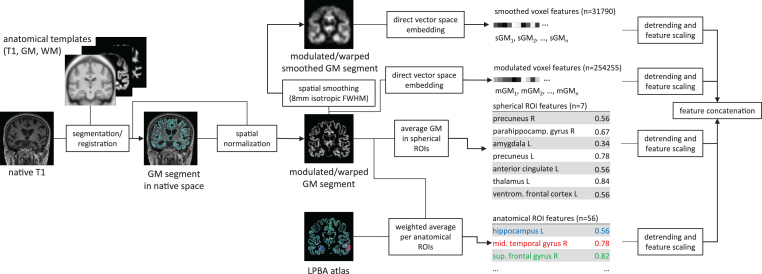
Older patients with depression or Alzheimer's disease (AD) at the stage of early dementia or mild cognitive impairment may present with objective cognitive impairment, although the pathology and thus therapy and prognosis differ substantially. In this study, we assessed the potential of an automated algorithm to categorize a test set of 65 T1-weighted structural magnetic resonance images (MRI). A convenience sample of elderly individuals fulfilling clinical criteria of either AD (n = 28) or moderate and severe depression (n = 37) was recruited from different settings to assess the potential of the pattern recognition method to assist in the differential diagnosis of AD versus depression. We found that our algorithm learned discriminative patterns in the subject's grey matter distribution reflected by an area under the receiver operator characteristics curve of up to 0.83 (confidence interval ranged from 0.67 to 0.92) and a balanced accuracy of 0.79 for the separation of depression from AD, evaluated by leave-one-out cross validation. The algorithm also identified consistent structural differences in a clinically more relevant scenario where the data used during training were independent from the data used for evaluation and, critically, which included five possible diagnoses (specifically AD, frontotemporal dementia, Lewy body dementia, depression, and healthy aging). While the output was insufficiently accurate to use it directly as a means for classification when multiple classes are possible, the continuous output computed by the machine learning algorithm differed between the two groups that were investigated. The automated analysis thus could complement, but not replace clinical assessments.
患有抑郁症或阿尔茨海默病(AD)的老年患者,在早期痴呆或轻度认知障碍阶段可能表现出客观认知障碍,尽管其病理和治疗方法以及预后有很大差异。在这项研究中,我们评估了一种自动化算法将一组 65 个 T1 加权结构磁共振图像(MRI)分类的能力。从不同环境中招募了满足 AD(n = 28)或中度和重度抑郁症(n = 37)临床标准的老年患者的便利样本,以评估模式识别方法辅助 AD 与抑郁症鉴别诊断的潜力。我们发现,我们的算法在受检者的灰质分布中学习到了有区分性的模式,这在接收器操作特征曲线下的面积高达 0.83(置信区间为 0.67 至 0.92),并且在通过留一法交叉验证评估的抑郁与 AD 分离中具有 0.79 的平衡准确性。该算法还在更具临床相关性的情况下识别出了一致的结构差异,即训练中使用的数据与评估中使用的数据独立,并且关键是,包括了五个可能的诊断(即 AD、额颞叶痴呆、路易体痴呆、抑郁症和健康衰老)。虽然当存在多个类别时,输出结果的准确性不足以直接用作分类手段,但机器学习算法计算出的连续输出在两个被调查的组别之间存在差异。因此,自动化分析可以作为临床评估的补充,但不能替代。