Agustí Ana, García-Pardo Maria P, López-Almela Inmaculada, Campillo Isabel, Maes Michael, Romaní-Pérez Marina, Sanz Yolanda
Microbial Ecology and Nutrition Research Unit, Institute of Agrochemistry and Food Technology, National Research Council (IATA-CSIC), Valencia, Spain.
IMPACT Strategic Research Centre, School of Medicine, Deakin University, Geelong, VIC, Australia.
Front Neurosci. 2018 Mar 16;12:155. doi: 10.3389/fnins.2018.00155. eCollection 2018.
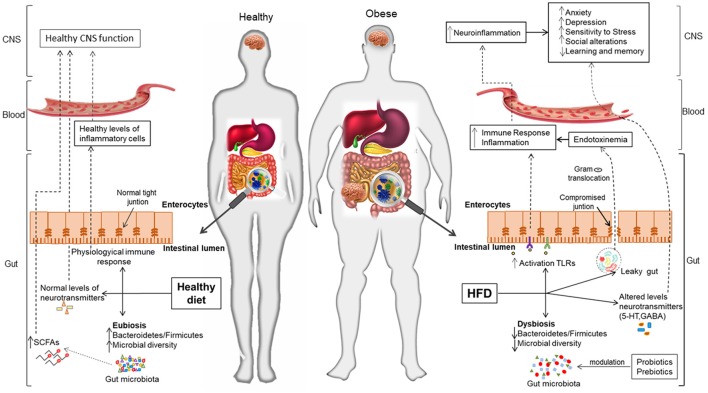
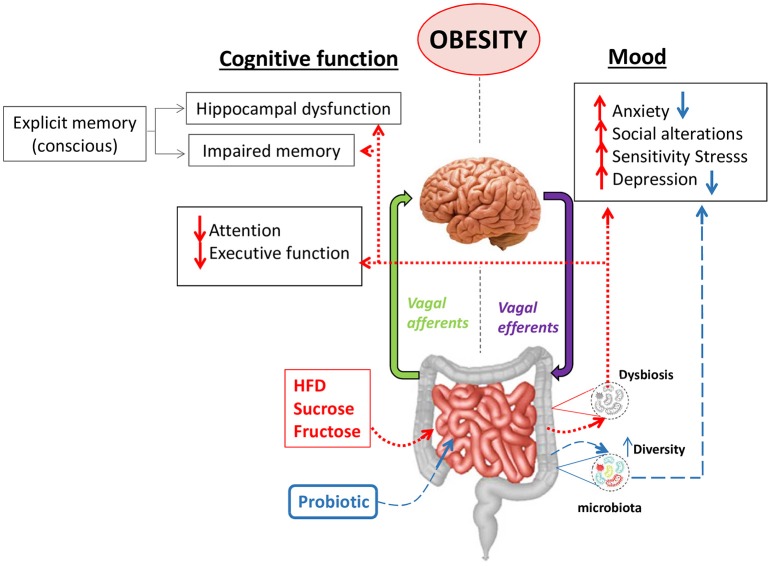
Obesity continues to be one of the major public health problems due to its high prevalence and co-morbidities. Common co-morbidities not only include cardiometabolic disorders but also mood and cognitive disorders. Obese subjects often show deficits in memory, learning and executive functions compared to normal weight subjects. Epidemiological studies also indicate that obesity is associated with a higher risk of developing depression and anxiety, and . These associations between pathologies that presumably have different etiologies suggest shared pathological mechanisms. Gut microbiota is a mediating factor between the environmental pressures (e.g., diet, lifestyle) and host physiology, and its alteration could partly explain the cross-link between those pathologies. Westernized dietary patterns are known to be a major cause of the obesity epidemic, which also promotes a dysbiotic drift in the gut microbiota; this, in turn, seems to contribute to obesity-related complications. Experimental studies in animal models and, to a lesser extent, in humans suggest that the obesity-associated microbiota may contribute to the endocrine, neurochemical and inflammatory alterations underlying obesity and its comorbidities. These include dysregulation of the HPA-axis with overproduction of glucocorticoids, alterations in levels of neuroactive metabolites (e.g., neurotransmitters, short-chain fatty acids) and activation of a pro-inflammatory milieu that can cause neuro-inflammation. This review updates current knowledge about the role and mode of action of the gut microbiota in the cross-link between energy metabolism, mood and cognitive function.
肥胖因其高患病率和合并症,仍然是主要的公共卫生问题之一。常见的合并症不仅包括心脏代谢紊乱,还包括情绪和认知障碍。与正常体重的受试者相比,肥胖受试者在记忆、学习和执行功能方面往往表现出缺陷。流行病学研究还表明,肥胖与患抑郁症和焦虑症的较高风险相关。这些病因可能不同的病症之间的关联表明存在共同的病理机制。肠道微生物群是环境压力(如饮食、生活方式)与宿主生理之间的中介因素,其改变可能部分解释了这些病症之间的联系。西方化的饮食模式是肥胖流行的主要原因,它还会促使肠道微生物群发生生态失调性漂移;反过来,这似乎也会导致与肥胖相关的并发症。在动物模型以及在较小程度上在人体进行的实验研究表明,与肥胖相关的微生物群可能导致肥胖及其合并症背后的内分泌、神经化学和炎症改变。这些改变包括下丘脑 - 垂体 - 肾上腺轴(HPA轴)失调导致糖皮质激素过度产生、神经活性代谢物(如神经递质、短链脂肪酸)水平改变以及促炎环境的激活,进而引发神经炎症。本综述更新了关于肠道微生物群在能量代谢、情绪和认知功能之间的联系中所起作用及作用方式的现有知识。