Chulpanova Daria S, Kitaeva Kristina V, Tazetdinova Leysan G, James Victoria, Rizvanov Albert A, Solovyeva Valeriya V
OpenLab Gene and Cell Technologies, Institute of Fundamental Medicine and Biology, Kazan Federal University, Kazan, Russia.
School of Veterinary Medicine and Science, University of Nottingham, Nottingham, United Kingdom.
Front Pharmacol. 2018 Mar 20;9:259. doi: 10.3389/fphar.2018.00259. eCollection 2018.
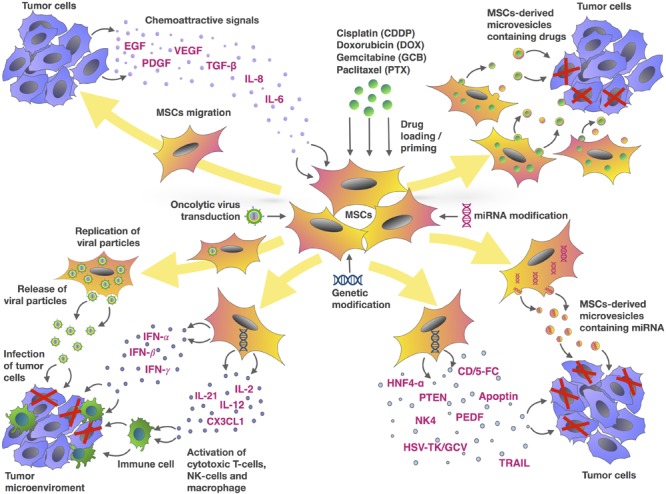
Mesenchymal stem cells (MSCs) are non-hematopoietic progenitor cells, which can be isolated from different types of tissues including bone marrow, adipose tissue, tooth pulp, and placenta/umbilical cord blood. There isolation from adult tissues circumvents the ethical concerns of working with embryonic or fetal stem cells, whilst still providing cells capable of differentiating into various cell lineages, such as adipocytes, osteocytes and chondrocytes. An important feature of MSCs is the low immunogenicity due to the lack of co-stimulatory molecules expression, meaning there is no need for immunosuppression during allogenic transplantation. The tropism of MSCs to damaged tissues and tumor sites makes them a promising vector for therapeutic agent delivery to tumors and metastatic niches. MSCs can be genetically modified by virus vectors to encode tumor suppressor genes, immunomodulating cytokines and their combinations, other therapeutic approaches include MSCs priming/loading with chemotherapeutic drugs or nanoparticles. MSCs derived membrane microvesicles (MVs), which play an important role in intercellular communication, are also considered as a new therapeutic agent and drug delivery vector. Recruited by the tumor, MSCs can exhibit both pro- and anti-oncogenic properties. In this regard, for the development of new methods for cancer therapy using MSCs, a deeper understanding of the molecular and cellular interactions between MSCs and the tumor microenvironment is necessary. In this review, we discuss MSC and tumor interaction mechanisms and review the new therapeutic strategies using MSCs and MSCs derived MVs for cancer treatment.
间充质干细胞(MSCs)是一种非造血祖细胞,可从包括骨髓、脂肪组织、牙髓以及胎盘/脐带血等不同类型的组织中分离得到。从成人组织中分离这些细胞避免了使用胚胎或胎儿干细胞所涉及的伦理问题,同时仍能提供能够分化为各种细胞谱系的细胞,如脂肪细胞、骨细胞和软骨细胞。MSCs的一个重要特征是由于缺乏共刺激分子表达而具有低免疫原性,这意味着在同种异体移植过程中无需进行免疫抑制。MSCs对受损组织和肿瘤部位的趋向性使其成为将治疗剂递送至肿瘤和转移微环境的有前景的载体。MSCs可以通过病毒载体进行基因改造,以编码肿瘤抑制基因、免疫调节细胞因子及其组合,其他治疗方法包括用化疗药物或纳米颗粒对MSCs进行预处理/负载。源自MSCs的膜微泡(MVs)在细胞间通讯中起重要作用,也被视为一种新的治疗剂和药物递送载体。被肿瘤招募后,MSCs可表现出促癌和抗癌特性。在这方面,为了开发使用MSCs治疗癌症的新方法,有必要更深入地了解MSCs与肿瘤微环境之间的分子和细胞相互作用。在本综述中,我们讨论了MSCs与肿瘤的相互作用机制,并综述了使用MSCs和源自MSCs的MVs治疗癌症的新策略。