Shen Lu, Mickley Loretta J
John A. Paulson School of Engineering and Applied Sciences, Harvard University, Cambridge, Massachusetts, USA.
Geophys Res Lett. 2017 Dec 28;44(24):12543-12550. doi: 10.1002/2017GL076150. Epub 2017 Dec 13.
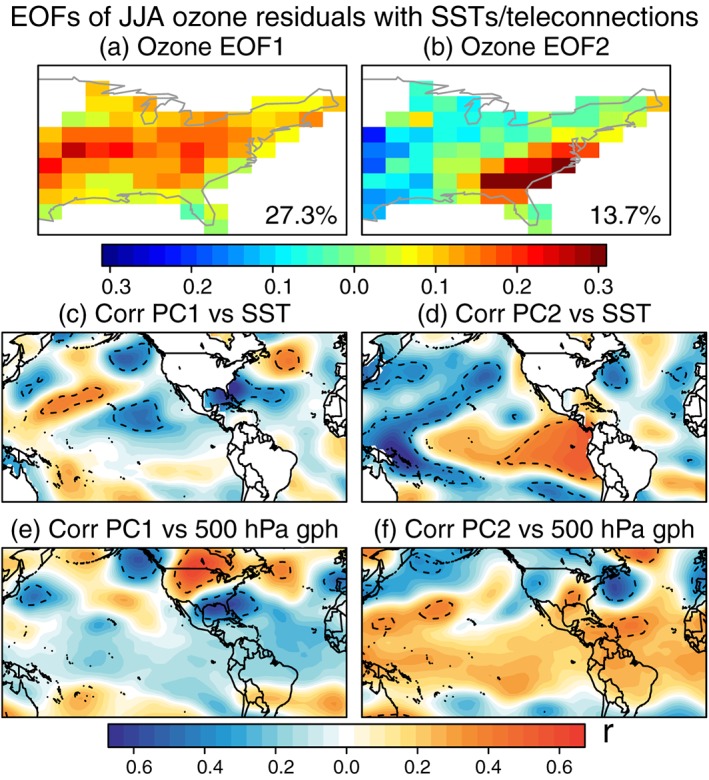
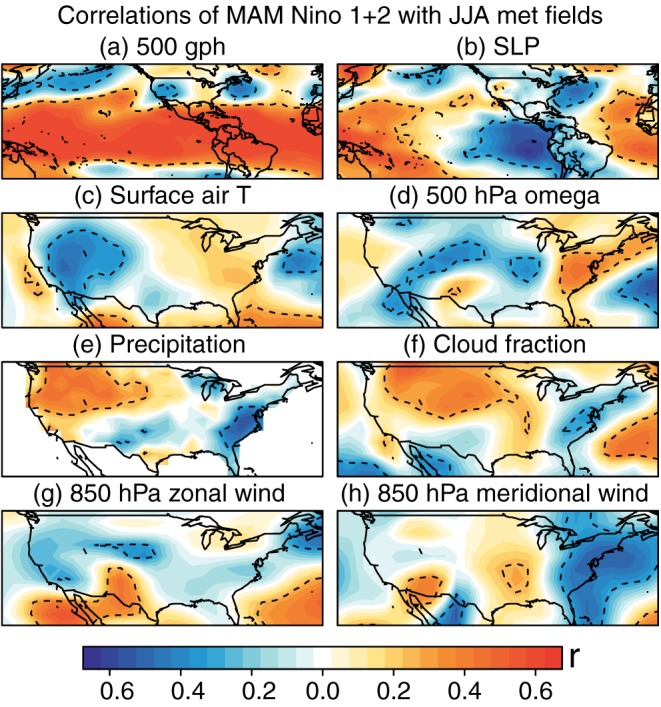
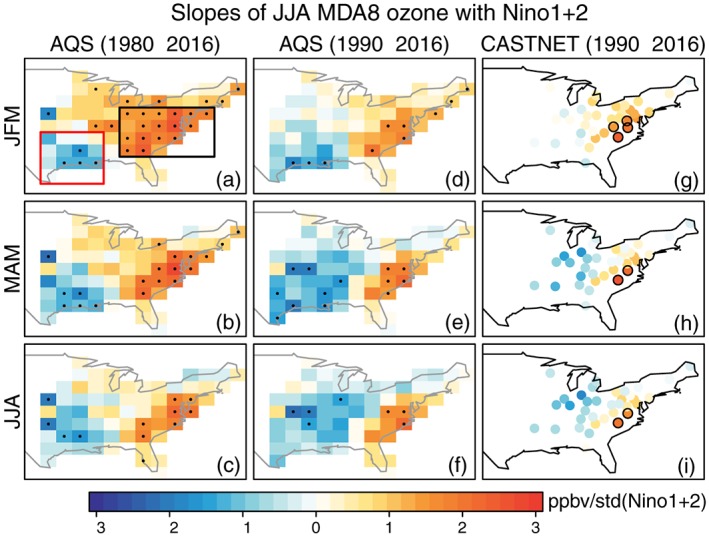
We investigate the effect of El Niño on maximum daily 8-hour average surface ozone over the eastern United States in summer during 1980-2016. El Niño can influence the extra-tropical climate through the propagation of stationary waves, leading to (1) reduced transport of moist, clean air into the mid- and southern Atlantic states and greater subsidence, reduced precipitation, and increased surface solar radiation in this region, as well as (2) intensified southerly flow into the south central states, which here enhances flux of moist and clean air. As a result, each standard deviation increase in the Niño 1+2 index is associated with an increase of 1-2 ppbv ozone in the Atlantic states and a decrease of 0.5-2 ppbv ozone in the south central states. These influences can be predicted 4 month in advance. We show that U.S. summertime ozone responds differently to eastern-type El Niño events compared to central-type events.
我们研究了1980 - 2016年夏季厄尔尼诺现象对美国东部地区每日最大8小时平均地面臭氧的影响。厄尔尼诺现象可通过驻波传播影响温带气候,导致:(1)进入大西洋中部和南部各州的潮湿清洁空气输送减少,该地区下沉增强、降水减少、地表太阳辐射增加;以及(2)流入中南部各州的南风增强,从而增加了潮湿清洁空气的通量。结果,尼诺1 + 2指数每增加一个标准差,大西洋各州的臭氧增加1 - 2 ppbv,中南部各州的臭氧减少0.5 - 2 ppbv。这些影响可提前4个月预测。我们表明,与中部型事件相比,美国夏季臭氧对东部型厄尔尼诺事件的响应有所不同。