Park Hyun Ah
Department of Family Medicine, Inje University Seoul Paik Hospital, Inje University College of Medicine, Seoul, Korea.
Korean J Fam Med. 2018 Mar;39(2):130-134. doi: 10.4082/kjfm.2018.39.2.130. Epub 2018 Mar 22.
Protein intake in South Korea is generally considered to be adequate; however, there is concern that it may be inadequate among the elderly. This study evaluated the adequacy of protein intake, the source of protein, and the distribution of protein intake in daily meals in the Korean elderly population.
Data were obtained from 1,484 men and 2,028 women aged 60 years or older who had participated in the nutrition survey of the 2013-2014 Korea National Health and Nutrition Examination Survey. One-day (24-hour) recall data were used to estimate the daily protein intake.
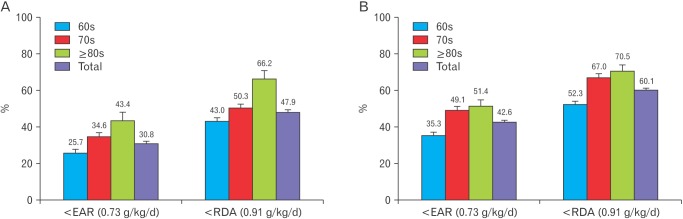
The mean protein intake was 65.3±1.0 g/d (13.1%±0.1% of energy) and 49.7±0.7 g/d (12.6%±0.1% of energy) for men and women, respectively. The protein intake was less than the estimated average requirement in 30.8%±1.4% of men and 42.6%±1.3% of women, and 47.9%±1.6% and 60.1%±1.4%, respectively, consumed less than the recommended daily allowance. The protein intake was relatively evenly distributed among meals; however, the absolute amount of protein consumption per meal was very low. Only one-third of the protein intake came from animal sources.
The quantity and quality of protein intake were inadequate in the elderly Korean population.
韩国的蛋白质摄入量一般被认为是充足的;然而,人们担心老年人的蛋白质摄入量可能不足。本研究评估了韩国老年人群蛋白质摄入量的充足性、蛋白质来源以及每日膳食中蛋白质摄入的分布情况。
数据来自于1484名60岁及以上男性和2028名60岁及以上女性,他们参与了2013 - 2014年韩国国家健康与营养检查调查的营养调查。采用一日(24小时)回顾性数据来估计每日蛋白质摄入量。
男性和女性的平均蛋白质摄入量分别为65.3±1.0克/天(占能量的13.1%±0.1%)和49.7±0.7克/天(占能量的12.6%±0.1%)。分别有30.8%±1.4%的男性和42.6%±1.3%的女性蛋白质摄入量低于估计平均需求量,分别有47.9%±1.6%和60.1%±1.4%的人群蛋白质摄入量低于推荐每日摄入量。蛋白质摄入量在各餐之间相对均匀分布;然而,每餐的蛋白质绝对摄入量非常低。只有三分之一的蛋白质摄入量来自动物性食物。
韩国老年人群蛋白质摄入的数量和质量均不足。