Department of Food and Nutrition, Sookmyung Women's University, Cheongpa-ro 47-gil 100, Yongsan-gu, Seoul, 04310, Korea.
Division of Endocrinology, Department of Internal Medicine, Hallym University Dongtan Sacred Heart Hospital, 7, Keunjaebong-gil, Hwaseong-si, Gyeonggi-do, Seoul, 18450, Korea.
BMC Public Health. 2018 Mar 15;18(1):359. doi: 10.1186/s12889-018-5233-z.
Migration has an influence on health behavior and food intake. Dietary variety is a key component to high-quality diets because a single food item does not contain a variety of nutrients and may not reflect nutritional adequacy. We aimed to compare the dietary diversity scores (DDS), food variety scores (FVS), and nutrient adequacy levels of married Filipino immigrant women in Korea to those of Korean women.
We matched the data of 474 participants aged 20-57 years from the Filipino Women's Diet and Health Study (FiLWHEL) by age category with those of married Korean women randomly selected from the Korea National Health and Nutrition Examination Survey (KNHANES). Dietary information in FiLWHEL and KNHANES were assessed through the 24-hour recall method. We calculated the DDS by summing the number of eleven food groups consumed (DDS 10 g if they consumed at least 10 g/day; DDS all if they consumed any amount) and the FVS by counting the number of food items consumed. For nutrient adequacy, we calculated the probability of adequacy (PA) and intake below the estimated average requirement (EAR).
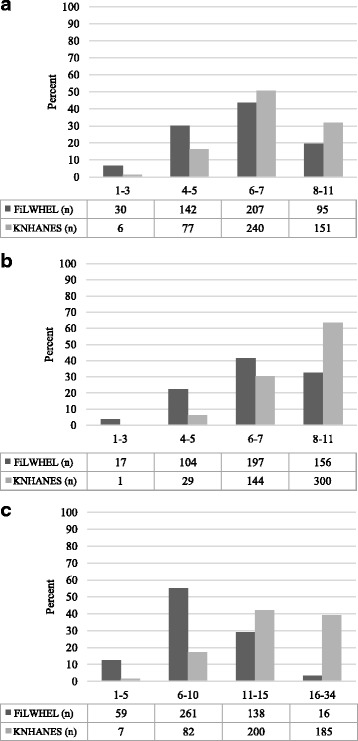
Filipino women had a lower DDS and FVS in comparison to Korean women. The means (±SDs) of DDS 10 g, DDS all, and FVS for Filipino women versus Korean women were 6.0 (±1.6) versus 6.8 (±1.5) (p < 0.001), 6.7 (±1.7) versus 7.9 (±1.4) (p < 0.001) and 9.2 (±3.3) versus 14.7 (±4.9) (p < 0.001), respectively. When we compared each food group, the intakes of fish, other seafood, legumes/seeds/nuts, eggs, vegetables, and fruits were lower for Filipino women than for Korean women. The mean probability of adequacy (MPA) of nutrient intake of the nine selected nutrients was lower for Filipino women in comparison to Korean women. The mean (±SD) was 0.55 (±0.28) versus 0.66 (±0.26), respectively.
Our findings showed that married Filipino immigrant women in Korea had lower dietary variety scores in comparison to Korean women. This was reflected in their nutritional adequacy. Nutrition education focusing on the promotion of eating a variety of foods may be needed for Filipino immigrant women in Korea.
迁移对健康行为和食物摄入有影响。饮食多样性是高质量饮食的关键组成部分,因为单一食物不能包含多种营养物质,也可能无法反映营养充足性。我们旨在比较在韩国的菲律宾已婚移民妇女的膳食多样性评分(DDS)、食物种类评分(FVS)和营养充足水平与韩国妇女的这些水平。
我们通过年龄类别,将年龄在 20-57 岁之间的来自菲律宾妇女饮食与健康研究(FiLWHEL)的 474 名参与者的数据与从韩国国民健康与营养检查调查(KNHANES)中随机选择的已婚韩国妇女的数据进行匹配。通过 24 小时回忆法评估 FiLWHEL 和 KNHANES 的饮食信息。我们通过将食用的 11 种食物组的数量相加来计算 DDS(如果每天至少食用 10 克,则 DDS 为 10 克;如果食用任何数量,则 DDS 全部),并通过计算食用的食物种类数来计算 FVS。对于营养充足性,我们计算了充足概率(PA)和低于估计平均需求量(EAR)的摄入量。
与韩国妇女相比,菲律宾妇女的 DDS 和 FVS 较低。与韩国妇女相比,菲律宾妇女的 DDS 10 克、DDS 全部和 FVS 的平均值(±SD)分别为 6.0(±1.6)与 6.8(±1.5)(p<0.001)、6.7(±1.7)与 7.9(±1.4)(p<0.001)和 9.2(±3.3)与 14.7(±4.9)(p<0.001)。当我们比较每个食物组时,与韩国妇女相比,菲律宾妇女食用的鱼、其他海鲜、豆类/种子/坚果、鸡蛋、蔬菜和水果较少。与韩国妇女相比,9 种选定营养素摄入的平均充足概率(MPA)较低。平均值(±SD)分别为 0.55(±0.28)与 0.66(±0.26)。
我们的研究结果表明,与韩国妇女相比,在韩国的菲律宾已婚移民妇女的饮食多样性评分较低。这反映在她们的营养充足性上。可能需要针对在韩国的菲律宾移民妇女开展以促进食用多种食物为重点的营养教育。