Department of Physical Biochemistry, Max Planck Institute for Biophysical Chemistry, 37077 Göttingen, Germany.
Department of Physical Biochemistry, Max Planck Institute for Biophysical Chemistry, 37077 Göttingen, Germany
Proc Natl Acad Sci U S A. 2018 Apr 24;115(17):4411-4416. doi: 10.1073/pnas.1718029115. Epub 2018 Apr 9.
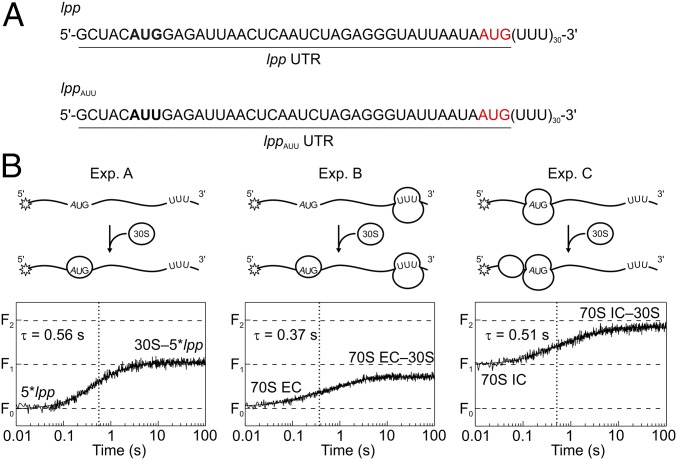
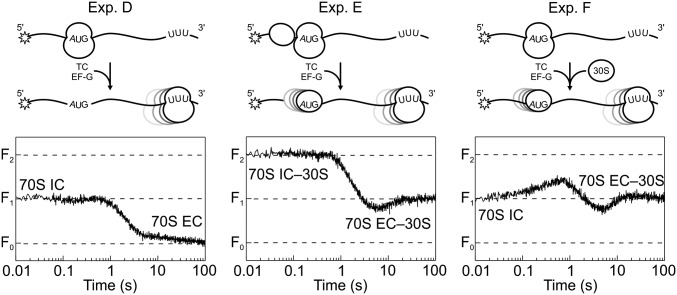
During translation, consecutive ribosomes load on an mRNA and form a polysome. The first ribosome binds to a single-stranded mRNA region and moves toward the start codon, unwinding potential mRNA structures on the way. In contrast, the following ribosomes can dock at the start codon only when the first ribosome has vacated the initiation site. Here we show that loading of the second ribosome on a natural 38-nt-long 5' untranslated region of mRNA, which codes for the outer membrane lipoprotein from , takes place before the leading ribosome has moved away from the start codon. The rapid formation of this standby complex depends on the presence of ribosomal proteins S1/S2 in the leading ribosome. The early recruitment of the second ribosome to the standby site before translation by the leading ribosome and the tight coupling between translation elongation by the first ribosome and the accommodation of the second ribosome can contribute to high translational efficiency of the mRNA.
在翻译过程中,连续的核糖体装载在 mRNA 上并形成多核糖体。第一个核糖体结合到单链 mRNA 区域,并朝着起始密码子移动,在此过程中解开潜在的 mRNA 结构。相比之下,只有当第一个核糖体离开起始位点时,后续的核糖体才能在起始密码子处停靠。在这里,我们表明,第二个核糖体在编码来自 的外膜脂蛋白的天然 38nt 长的 5'非翻译区 mRNA 上的加载发生在先导核糖体离开起始密码子之前。这种备用复合物的快速形成取决于先导核糖体中核糖体蛋白 S1/S2 的存在。在第一个核糖体翻译之前,第二个核糖体被先导核糖体招募到备用位点,以及第一个核糖体的翻译延伸和第二个核糖体的适应之间的紧密偶联,可以有助于 mRNA 的高翻译效率。