Institute of Biomedical Engineering, Department of Engineering Science, University of Oxford, Oxford, OX3 7DQ, UK.
University Department of Psychiatry, University of Oxford, Oxford, OX3 7JX, UK.
Transl Psychiatry. 2018 Apr 12;8(1):79. doi: 10.1038/s41398-018-0125-7.
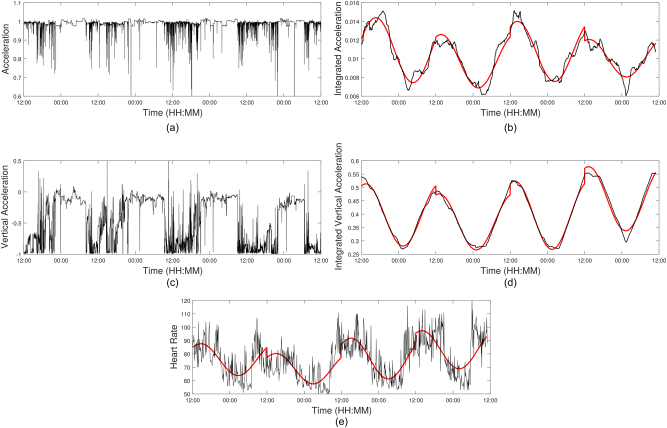
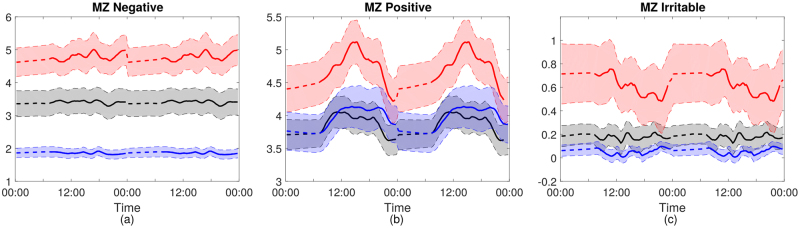
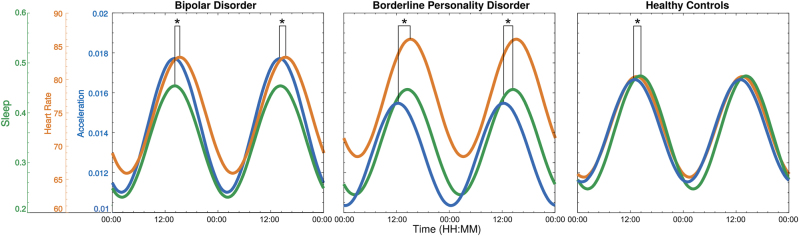
It has long been proposed that diurnal rhythms are disturbed in bipolar disorder (BD). Such changes are obvious in episodes of mania or depression. However, detailed study of patients between episodes has been rare and comparison with other psychiatric disorders rarer still. Our hypothesis was that evidence for desynchronization of diurnal rhythms would be evident in BD and that we could test the specificity of any effect by studying borderline personality disorder (BPD). Individuals with BD (n = 36), BPD (n = 22) and healthy volunteers (HC, n = 25) wore a portable heart rate and actigraphy device and used a smart-phone to record self-assessed mood scores 10 times per day for 1 week. Average diurnal patterns of heart rate (HR), activity and sleep were compared within and across groups. Desynchronization in the phase of diurnal rhythms of HR compared with activity were found in BPD (+3 h) and BD (+1 h), but not in HC. A clear diurnal pattern for positive mood was found in all subject groups. The coherence between negative and irritable mood and HR showed a four-cycle per day component in BD and BPD, which was not present in HC. The findings highlight marked de-synchronisation of measured diurnal function in both BD but particularly BPD and suggest an increased association with negative and irritable mood at ultradian frequencies. These findings enhance our understanding of the underlying physiological changes associated with BPD and BD, and suggest objective markers for monitoring and potential treatment targets. Improved mood stabilisation is a translational objective for management of both patient groups.
昼夜节律紊乱在双相情感障碍(BD)中早已被提出。这种变化在躁狂或抑郁发作时尤为明显。然而,在发作之间对患者进行详细研究的情况很少见,与其他精神障碍的比较则更为罕见。我们的假设是,BD 患者的昼夜节律失同步证据将是明显的,我们可以通过研究边缘型人格障碍(BPD)来测试任何效应的特异性。BD 患者(n = 36)、BPD 患者(n = 22)和健康志愿者(HC,n = 25)佩戴便携式心率和活动记录仪,并使用智能手机每天 10 次记录自我评估的情绪评分,持续 1 周。在组内和组间比较了心率(HR)、活动和睡眠的平均昼夜模式。与活动相比,BPD(+3 小时)和 BD(+1 小时)中 HR 的昼夜节律相位出现了明显的失同步,但 HC 中没有。所有受试者组均表现出明显的正向情绪昼夜模式。BD 和 BPD 中,负性和易怒情绪与 HR 的相干性表现出每天四周期的成分,而 HC 中则没有。这些发现突出了 BD 和 BPD 中昼夜功能明显的失同步,并且提示与负性和易怒情绪的超日频率有更高的关联。这些发现增进了我们对 BPD 和 BD 相关生理变化的理解,并提示了监测和潜在治疗目标的客观标志物。改善情绪稳定是管理这两个患者群体的转化目标。