Farzanehfar Parisa, Woodrow Holly, Braybrook Michelle, McGregor Sarah, Evans Andrew, Nicklason Frank, Horne Malcolm
1Florey Institute of Neuroscience and Mental Health, The University of Melbourne, Parkville, VIC 3010 Australia.
2Department of Neurology, St Vincent's Hospital, Fitzroy, VIC 3065 Australia.
NPJ Parkinsons Dis. 2018 Apr 3;4:10. doi: 10.1038/s41531-018-0046-4. eCollection 2018.
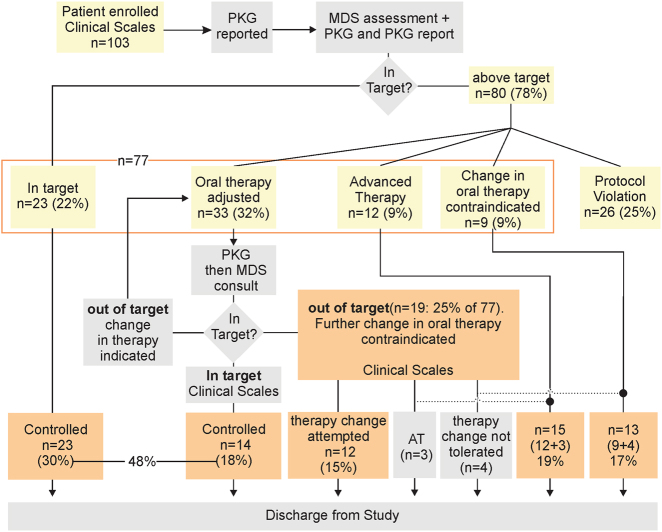
It is common in medicine to titrate therapy according to target ranges of objectively measured parameters. Objective measurement of motor function is available for Parkinson's Disease (PD), making it possible to optimise therapy and clinical outcomes. In this study, an accelerometry based measurement and predefined target ranges were used to assess motor function in a Northern Tasmania PD cohort managed by a Movement Disorder clinic. Approximately 40% ( = 103) of the total PD population participated in this study and motor scores were within target in 22%. In the 78% above target, changes in oral therapy were recommended in 74%, Advanced Therapy in 12% and treatment was contraindicated in 9%. Following changes in oral therapy, there was a further objective measurement and clinical consultation to establish whether scores had reached target range: if so subjects left the study, otherwise further changes of therapy were recommended (unless contraindications were present). Seventy-seven cases completed the study, with 48% achieving target (including 22% at outset), Advanced Therapy recommended in 19% and contraindications preventing any change in therapy in 17%. In the 43% of cases in whom oral therapy was changed, total UPDRS improved significantly (effect size = 8) as did the PDQ39 in cases reaching target. NMS Quest and MOCA scores also improved significantly. This study shows that many people in a representative cohort of PD would benefit from objective assessment and treatment of their PD features against a target.
在医学中,根据客观测量参数的目标范围来调整治疗方案是很常见的。帕金森病(PD)可以对运动功能进行客观测量,这使得优化治疗和临床结果成为可能。在本研究中,基于加速度计的测量方法和预定义的目标范围被用于评估由运动障碍诊所管理的塔斯马尼亚北部PD队列中的运动功能。PD总人群中约40%(n = 103)参与了本研究,其中22%的运动评分在目标范围内。在78%高于目标值的患者中,74%建议调整口服治疗,12%建议采用高级治疗,9%建议禁忌治疗。在调整口服治疗后,会进行进一步的客观测量和临床会诊,以确定评分是否达到目标范围:如果达到,受试者退出研究,否则建议进一步调整治疗(除非存在禁忌证)。77例患者完成了研究,48%达到目标(包括一开始就达到目标的22%),19%建议采用高级治疗,17%因禁忌证无法改变治疗方案。在43%调整口服治疗的病例中,总统一帕金森病评定量表(UPDRS)显著改善(效应量 = 8),达到目标的病例中帕金森病问卷39项(PDQ39)也显著改善。非运动症状问卷(NMS Quest)和蒙特利尔认知评估量表(MOCA)评分也显著改善。本研究表明,在具有代表性的PD队列中,许多人将从针对目标的PD特征的客观评估和治疗中受益。