• 文献检索
  • 文档翻译
  • 深度研究
  • 学术资讯
  • Suppr Zotero 插件Zotero 插件
  • 邀请有礼
  • 套餐&价格
  • 历史记录
应用&插件
Suppr Zotero 插件Zotero 插件浏览器插件Mac 客户端Windows 客户端微信小程序
定价
高级版会员购买积分包购买API积分包
服务
文献检索文档翻译深度研究API 文档MCP 服务
关于我们
关于 Suppr公司介绍联系我们用户协议隐私条款
关注我们

Suppr 超能文献

核心技术专利:CN118964589B侵权必究
粤ICP备2023148730 号-1Suppr @ 2026

文献检索

告别复杂PubMed语法,用中文像聊天一样搜索,搜遍4000万医学文献。AI智能推荐,让科研检索更轻松。

立即免费搜索

文件翻译

保留排版,准确专业,支持PDF/Word/PPT等文件格式,支持 12+语言互译。

免费翻译文档

深度研究

AI帮你快速写综述,25分钟生成高质量综述,智能提取关键信息,辅助科研写作。

立即免费体验

膜曲率在纳米形貌诱导的细胞内信号转导中的作用。

The Role of Membrane Curvature in Nanoscale Topography-Induced Intracellular Signaling.

机构信息

Department of Chemistry , Stanford University , Stanford , California 94305 , United States.

School of Chemical and Biomedical Engineering , Nanyang Technological University , Singapore 637457 , Singapore.

出版信息

Acc Chem Res. 2018 May 15;51(5):1046-1053. doi: 10.1021/acs.accounts.7b00594. Epub 2018 Apr 12.

DOI:10.1021/acs.accounts.7b00594
PMID:29648779
原文链接:https://pmc.ncbi.nlm.nih.gov/articles/PMC7384307/
Abstract

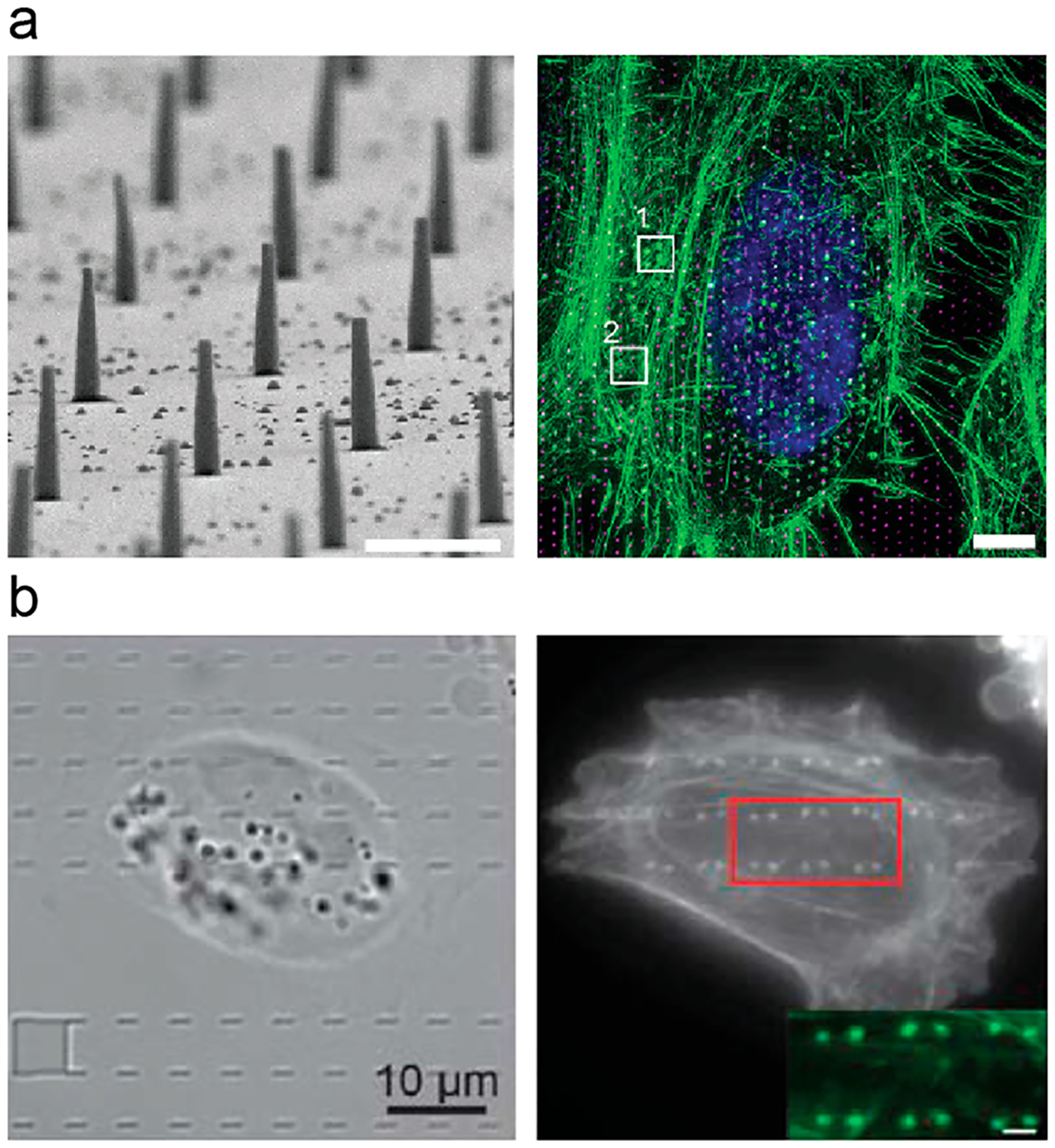
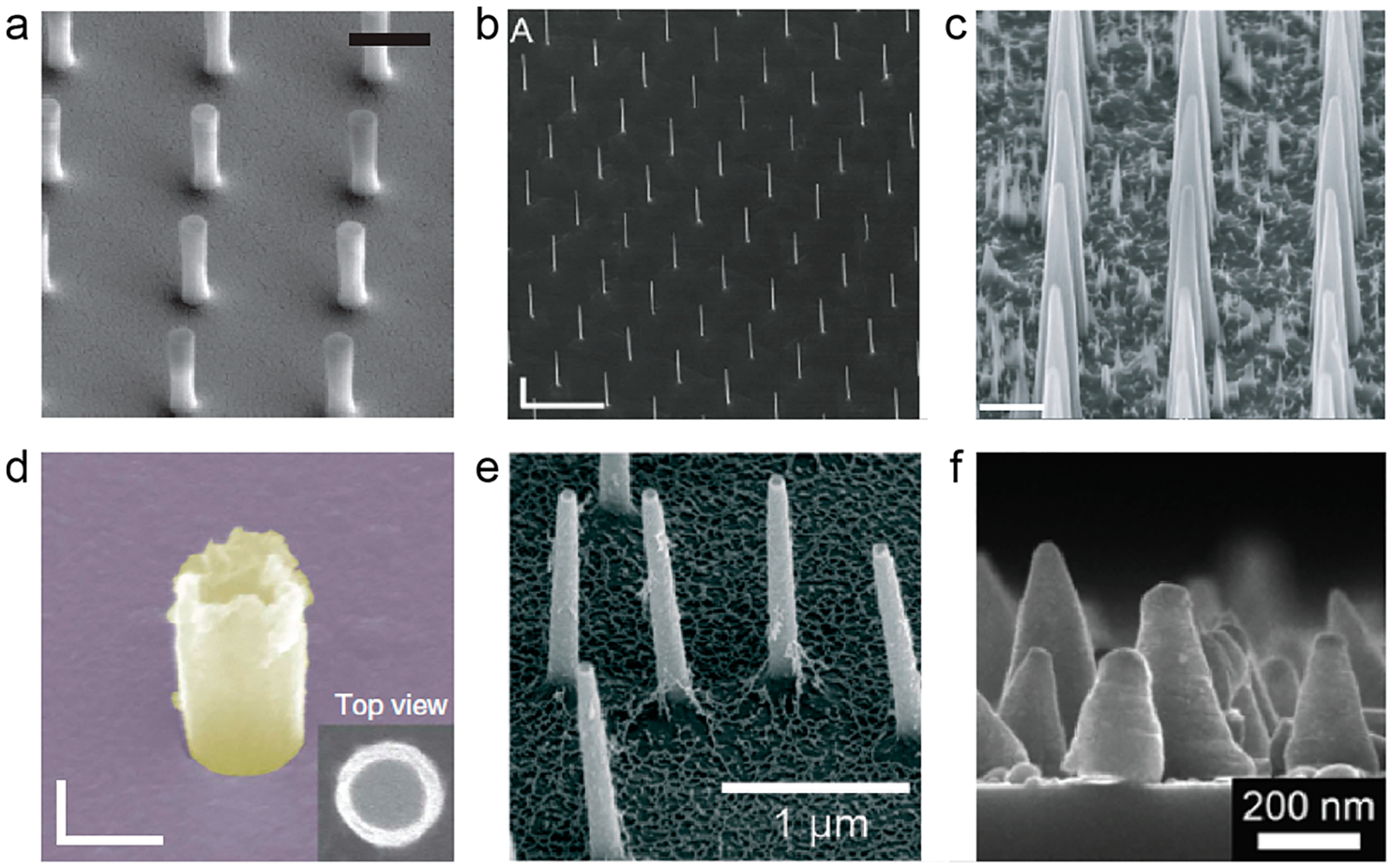
Over the past decade, there has been growing interest in developing biosensors and devices with nanoscale and vertical topography. Vertical nanostructures induce spontaneous cell engulfment, which enhances the cell-probe coupling efficiency and the sensitivity of biosensors. Although local membranes in contact with the nanostructures are found to be fully fluidic for lipid and membrane protein diffusions, cells appear to actively sense and respond to the surface topography presented by vertical nanostructures. For future development of biodevices, it is important to understand how cells interact with these nanostructures and how their presence modulates cellular function and activities. How cells recognize nanoscale surface topography has been an area of active research for two decades before the recent biosensor works. Extensive studies show that surface topographies in the range of tens to hundreds of nanometers can significantly affect cell functions, behaviors, and ultimately the cell fate. For example, titanium implants having rough surfaces are better for osteoblast attachment and host-implant integration than those with smooth surfaces. At the cellular level, nanoscale surface topography has been shown by a large number of studies to modulate cell attachment, activity, and differentiation. However, a mechanistic understanding of how cells interact and respond to nanoscale topographic features is still lacking. In this Account, we focus on some recent studies that support a new mechanism that local membrane curvature induced by nanoscale topography directly acts as a biochemical signal to induce intracellular signaling, which we refer to as the curvature hypothesis. The curvature hypothesis proposes that some intracellular proteins can recognize membrane curvatures of a certain range at the cell-to-material interface. These proteins then recruit and activate downstream components to modulate cell signaling and behavior. We discuss current technologies allowing the visualization of membrane deformation at the cell membrane-to-substrate interface with nanometer precision and demonstrate that vertical nanostructures induce local curvatures on the plasma membrane. These local curvatures enhance the process of clathrin-mediated endocytosis and affect actin dynamics. We also present evidence that vertical nanostructures can induce significant deformation of the nuclear membrane, which can affect chromatin distribution and gene expression. Finally, we provide a brief perspective on the curvature hypothesis and the challenges and opportunities for the design of nanotopography for manipulating cell behavior.

摘要

在过去的十年中,人们对开发具有纳米级和垂直形貌的生物传感器和设备产生了浓厚的兴趣。垂直纳米结构诱导细胞自发吞噬,从而提高了细胞-探针的耦合效率和生物传感器的灵敏度。尽管与纳米结构接触的局部膜对于脂质和膜蛋白的扩散是完全流体的,但细胞似乎能够主动感知和响应垂直纳米结构所呈现的表面形貌。为了未来生物设备的发展,了解细胞如何与这些纳米结构相互作用以及它们的存在如何调节细胞功能和活动非常重要。细胞如何识别纳米级表面形貌是近十年来生物传感器工作之前二十年的一个活跃研究领域。大量研究表明,几十到几百纳米范围内的表面形貌可以显著影响细胞功能、行为,最终影响细胞命运。例如,具有粗糙表面的钛植入物比具有光滑表面的植入物更有利于成骨细胞附着和宿主-植入物整合。在细胞水平上,大量研究表明,纳米级表面形貌可以调节细胞的附着、活性和分化。然而,细胞如何相互作用并响应纳米级形貌特征的机制仍不清楚。在本报告中,我们重点介绍了一些支持新机制的最新研究,该机制认为纳米形貌引起的局部膜曲率直接作为生化信号诱导细胞内信号转导,我们称之为曲率假说。曲率假说提出,一些细胞内蛋白可以识别细胞-材料界面处一定范围内的膜曲率。这些蛋白然后募集并激活下游组件来调节细胞信号转导和行为。我们讨论了当前允许以纳米级精度可视化细胞膜在细胞膜-基底界面上的变形的技术,并证明垂直纳米结构会在质膜上诱导局部曲率。这些局部曲率增强了网格蛋白介导的内吞作用过程并影响肌动蛋白动力学。我们还提供了证据表明,垂直纳米结构可以诱导核膜的显著变形,从而影响染色质分布和基因表达。最后,我们简要地讨论了曲率假说以及设计用于操纵细胞行为的纳米形貌的挑战和机遇。
https://cdn.ncbi.nlm.nih.gov/pmc/blobs/6363/7384307/2ea267c6dc21/nihms-1611531-f0007.jpg
https://cdn.ncbi.nlm.nih.gov/pmc/blobs/6363/7384307/8775384028e7/nihms-1611531-f0002.jpg
https://cdn.ncbi.nlm.nih.gov/pmc/blobs/6363/7384307/39d8910326fb/nihms-1611531-f0003.jpg
https://cdn.ncbi.nlm.nih.gov/pmc/blobs/6363/7384307/fa1667cf3cf9/nihms-1611531-f0004.jpg
https://cdn.ncbi.nlm.nih.gov/pmc/blobs/6363/7384307/6c8076fc24d9/nihms-1611531-f0005.jpg
https://cdn.ncbi.nlm.nih.gov/pmc/blobs/6363/7384307/dee468618a48/nihms-1611531-f0006.jpg
https://cdn.ncbi.nlm.nih.gov/pmc/blobs/6363/7384307/2ea267c6dc21/nihms-1611531-f0007.jpg
https://cdn.ncbi.nlm.nih.gov/pmc/blobs/6363/7384307/8775384028e7/nihms-1611531-f0002.jpg
https://cdn.ncbi.nlm.nih.gov/pmc/blobs/6363/7384307/39d8910326fb/nihms-1611531-f0003.jpg
https://cdn.ncbi.nlm.nih.gov/pmc/blobs/6363/7384307/fa1667cf3cf9/nihms-1611531-f0004.jpg
https://cdn.ncbi.nlm.nih.gov/pmc/blobs/6363/7384307/6c8076fc24d9/nihms-1611531-f0005.jpg
https://cdn.ncbi.nlm.nih.gov/pmc/blobs/6363/7384307/dee468618a48/nihms-1611531-f0006.jpg
https://cdn.ncbi.nlm.nih.gov/pmc/blobs/6363/7384307/2ea267c6dc21/nihms-1611531-f0007.jpg

相似文献

1
The Role of Membrane Curvature in Nanoscale Topography-Induced Intracellular Signaling.膜曲率在纳米形貌诱导的细胞内信号转导中的作用。
Acc Chem Res. 2018 May 15;51(5):1046-1053. doi: 10.1021/acs.accounts.7b00594. Epub 2018 Apr 12.
2
Membrane curvature underlies actin reorganization in response to nanoscale surface topography.细胞膜曲率在响应纳米级表面形貌的肌动蛋白重组中起基础作用。
Proc Natl Acad Sci U S A. 2019 Nov 12;116(46):23143-23151. doi: 10.1073/pnas.1910166116. Epub 2019 Oct 7.
3
A nanostructure platform for live-cell manipulation of membrane curvature.用于活细胞膜曲率操控的纳米结构平台。
Nat Protoc. 2019 Jun;14(6):1772-1802. doi: 10.1038/s41596-019-0161-7. Epub 2019 May 17.
4
Dynamic Manipulation of Cell Membrane Curvature by Light-Driven Reshaping of Azopolymer.通过光驱动偶氮聚合物重塑对细胞膜曲率进行动态调控
Nano Lett. 2020 Jan 8;20(1):577-584. doi: 10.1021/acs.nanolett.9b04307. Epub 2019 Dec 19.
5
Nanoscale manipulation of membrane curvature for probing endocytosis in live cells.纳米尺度操控细胞膜曲率以探测活细胞内的胞吞作用。
Nat Nanotechnol. 2017 Aug;12(8):750-756. doi: 10.1038/nnano.2017.98. Epub 2017 Jun 5.
6
New perspectives on the roles of nanoscale surface topography in modulating intracellular signaling.纳米级表面形貌在调节细胞内信号传导中作用的新视角。
Curr Opin Solid State Mater Sci. 2021 Feb;25(1). doi: 10.1016/j.cossms.2020.100873. Epub 2020 Nov 29.
7
Nanotopography on titanium promotes osteogenesis via autophagy-mediated signaling between YAP and β-catenin.钛纳米形貌通过自噬介导的 YAP 和 β-连环蛋白之间的信号传导促进成骨。
Acta Biomater. 2019 Sep 15;96:674-685. doi: 10.1016/j.actbio.2019.07.007. Epub 2019 Jul 5.
8
Three-dimensionally Patterned Scaffolds Modulate the Biointerface at the Nanoscale.三维图案化支架调节纳米尺度的生物界面。
Nano Lett. 2019 Aug 14;19(8):5118-5123. doi: 10.1021/acs.nanolett.9b01468. Epub 2019 Jul 3.
9
Quantitative Control of Protein and Cell Interaction with Nanostructured Surfaces by Cluster Assembling.通过簇组装对纳米结构表面上的蛋白质和细胞相互作用进行定量控制。
Acc Chem Res. 2017 Feb 21;50(2):231-239. doi: 10.1021/acs.accounts.6b00433. Epub 2017 Jan 24.
10
Subcellular topography modulates actin dynamics and signaling in B-cells.亚细胞拓扑结构调节 B 细胞中的肌动蛋白动力学和信号转导。
Mol Biol Cell. 2018 Jul 15;29(13):1732-1742. doi: 10.1091/mbc.E17-06-0422. Epub 2018 May 17.

引用本文的文献

1
Silicon Nanowire Mats Enable Advanced Bioelectrical Recordings in Primary DRG Cell Cultures.硅纳米线垫可实现初级背根神经节细胞培养中的先进生物电记录。
Adv Healthc Mater. 2025 Jul;14(17):e2500379. doi: 10.1002/adhm.202500379. Epub 2025 May 24.
2
Cellular Signaling at the Nano-Bio Interface: Spotlighting Membrane Curvature.纳米生物界面处的细胞信号传导:聚焦膜曲率
Annu Rev Phys Chem. 2025 Apr;76(1):251-277. doi: 10.1146/annurev-physchem-090722-021151.
3
Dynamic Plasma Membrane Topography Linked With Arp2/3 Actin Network Induction During Cell Shape Change.

本文引用的文献

1
Nanoscale silicon for subcellular biointerfaces.用于亚细胞生物界面的纳米级硅
J Mater Chem B. 2017 Jun 21;5(23):4276-4289. doi: 10.1039/c7tb00151g. Epub 2017 Apr 6.
2
Cell-geometry-dependent changes in plasma membrane order direct stem cell signalling and fate.细胞膜有序性的细胞-几何依赖性变化指导干细胞信号转导和命运决定。
Nat Mater. 2018 Mar;17(3):237-242. doi: 10.1038/s41563-017-0014-0. Epub 2018 Feb 12.
3
Revealing the Cell-Material Interface with Nanometer Resolution by Focused Ion Beam/Scanning Electron Microscopy.利用聚焦离子束/扫描电子显微镜以纳米分辨率揭示细胞-材料界面。
细胞形状改变过程中与Arp2/3肌动蛋白网络诱导相关的动态质膜拓扑结构
Bioessays. 2025 Jun;47(6):e70004. doi: 10.1002/bies.70004. Epub 2025 Mar 31.
4
Exploration and analytical techniques for membrane curvature-sensing proteins in bacteria.细菌中膜曲率感知蛋白的探索与分析技术
J Bacteriol. 2025 Apr 17;207(4):e0048224. doi: 10.1128/jb.00482-24. Epub 2025 Mar 26.
5
Supra- and sub-threshold intracellular-like recording of 2D and 3D neuronal networks using nanopillar electrode arrays.使用纳米柱电极阵列对二维和三维神经元网络进行超阈值和亚阈值细胞内样记录。
Microsyst Nanoeng. 2024 Dec 5;10(1):184. doi: 10.1038/s41378-024-00817-y.
6
Silk films with distinct surface topography modulate plasma membrane curvature to polarize macrophages.具有独特表面形貌的丝素膜可调节质膜曲率以使巨噬细胞极化。
Mater Today Bio. 2024 Aug 8;28:101193. doi: 10.1016/j.mtbio.2024.101193. eCollection 2024 Oct.
7
Engineering the Cellular Microenvironment: Integrating Three-Dimensional Nontopographical and Two-Dimensional Biochemical Cues for Precise Control of Cellular Behavior.工程化细胞微环境:整合三维非形貌和二维生化线索以精确控制细胞行为。
ACS Nano. 2024 Jul 23;18(29):19064-19076. doi: 10.1021/acsnano.4c03743. Epub 2024 Jul 9.
8
The Effects of Biomimetic Surface Topography on Vascular Cells: Implications for Vascular Conduits.仿生表面形貌对血管细胞的影响:对血管导管的启示。
Adv Healthc Mater. 2024 Oct;13(27):e2400335. doi: 10.1002/adhm.202400335. Epub 2024 Jul 15.
9
Investigating Communication Dynamics in Neuronal Network using 3D Gold Microelectrode Arrays.使用 3D 金微电极阵列研究神经网络中的通信动态。
ACS Nano. 2024 Jul 2;18(26):17162-17174. doi: 10.1021/acsnano.4c03983. Epub 2024 Jun 20.
10
The influence of physical and spatial substrate characteristics on endothelial cells.物理和空间基质特征对内皮细胞的影响。
Mater Today Bio. 2024 Apr 18;26:101060. doi: 10.1016/j.mtbio.2024.101060. eCollection 2024 Jun.
ACS Nano. 2017 Aug 22;11(8):8320-8328. doi: 10.1021/acsnano.7b03494. Epub 2017 Jul 21.
4
Nanoscale manipulation of membrane curvature for probing endocytosis in live cells.纳米尺度操控细胞膜曲率以探测活细胞内的胞吞作用。
Nat Nanotechnol. 2017 Aug;12(8):750-756. doi: 10.1038/nnano.2017.98. Epub 2017 Jun 5.
5
Mapping cell behavior across a wide range of vertical silicon nanocolumn densities.在广泛的垂直硅纳米柱密度范围内绘制细胞行为图。
Nanoscale. 2017 May 4;9(17):5517-5527. doi: 10.1039/c6nr09700f.
6
Membrane curvature in cell biology: An integration of molecular mechanisms.细胞生物学中的膜曲率:分子机制的整合
J Cell Biol. 2016 Aug 15;214(4):375-87. doi: 10.1083/jcb.201604003.
7
Temporally resolved direct delivery of second messengers into cells using nanostraws.利用纳米吸管实现第二信使的时间分辨直接递送入细胞。
Lab Chip. 2016 Jul 7;16(13):2434-9. doi: 10.1039/c6lc00463f. Epub 2016 Jun 13.
8
Determining the Time Window for Dynamic Nanowire Cell Penetration Processes.确定动态纳米线细胞穿透过程的时间窗口。
ACS Nano. 2015 Dec 22;9(12):11667-77. doi: 10.1021/acsnano.5b05498. Epub 2015 Nov 13.
9
Vertical nanopillars for in situ probing of nuclear mechanics in adherent cells.用于原位探测贴壁细胞中核力学的垂直纳米柱。
Nat Nanotechnol. 2015 Jun;10(6):554-62. doi: 10.1038/nnano.2015.88. Epub 2015 May 18.
10
Tunable high aspect ratio polymer nanostructures for cell interfaces.用于细胞界面的可调高纵横比聚合物纳米结构。
Nanoscale. 2015 May 14;7(18):8438-50. doi: 10.1039/c5nr00674k.