Ren Lei, Xu Shujia, Gao Jie, Lin Zi, Chen Zhipeng, Liu Bin, Liang Liang, Jiang Lelun
Guangdong Provincial Key Laboratory of Sensor Technology and Biomedical Instrument, Sun Yat-Sen University, Guangzhou 510006, China.
School of Mechanical and Automotive Engineering, South China University of Technology, Guangzhou 510640, China.
Sensors (Basel). 2018 Apr 13;18(4):1191. doi: 10.3390/s18041191.
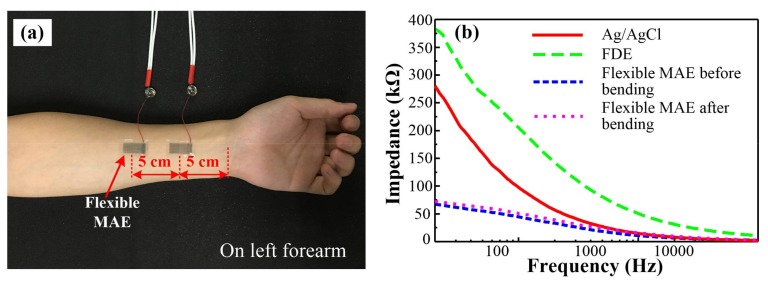
Laser-direct writing (LDW) and magneto-rheological drawing lithography (MRDL) have been proposed for the fabrication of a flexible microneedle array electrode (MAE) for wearable bio-signal monitoring. Conductive patterns were directly written onto the flexible polyethylene terephthalate (PET) substrate by LDW. The microneedle array was rapidly drawn and formed from the droplets of curable magnetorheological fluid with the assistance of an external magnetic field by MRDL. A flexible MAE can maintain a stable contact interface with curved human skin due to the flexibility of the PET substrate. Compared with Ag/AgCl electrodes and flexible dry electrodes (FDE), the electrode-skin interface impedance of flexible MAE was the minimum even after a 50-cycle bending test. Flexible MAE can record electromyography (EMG), electroencephalography (EEG) and static electrocardiography (ECG) signals with good fidelity. The main features of the dynamic ECG signal recorded by flexible MAE are the most distinguishable with the least moving artifacts. Flexible MAE is an attractive candidate electrode for wearable bio-signal monitoring.
激光直写(LDW)和磁流变绘图光刻(MRDL)已被用于制造用于可穿戴生物信号监测的柔性微针阵列电极(MAE)。通过LDW将导电图案直接写入柔性聚对苯二甲酸乙二酯(PET)基板上。在外部磁场的辅助下,通过MRDL从可固化的磁流变液滴中快速绘制并形成微针阵列。由于PET基板的柔韧性,柔性MAE可以与弯曲的人体皮肤保持稳定的接触界面。与Ag/AgCl电极和柔性干电极(FDE)相比,即使经过50次循环弯曲测试,柔性MAE的电极-皮肤界面阻抗也是最小的。柔性MAE能够以良好的保真度记录肌电图(EMG)、脑电图(EEG)和静态心电图(ECG)信号。柔性MAE记录的动态ECG信号的主要特征最明显,运动伪影最少。柔性MAE是用于可穿戴生物信号监测的有吸引力的候选电极。