Microbes, Evolution, Phylogeny and Infection, Aix-Marseille Université, UM 63, CNRS 7278, IRD 198, Inserm 1095, IHU - Méditerranée Infection, 19-21 Boulevard Jean Moulin, 13005 Marseille, France.
Microbiologyopen. 2019 Jan;8(1):e00621. doi: 10.1002/mbo3.621. Epub 2018 Apr 14.
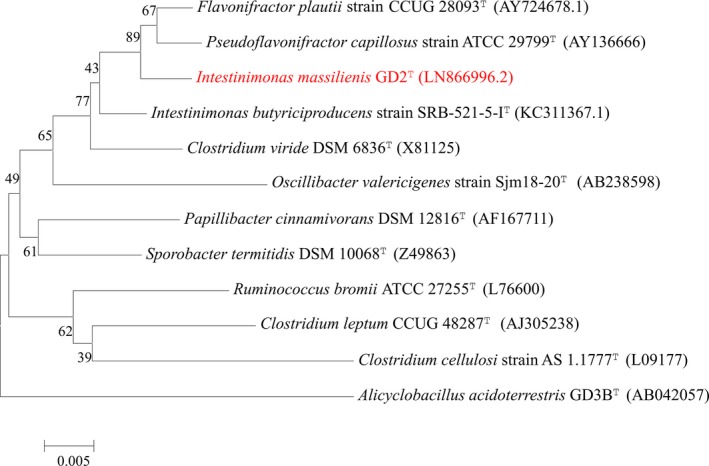
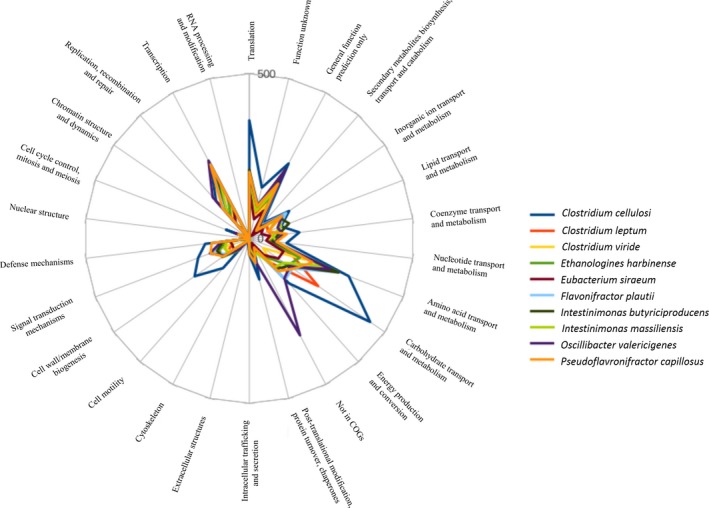
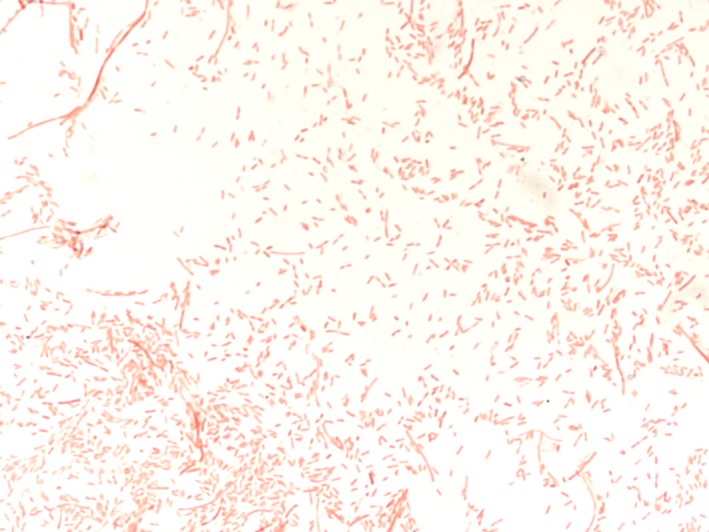
Intestinimonas massiliensis sp. nov strain GD2 is a new species of the genus Intestinimonas (the second, following Intestinimonas butyriciproducens gen. nov., sp. nov). First isolated from the gut microbiota of a healthy subject of French origin using a culturomics approach combined with taxono-genomics, it is strictly anaerobic, nonspore-forming, rod-shaped, with catalase- and oxidase-negative reactions. Its growth was observed after preincubation in an anaerobic blood culture enriched with sheep blood (5%) and rumen fluid (5%), incubated at 37°C. Its phenotypic and genotypic descriptions are presented in this paper with a full annotation of its genome sequence. This genome consists of 3,104,261 bp in length and contains 3,074 predicted genes, including 3,012 protein-coding genes and 62 RNA-coding genes. Strain GD2 significantly produces butyrate and is frequently found among available 16S rRNA gene amplicon datasets, which leads consideration of Intestinimonas massiliensis as an important human gut commensal.
肠道单胞菌属新种 GD2 株是肠道单胞菌属的一个新物种(继肠道丁酸单胞菌新种之后的第二个物种)。它是使用培养组学方法结合分类基因组学从一个原籍法国的健康个体的肠道微生物群中首次分离出来的,它是严格厌氧的,非孢子形成的,杆状的,过氧化氢酶和氧化酶反应阴性。在含有 5%绵羊血和 5%瘤胃液的厌氧血液培养物中预孵育后,可以观察到其生长,在 37°C 下孵育。本文介绍了其表型和基因型描述,并对其全基因组序列进行了完整注释。该基因组长 3,104,261bp,包含 3,074 个预测基因,包括 3,012 个蛋白编码基因和 62 个 RNA 编码基因。GD2 株显著产生丁酸,并且经常在可用的 16S rRNA 基因扩增子数据集,这使得肠道单胞菌属新种被认为是一种重要的人类肠道共生菌。