John Ring LaMontagne Center for Infectious Disease, The University of Texas at Austin, Austin, Texas, USA.
Department of Molecular Biosciences, The University of Texas at Austin, Austin, Texas, USA.
mBio. 2018 Apr 17;9(2):e00575-18. doi: 10.1128/mBio.00575-18.
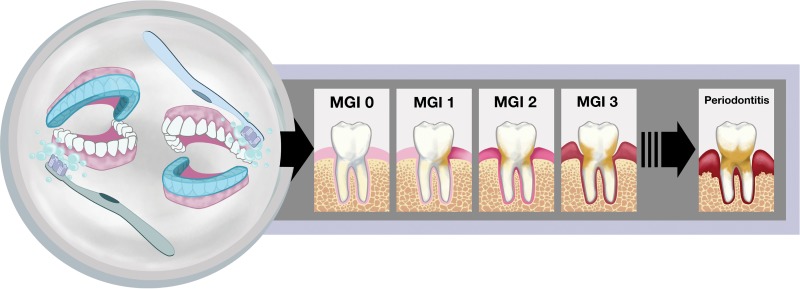
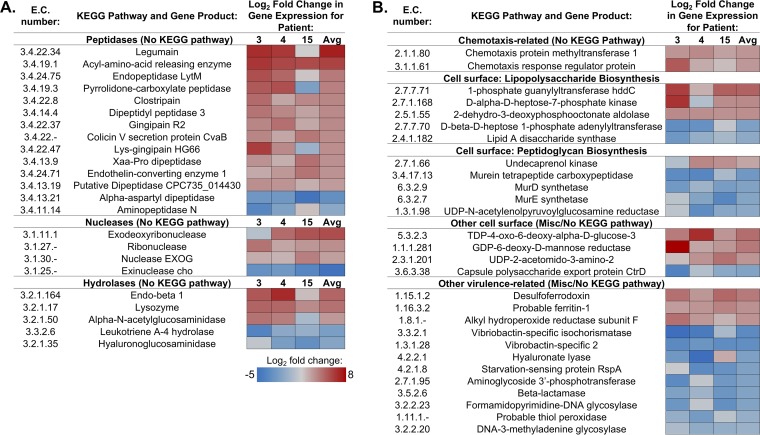
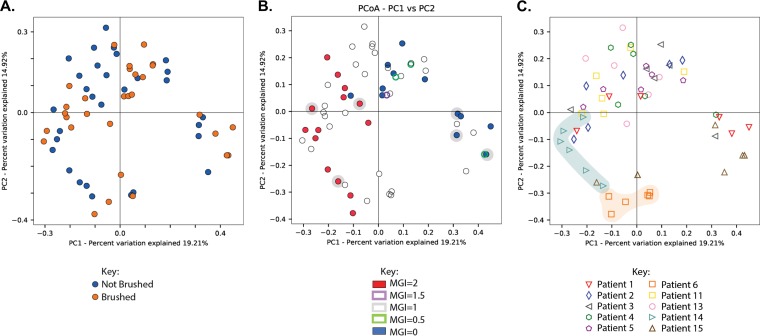
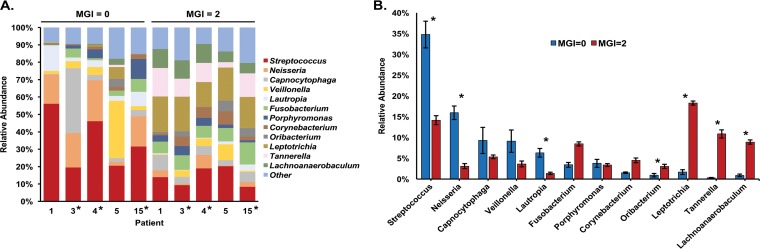
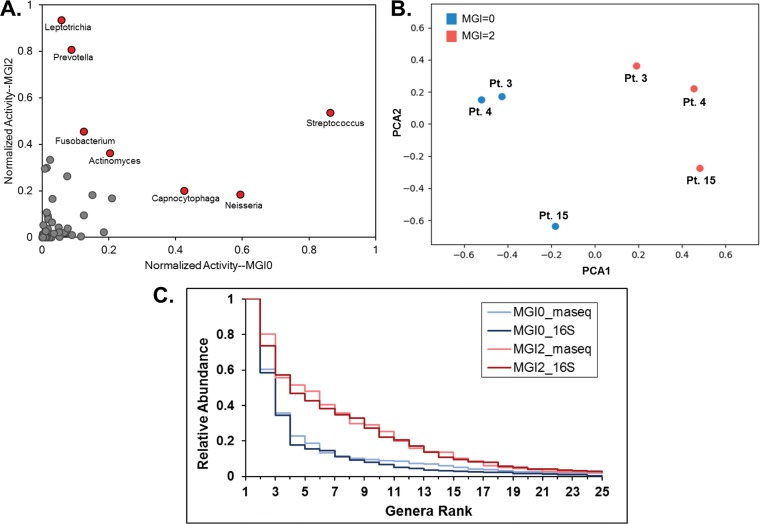
Over half of adults experience gingivitis, a mild yet treatable form of periodontal disease caused by the overgrowth of oral microbes. Left untreated, gingivitis can progress to a more severe and irreversible disease, most commonly chronic periodontitis. While periodontal diseases are associated with a shift in the oral microbiota composition, it remains unclear how this shift impacts microbiota function early in disease progression. Here, we analyzed the transition from health to gingivitis through both 16S v4-v5 rRNA amplicon and metatranscriptome sequencing of subgingival plaque samples from individuals undergoing an experimental gingivitis treatment. Beta-diversity analysis of 16S rRNA reveals that samples cluster based on disease severity and patient but not by oral hygiene status. Significant shifts in the abundance of several genera occurred during disease transition, suggesting a dysbiosis due to development of gingivitis. Comparing taxonomic abundance with transcriptomic activity revealed concordance of bacterial diversity composition between the two quantification assays in samples originating from both healthy and diseased teeth. Metatranscriptome sequencing analysis indicates that during the early stages of transition to gingivitis, a number of virulence-related transcripts were significantly differentially expressed in individual and across pooled patient samples. Upregulated genes include those involved in proteolytic and nucleolytic processes, while expression levels of those involved in surface structure assembly and other general virulence functions leading to colonization or adaptation within the host are more dynamic. These findings help characterize the transition from health to periodontal disease and identify genes associated with early disease. Although more than 50% of adults have some form of periodontal disease, there remains a significant gap in our understanding of its underlying cause. We initiated this study in order to better characterize the progression from oral health to disease. We first analyzed changes in the abundances of specific microorganisms in dental plaque collected from teeth during health and gingivitis, the mildest form of periodontal disease. We found that the clinical score of disease and patient from whom the sample originated but not tooth brushing are significantly correlated with microbial community composition. While a number of virulence-related gene transcripts are differentially expressed in gingivitis samples relative to health, not all are increased, suggesting that the overall activity of the microbiota is dynamic during disease transition. Better understanding of which microbes are present and their function during early periodontal disease can potentially lead to more targeted prophylactic approaches to prevent disease progression.
超过一半的成年人患有牙龈炎,这是一种由口腔微生物过度生长引起的轻度但可治疗的牙周病。如果不加以治疗,牙龈炎可能会发展为更严重和不可逆的疾病,最常见的是慢性牙周炎。虽然牙周病与口腔微生物群落组成的变化有关,但目前尚不清楚这种变化如何影响疾病早期进展过程中的微生物群落功能。在这里,我们通过对接受实验性牙龈炎治疗的个体的龈下菌斑样本进行 16S v4-v5 rRNA 扩增子和宏转录组测序,分析了从健康到牙龈炎的转变。16S rRNA 的β多样性分析表明,样本根据疾病严重程度和患者聚类,但与口腔卫生状况无关。在疾病转变过程中,几个属的丰度发生了显著变化,表明由于牙龈炎的发展而出现了菌群失调。将分类丰度与转录组活性进行比较,发现来自健康和患病牙齿的样本中,两种定量检测方法的细菌多样性组成具有一致性。宏转录组测序分析表明,在向牙龈炎转变的早期阶段,个体和 pooled 患者样本中的许多毒力相关转录本的表达水平显著不同。上调的基因包括参与蛋白水解和核水解过程的基因,而参与表面结构组装和其他导致定植或宿主内适应的一般毒力功能的基因表达水平则更为动态。这些发现有助于描述从健康到牙周病的转变,并确定与早期疾病相关的基因。尽管超过 50%的成年人患有某种形式的牙周病,但我们对其根本原因的理解仍存在重大差距。我们发起这项研究是为了更好地描述从口腔健康到疾病的进展。我们首先分析了从健康牙齿和牙龈炎(牙周病的最轻度形式)中收集的牙菌斑中特定微生物丰度的变化。我们发现,疾病的临床评分和样本来源的患者与牙刷牙刷显著相关,但与微生物群落组成无关。虽然与健康样本相比,牙龈炎样本中许多与毒力相关的基因转录本表达水平不同,但并非所有基因都上调,这表明在疾病转变过程中微生物群落的整体活性是动态的。更好地了解哪些微生物存在及其在早期牙周病中的功能可能会导致更有针对性的预防措施来阻止疾病的进展。