Department of Genetics and Microbiology, Faculty of Science, Charles University, Průmyslová 595, Vestec, CZ-25250, 128 44 Prague, Czech Republic.
Int J Mol Sci. 2018 Apr 17;19(4):1217. doi: 10.3390/ijms19041217.
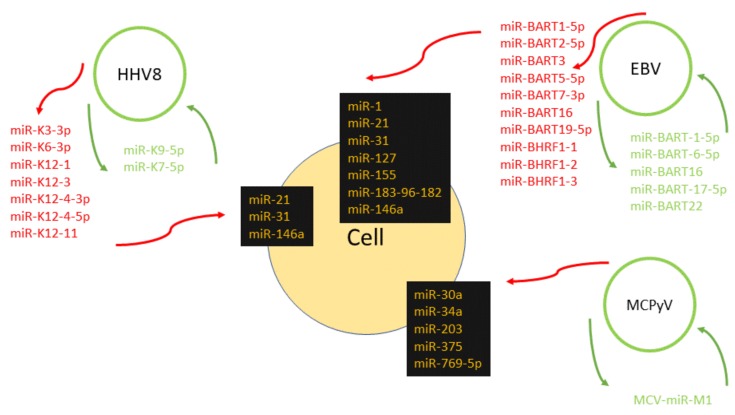
To date, viruses are reported to be responsible for more than 15% of all tumors worldwide. The oncogenesis could be influenced directly by the activity of viral oncoproteins or by the chronic infection or inflammation. The group of human oncoviruses includes Epstein–Barr virus (EBV), human papillomavirus (HPV), hepatitis B virus (HBV), hepatitis C virus (HCV), human herpesvirus 8 (HHV-8) or polyomaviruses, and transregulating retroviruses such as HIV or HTLV-1. Most of these viruses express short noncoding RNAs called miRNAs to regulate their own gene expression or to influence host gene expression and thus contribute to the carcinogenic processes. In this review, we will focus on oncogenic viruses and summarize the role of both types of miRNAs, viral as well as host’s, in the oncogenesis.
迄今为止,据报道病毒导致了全球超过 15%的所有肿瘤。致癌作用可能直接受到病毒致癌蛋白的活性影响,也可能受到慢性感染或炎症的影响。人类致癌病毒包括 Epstein–Barr 病毒(EBV)、人乳头瘤病毒(HPV)、乙型肝炎病毒(HBV)、丙型肝炎病毒(HCV)、人类疱疹病毒 8 型(HHV-8)或多瘤病毒,以及调节逆转录病毒如 HIV 或 HTLV-1。这些病毒中的大多数表达短的非编码 RNA 称为 miRNA,以调节自身基因表达或影响宿主基因表达,从而有助于致癌过程。在这篇综述中,我们将重点关注致癌病毒,并总结两种类型的 miRNA(病毒和宿主的)在致癌中的作用。