Liu Peng, Peng Liang, Zhang Haojun, Tang Patrick Ming-Kuen, Zhao Tingting, Yan Meihua, Zhao Hailing, Huang Xiaoru, Lan Huiyao, Li Ping
Beijing Key Lab Immune-Mediated Inflammatory Diseases, Institute of Clinical Medical Sciences, China-Japan Friendship Hospital, Beijing, China.
Graduate School of Peking Union Medical College, Chinese Academy of Medical Science & Peking Union Medical College, Beijing, China.
Front Physiol. 2018 Apr 6;9:343. doi: 10.3389/fphys.2018.00343. eCollection 2018.
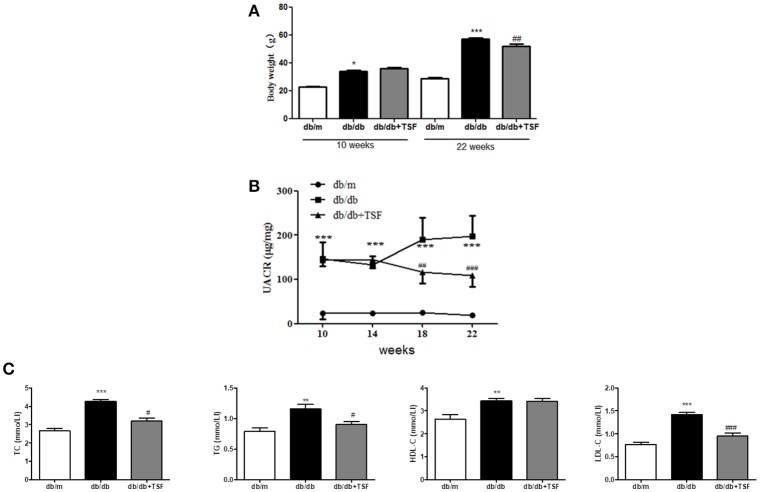
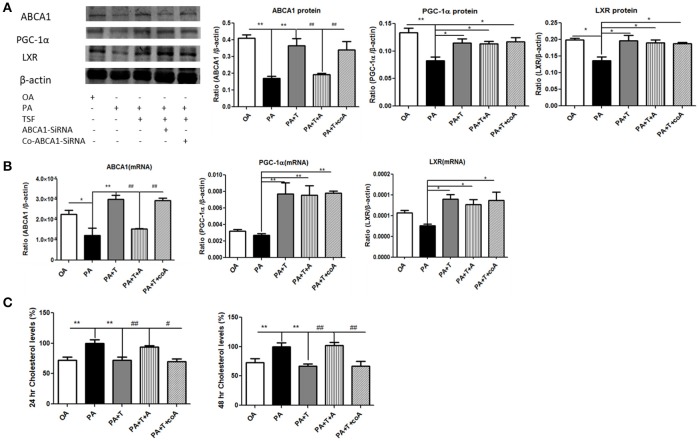
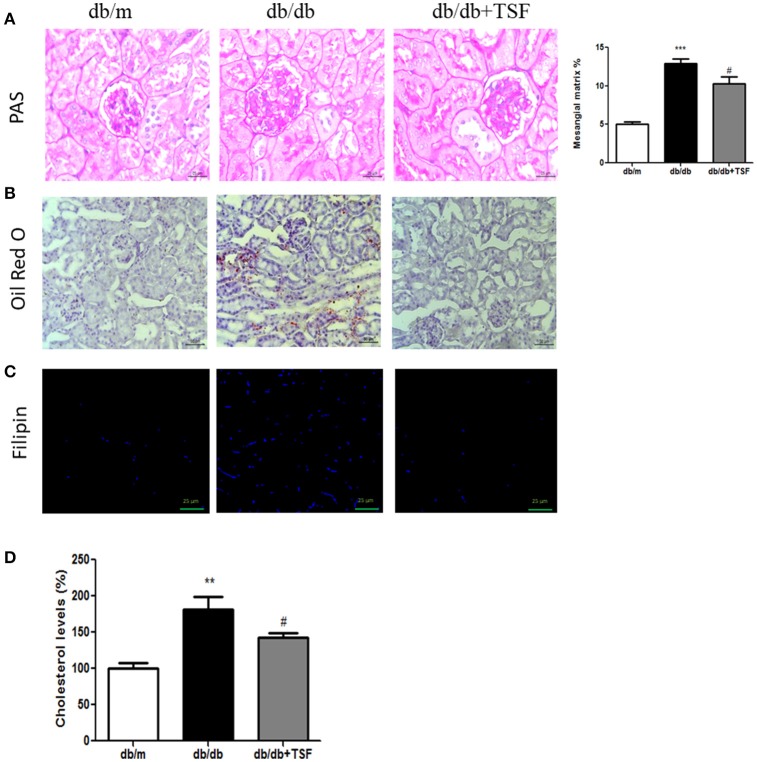
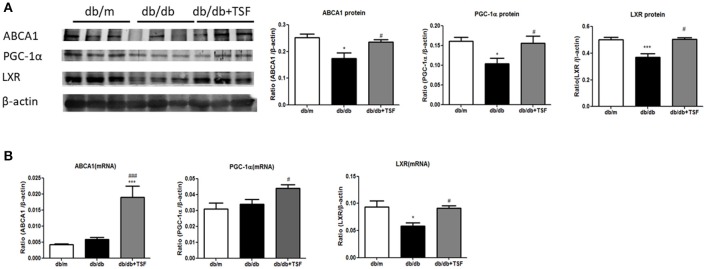
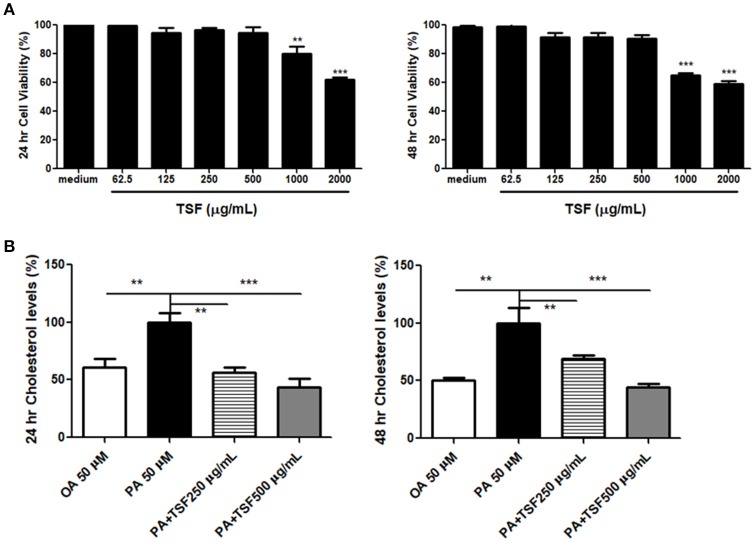
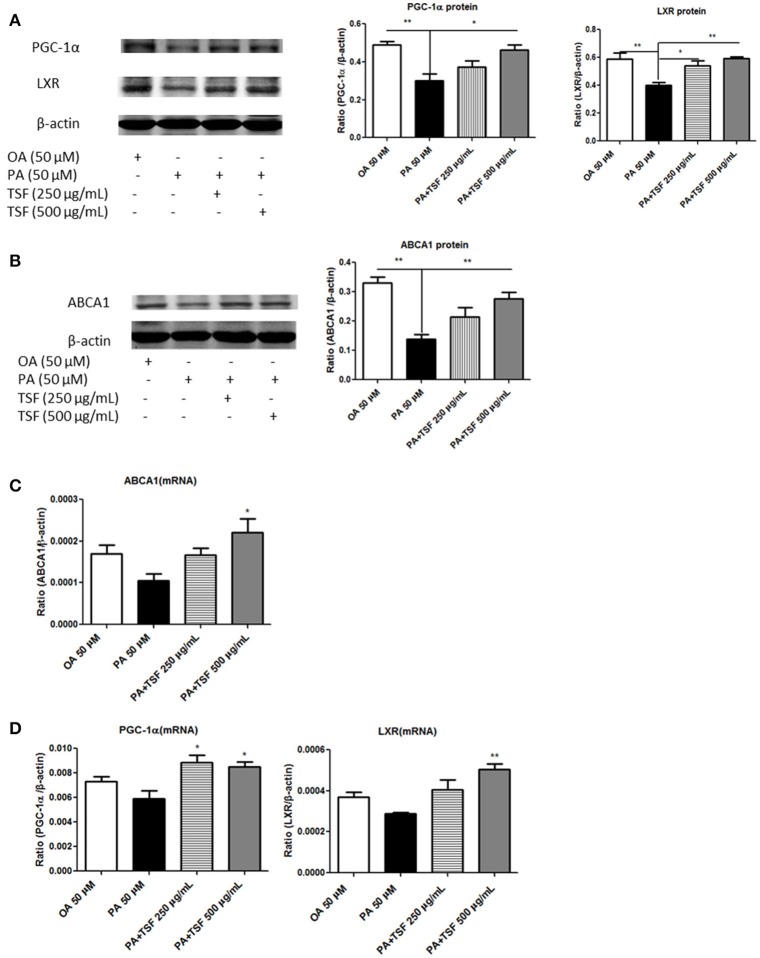
The commonly prescribed Tangshen Formula (TSF) is a traditional Chinese formulation that has been shown to reduce plasma lipid metabolism and proteinuria and improve the estimated glomerular filtration rate (eGFR) in patients with diabetic kidney disease. This study investigated the underlying mechanism whereby TSF regulates renal lipid accumulation and ameliorates diabetic renal injuries in spontaneous diabetic db/db mice and in sodium palmitate (PA)-stimulated and Abca1-SiRNA-transfected mouse tubular epithelial cells (mTECs). The results revealed that TSF treatment significantly ameliorated the renal injuries by lowering urinary albumin excretion and improving renal tissue injuries in diabetic (db/db) mice. Interestingly, the treatment with TSF also resulted in decreased cholesterol levels in the renal tissues of db/db mice, which was associated with increased expression of the peroxisome proliferator-activated receptor γ coactivator 1-α (PGC-1α), the Liver X receptors (LXR), and ATP-binding cassette subfamily A member 1 (ABCA1), suggesting that TSF might attenuate diabetic kidney injury via a mechanism associated with improving cholesterol efflux in the diabetic kidney. This was investigated in mTECs, and the results showed that TSF reduced the PA-stimulated cholesterol accumulation in mTECs. Mechanistically, the addition of TSF was capable of reversing PA-induced downregulation of PGC-1α, LXR, and ABCA1 expression and cholesterol accumulation in mTECs, suggesting that TSF might act the protection via the PGC-1α-LXR-ABCA1 pathway to improve the cholesterol efflux in the renal tissues of db/db mice. This was further confirmed by silencing ABCA1 to block the promotive effect of TSF on cholesterol efflux . In conclusion, TSF might ameliorate diabetic kidney injuries by promoting ABCA1-mediated renal cholesterol efflux.
常用的糖肾方(TSF)是一种传统中药配方,已被证明可降低糖尿病肾病患者的血脂代谢和蛋白尿,并提高估计肾小球滤过率(eGFR)。本研究探讨了TSF调节肾脂质蓄积并改善自发性糖尿病db/db小鼠以及棕榈酸钠(PA)刺激和Abca1 - SiRNA转染的小鼠肾小管上皮细胞(mTECs)中糖尿病肾损伤的潜在机制。结果显示,TSF治疗可通过降低糖尿病(db/db)小鼠的尿白蛋白排泄并改善肾组织损伤,显著减轻肾损伤。有趣的是,TSF治疗还导致db/db小鼠肾组织中的胆固醇水平降低,这与过氧化物酶体增殖物激活受体γ共激活因子1-α(PGC-1α)、肝脏X受体(LXR)和ATP结合盒亚家族A成员1(ABCA1)的表达增加有关,表明TSF可能通过与改善糖尿病肾中胆固醇流出相关的机制减轻糖尿病肾损伤。这在mTECs中进行了研究,结果表明TSF减少了PA刺激的mTECs中的胆固醇蓄积。机制上,添加TSF能够逆转PA诱导的mTECs中PGC-1α、LXR和ABCA1表达下调以及胆固醇蓄积,表明TSF可能通过PGC-1α-LXR-ABCA1途径发挥保护作用,以改善db/db小鼠肾组织中的胆固醇流出。通过沉默ABCA1以阻断TSF对胆固醇流出的促进作用进一步证实了这一点。总之,TSF可能通过促进ABCA1介导的肾胆固醇流出减轻糖尿病肾损伤。