Laboratory of Physiopharmacology, University of Antwerp, Antwerp, Belgium.
Department of Immunohistochemistry, HistoGeneX, Antwerp, Belgium.
Oxid Med Cell Longev. 2018 Feb 26;2018:7687083. doi: 10.1155/2018/7687083. eCollection 2018.
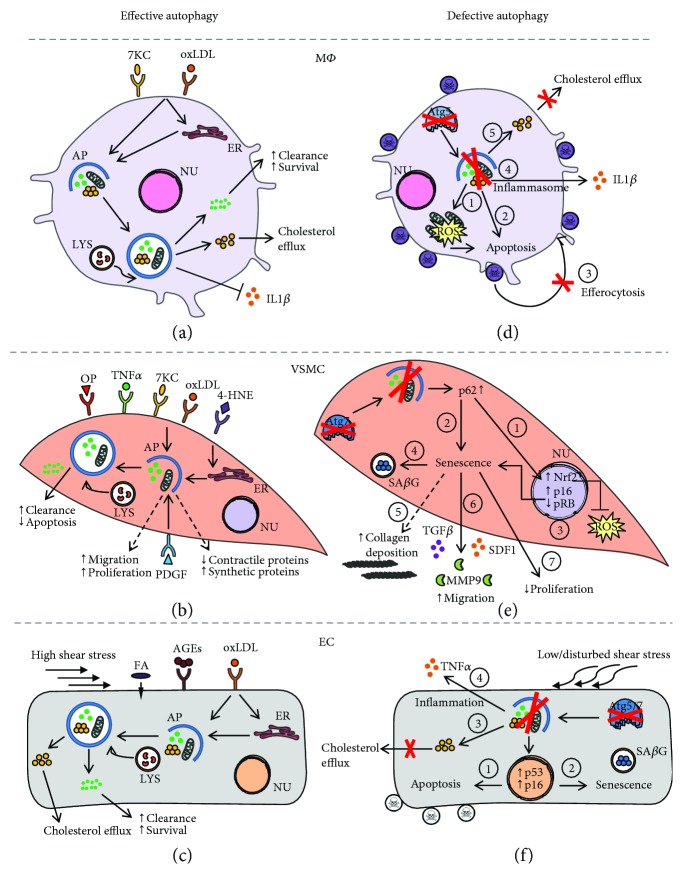
Autophagy is a subcellular process that plays an important role in the degradation of proteins and damaged organelles such as mitochondria (a process termed "mitophagy") via lysosomes. It is crucial for regulating protein and mitochondrial quality control and maintaining cellular homeostasis, whereas dysregulation of autophagy has been implicated in a wide range of diseases including atherosclerosis. Recent evidence has shown that the autophagic process becomes dysfunctional during the progression of atherosclerosis, regardless of whether there are many autophagy-stimulating factors (e.g., reactive oxygen species, oxidized lipids, and cytokines) present within the atherosclerotic plaque. This review highlights the recent insights into the causes and consequences of defective autophagy in atherosclerosis, with a special focus on the role of autophagy and mitophagy in plaque macrophages, vascular smooth muscle cells (VSMCs), and endothelial cells (ECs). It has been shown that defective autophagy can promote apoptosis in macrophages but that it accelerates premature senescence in VSMCs. In the ECs, defective autophagy promotes both apoptosis and senescence. We will discuss the discrepancy between these three cell types in their response to autophagy deficiency and underline the cell type-dependent role of autophagy, which may have important implications for the efficacy of autophagy-targeted treatments for atherosclerosis.
自噬是一种细胞内过程,通过溶酶体在降解蛋白质和受损的细胞器(如线粒体)(称为“线粒体自噬”)方面发挥着重要作用。它对于调节蛋白质和线粒体的质量控制以及维持细胞内稳态至关重要,而自噬的失调与包括动脉粥样硬化在内的广泛疾病有关。最近的证据表明,自噬过程在动脉粥样硬化的进展过程中变得功能失调,无论动脉粥样硬化斑块内是否存在许多自噬刺激因子(如活性氧、氧化脂质和细胞因子)。本综述强调了最近对动脉粥样硬化中自噬缺陷的原因和后果的深入了解,特别关注自噬和线粒体自噬在斑块巨噬细胞、血管平滑肌细胞(VSMCs)和内皮细胞(ECs)中的作用。已经表明,自噬缺陷可促进巨噬细胞中的细胞凋亡,但可加速 VSMCs 的过早衰老。在 ECs 中,自噬缺陷可促进细胞凋亡和衰老。我们将讨论这三种细胞类型对自噬缺陷反应的差异,并强调自噬的细胞类型依赖性作用,这可能对动脉粥样硬化的自噬靶向治疗的疗效具有重要意义。