Department of Computer Science, University of California, Irvine, CA 92697-3435, United States.
Department of Anatomy and Neurobiology, School of Medicine, University of California, Irvine, CA 92697-1275, United States; Department of Biomedical Engineering, University of California, Irvine, CA 92697-2715, United States; Department of Electrical Engineering and Computer Science, University of California, Irvine, CA 92697-2625, United States.
J Neurosci Methods. 2018 Aug 1;306:45-56. doi: 10.1016/j.jneumeth.2018.04.008. Epub 2018 Apr 22.
Brain mapping research in most neuroanatomical laboratories relies on conventional processing techniques, which often introduce histological artifacts such as tissue tears and tissue loss.
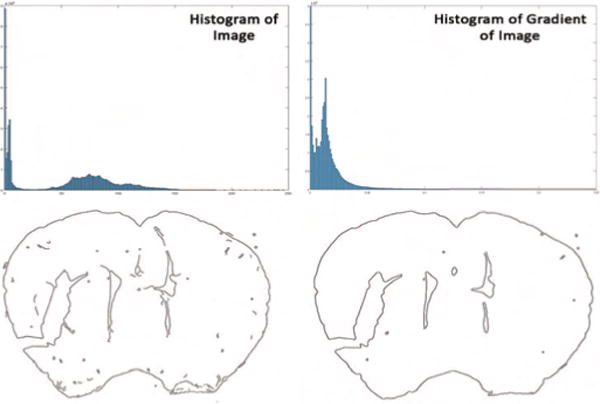
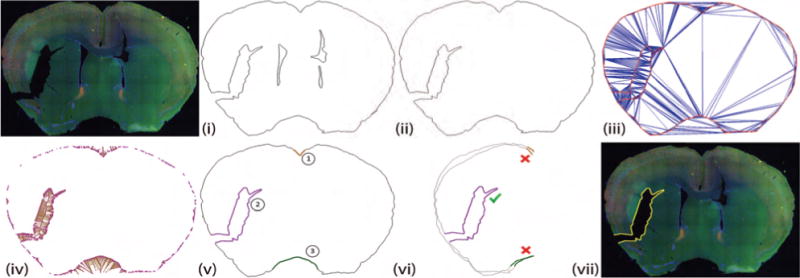
In this paper, we present techniques and algorithms for automatic registration and 3D reconstruction of conventionally produced mouse brain slices in a standardized atlas space. This is achieved first by constructing a virtual 3D mouse brain model from annotated slices of Allen Reference Atlas (ARA). Virtual re-slicing of the reconstructed model generates ARA-based slice images corresponding to the microscopic images of histological brain sections. These image pairs are aligned using a geometric approach through contour images. Histological artifacts in the microscopic images are detected and removed using Constrained Delaunay Triangulation before performing global alignment. Finally, non-linear registration is performed by solving Laplace's equation with Dirichlet boundary conditions.
Our methods provide significant improvements over previously reported registration techniques for the tested slices in 3D space, especially on slices with significant histological artifacts. Further, as one of the application we count the number of neurons in various anatomical regions using a dataset of 51 microscopic slices from a single mouse brain.
COMPARISON WITH EXISTING METHOD(S): To the best of our knowledge the presented work is the first that automatically registers both clean as well as highly damaged high-resolutions histological slices of mouse brain to a 3D annotated reference atlas space.
This work represents a significant contribution to this subfield of neuroscience as it provides tools to neuroanatomist for analyzing and processing histological data.
大多数神经解剖学实验室的脑图谱研究依赖于传统的处理技术,这些技术往往会引入组织撕裂和组织丢失等组织学伪影。
在本文中,我们提出了一种用于自动注册和以标准化图谱空间对常规制作的小鼠脑切片进行 3D 重建的技术和算法。这首先是通过从艾伦参考图谱(ARA)的注释切片构建虚拟 3D 小鼠脑模型来实现的。重建模型的虚拟重新切片生成与组织学脑切片的显微镜图像相对应的基于 ARA 的切片图像。通过轮廓图像使用几何方法对这些图像对进行对齐。在执行全局对齐之前,使用约束 Delaunay 三角剖分检测并去除显微镜图像中的组织学伪影。最后,通过求解具有狄利克雷边界条件的拉普拉斯方程来进行非线性注册。
我们的方法在 3D 空间中对测试切片的注册技术提供了显著的改进,尤其是在具有明显组织学伪影的切片上。此外,作为应用之一,我们使用来自单个小鼠大脑的 51 个微观切片数据集来计算各种解剖区域的神经元数量。
据我们所知,目前的工作是第一个自动将清洁和高度损坏的高分辨率组织学小鼠脑切片注册到 3D 注释参考图谱空间的工作。
这项工作代表了神经科学这一分支的重要贡献,因为它为神经解剖学家提供了分析和处理组织学数据的工具。