Developmental and Educational Psychology, Institute of Psychology, Leiden University, Leiden, The Netherlands.
Department of Psychiatry, Leiden University Medical Center, Leiden, The Netherlands.
Int J Methods Psychiatr Res. 2018 Jun;27(2):e1616. doi: 10.1002/mpr.1616. Epub 2018 Apr 26.
Social anxiety disorder (SAD) is a serious and prevalent psychiatric condition, with a heritable component. However, little is known about the characteristics that are associated with the genetic component of SAD, the so-called "endophenotypes". These endophenotypes could advance our insight in the genetic susceptibility to SAD, as they are on the pathway from genotype to phenotype. The Leiden Family Lab study on Social Anxiety Disorder (LFLSAD) is the first multiplex, multigenerational study aimed to identify neurocognitive endophenotypes of social anxiety.
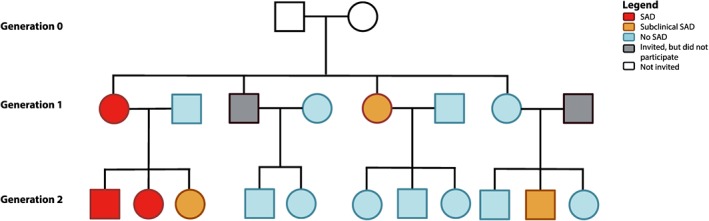
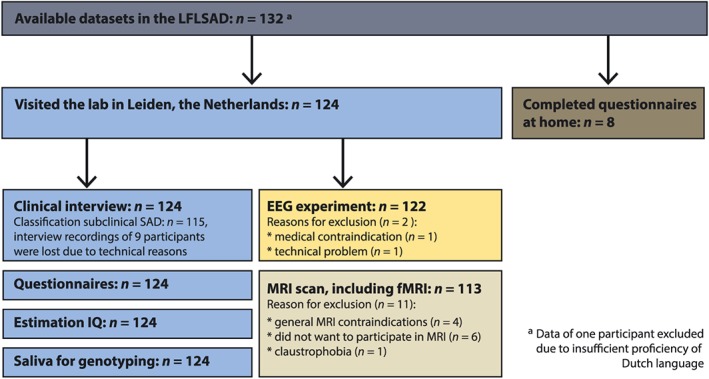
The LFLSAD is characterized by a multidisciplinary approach and encompasses a variety of measurements, including a clinical interview, functional and structural magnetic resonance imaging and an electroencephalography experiment. Participants are family members from 2 generations, from families genetically enriched for SAD.
The sample (n = 132 participants, from 9 families) was characterized by a high prevalence of SAD, in both generations (prevalence (sub)clinical SAD: 38.3%). Furthermore, (sub)clinical SAD was positively related to self-reported social anxiety, fear of negative evaluation, trait anxiety, behavioral inhibition, negative affect, and the level of depressive symptoms.
By the multidimensional character of the measurements and thorough characterization of the sample, the LFLSAD offers unique opportunities to investigate candidate neurocognitive endophenotypes of SAD.
社交焦虑障碍(SAD)是一种严重且普遍的精神疾病,具有遗传成分。然而,人们对与 SAD 的遗传成分相关的特征(即所谓的“内表型”)知之甚少。这些内表型可以增进我们对 SAD 遗传易感性的了解,因为它们是从基因型到表型的途径。莱顿社交焦虑障碍家族实验室研究(LFLSAD)是首个旨在确定社交焦虑神经认知内表型的多基因、多代研究。
LFLSAD 的特点是采用多学科方法,包括各种测量方法,包括临床访谈、功能和结构磁共振成像以及脑电图实验。参与者来自 2 代的家庭成员,来自遗传上 SAD 丰富的家庭。
该样本(n=132 名参与者,来自 9 个家庭)的特点是两代人中 SAD 的高患病率((亚)临床 SAD 患病率:38.3%)。此外,(亚)临床 SAD 与自我报告的社交焦虑、对负面评价的恐惧、特质焦虑、行为抑制、负性情绪和抑郁症状水平呈正相关。
通过测量的多维特征和样本的全面特征,LFLSAD 为研究 SAD 的候选神经认知内表型提供了独特的机会。