Department of Epidemiology & Biostatistics, College of Human Medicine, Michigan State University, West Fee Hall, 909 Fee Road, East Lansing, MI 48824, United States.
Drug Alcohol Depend. 2018 Jun 1;187:351-357. doi: 10.1016/j.drugalcdep.2018.03.012. Epub 2018 Apr 15.
A prevailing epidemiological theory about drug use occurrence among secondary school students is that trends in perceived risk of drug-related harms can drive use. If so, cannabis risk perceptions during one school year should predict newly incident cannabis use in the same school the following year. We aimed to study trends in incidence and epidemiological clustering of cannabis use among United States (US) 12th-graders, and a novel prediction that incidence in school-year 't' is influenced by school-specific cannabis risk perceptions (CRP) of 12th-graders a year prior at 't-1'.
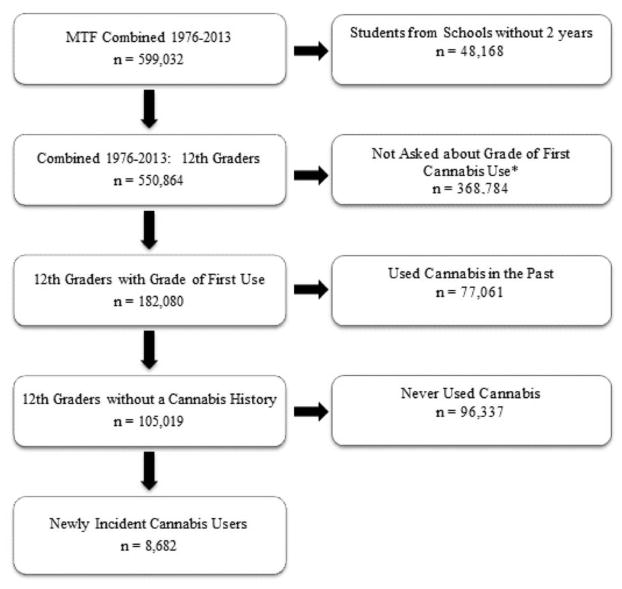
US schools sampled each year from 1976 to 2013 (∼130 schools per year) yielded an annual nationally representative sample of ∼15-16,000 12th-graders with questionnaire assessments. Analyses involved Alternating Logistic Regressions (ALR) to study trends in school-level clustering and slopes that estimate the degree to which CRP levels at 't-1' might predict newly incident cannabis use at 't'.
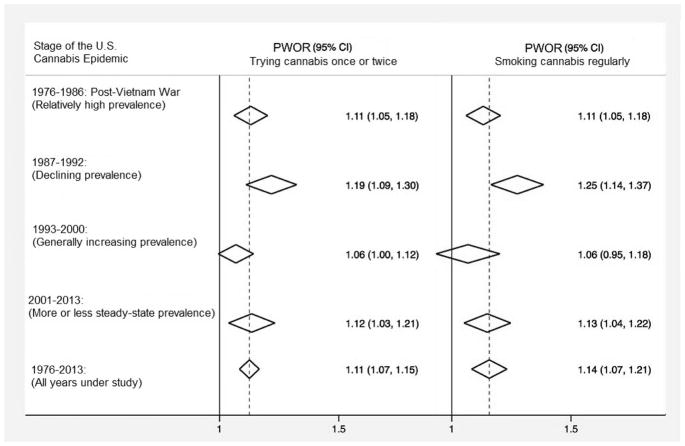
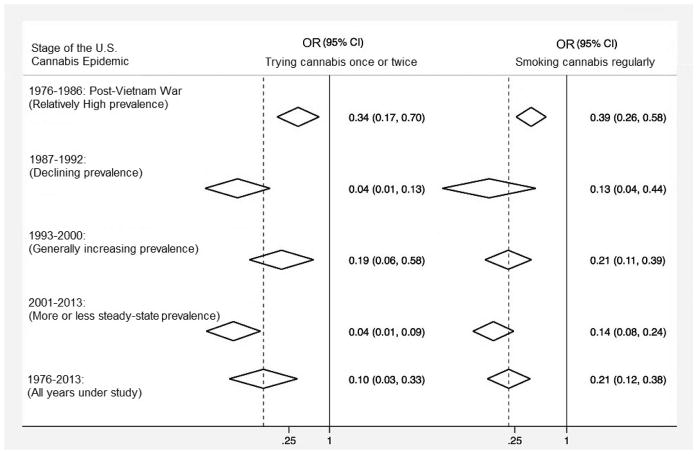
School-level CRP levels at 't-1' predict newly incident cannabis use in the next year's 12th-grade class. For each unit CRP increment, the next year's class shows tangibly reduced incidence of starting to use cannabis (overall odds ratio, OR = 0.10; 95% CI: 0.03, 0.33). Within-school clustering of newly incident cannabis smoking also can be seen (e.g., pairwise odds ratio, PWOR = 1.11; 95% CI: 1.07, 1.15).
Programmatic manipulation of perceived risk in one year's senior class via public health/school alliances might dampen the subsequent risk of newly incident cannabis use in the next year's class.
关于中学生药物使用发生的一种流行的流行病学理论是,与药物相关的危害感知风险趋势可以推动使用。如果是这样,那么一学年内的大麻风险感知应该可以预测次年同一所学校中新增的大麻使用情况。我们旨在研究美国(美国) 12 年级学生大麻使用的发生率和流行病学聚集趋势,以及一个新的预测,即在“ t-1”年,12 年级学生的特定学校大麻风险感知(CRP)对“ t”学年的发生率的影响。
从 1976 年到 2013 年,美国学校每年进行抽样(每年约有 130 所学校),得出了一个每年在全国具有代表性的约 15,000 名 12 年级学生的样本,这些学生接受了问卷调查。分析涉及交替逻辑回归(ALR),以研究学校层面聚类和斜率的趋势,这些趋势可以估计“ t-1”时的 CRP 水平对“ t”时新出现的大麻使用的预测程度。
“ t-1”时的学校层面 CRP 水平可预测次年 12 年级新生的大麻使用情况。CRP 每增加一个单位,下一年的班级开始使用大麻的发生率明显降低(总体优势比,OR = 0.10;95%CI:0.03,0.33)。也可以看到新出现的大麻吸烟的校内聚类现象(例如,成对优势比,PWOR = 1.11;95%CI:1.07,1.15)。
通过公共卫生/学校联盟,在一年内对高年级学生进行感知风险的计划性操纵,可能会减轻下一年新出现的大麻使用风险。