Department Biology II, Division of Neurobiology, Ludwig-Maximilians-Universitaet Munich, Planegg-Martinsried, D-82152, Germany.
Graduate School of Systemic Neurosciences, Ludwig-Maximilians-Universitaet Munich, Planegg-Martinsried, D-82152, Germany.
Nat Commun. 2018 May 2;9(1):1771. doi: 10.1038/s41467-018-04210-y.
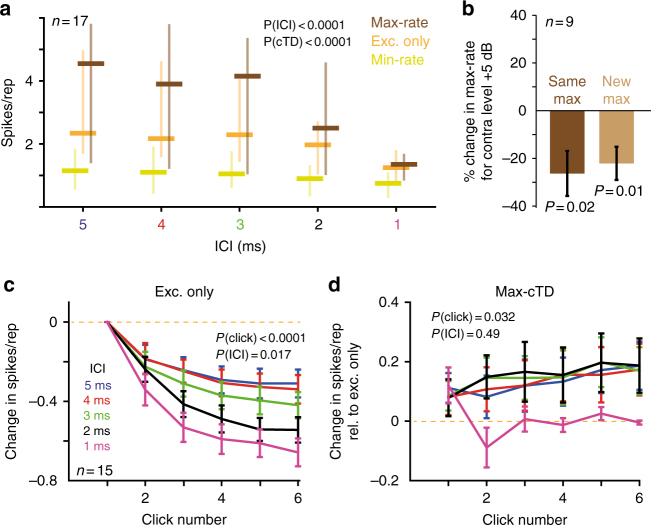
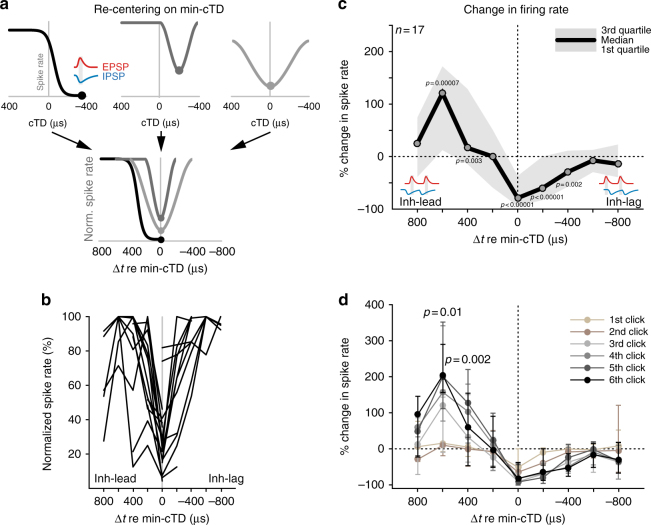
The integration of excitatory and inhibitory synaptic inputs is fundamental to neuronal processing. In the mammalian auditory brainstem, neurons compare excitatory and inhibitory inputs from the ipsilateral and contralateral ear, respectively, for sound localization. However, the temporal precision and functional roles of inhibition in this integration process are unclear. Here, we demonstrate by in vivo recordings from the lateral superior olive (LSO) that inhibition controls spiking with microsecond precision throughout high frequency click trains. Depending on the relative timing of excitation and inhibition, neuronal spike probability is either suppressed or-unexpectedly-facilitated. In vitro conductance-clamp LSO recordings establish that a reduction in the voltage threshold for spike initiation due to a prior hyperpolarization results in post-inhibitory facilitation of otherwise sub-threshold synaptic events. Thus, microsecond-precise differences in the arrival of inhibition relative to excitation can facilitate spiking in the LSO, thereby promoting spatial sensitivity during the processing of faint sounds.
兴奋性和抑制性突触输入的整合是神经元处理的基础。在哺乳动物的听觉脑干中,神经元分别比较来自同侧和对侧耳的兴奋性和抑制性输入,以进行声音定位。然而,在这个整合过程中,抑制作用的时间精度和功能作用尚不清楚。在这里,我们通过对外侧上橄榄核(LSO)的活体记录证明,抑制作用以微秒精度控制高频点击序列中的尖峰发放。根据兴奋和抑制的相对时间,神经元的尖峰发放概率要么被抑制,要么出乎意料地被促进。在体外电导率钳 LSO 记录中,由于先前的超极化导致的起始尖峰的电压阈值降低,导致在其他情况下低于阈值的突触事件的后抑制促进。因此,与兴奋性输入相比,抑制作用的到达时间的微秒级差异可以促进 LSO 中的尖峰发放,从而在处理微弱声音时提高空间灵敏度。