Modi Tapan G, Chalishazar Monali, Kumar Malay
Department of Oral Pathology and Microbiology, College of Dental Science and Research Centre, Gujarat University, Ahmedabad, Gujarat, India.
Department of Oral Pathology and Microbiology, Ahmedabad Dental College and Hospital, Gujarat University, Ahmedabad, Gujarat, India.
J Oral Maxillofac Pathol. 2018 Jan-Apr;22(1):146. doi: 10.4103/jomfp.JOMFP_94_16.
Odontogenic cysts are the most common cysts of the jaws and are formed from the remnants of the odontogenic apparatus. Among these odontogenic cysts, radicular cysts (RCs) (about 60% of all diagnosed jaw cysts), dentigerous cysts (DCs) (16.6% of all jaw cysts) and odontogenic keratocysts (OKCs) (11.2% of all developmental odontogenic cysts) are the most common. The behavior of any lesion is generally reflected by its growth potential. Growth potential is determined by measuring the cell proliferative activity. The cell proliferative activity is measured by various methods among which immunohistochemistry (IHC) is the commonly used technique. Most of the IHC studies on cell proliferation have been based on antibodies such as Ki-67 and proliferating cell nuclear antigen.
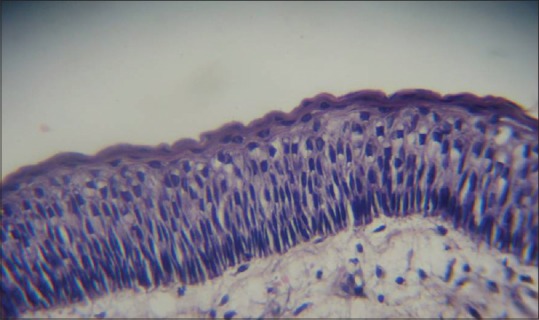
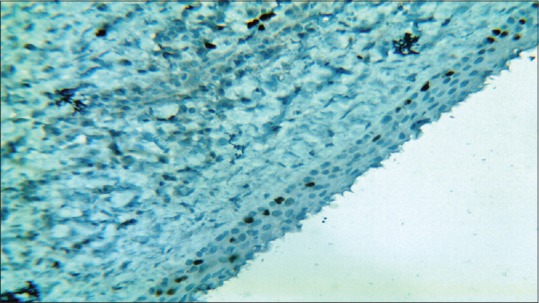
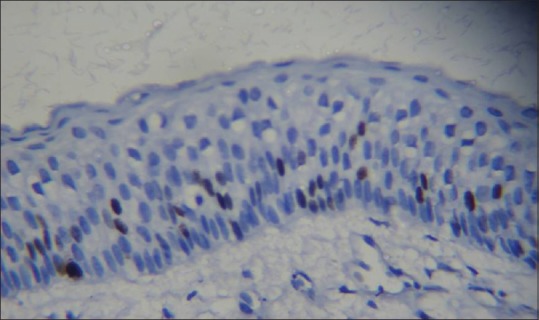
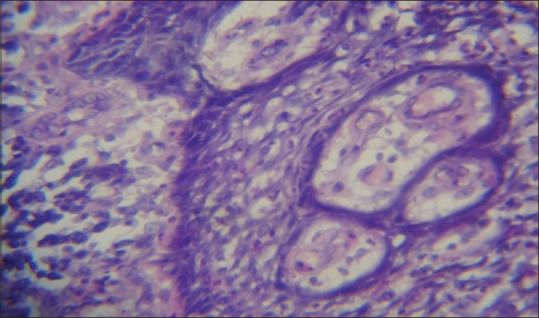
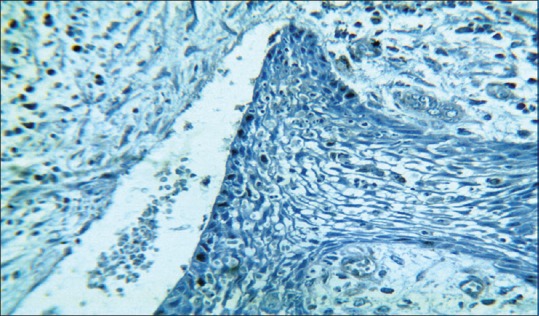
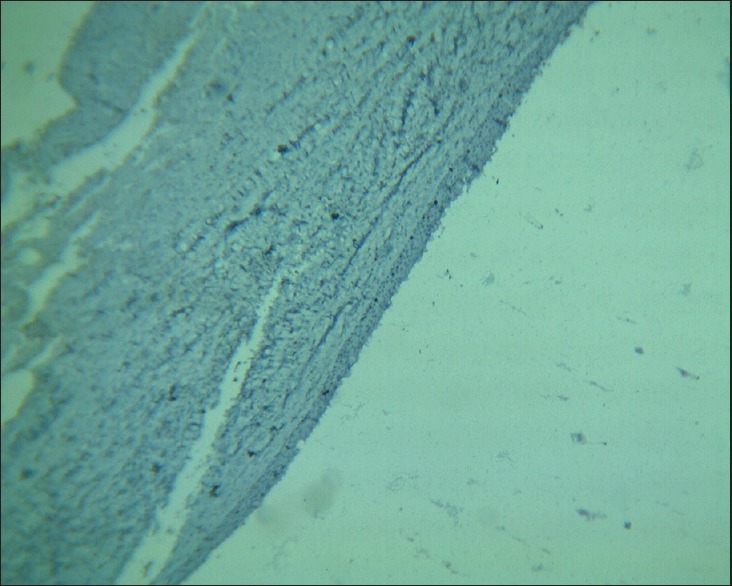
In the present study, the total sample size comprised of 45 cases of odontogenic cysts, with 15 cases each of OKC, RC and DC. Here, an attempt is made to study immunohistochemical (streptavidin-biotin detection system HRP-DAB) method to assess the expression of Ki-67 in different layers of the epithelial lining of OKCs, RCs and DCs.
Ki-67 positive cells were highest in epithelium of OKC as compared to DC and RC.
The increased Ki-67 labeling index and its expression in suprabasal cell layers of epithelial lining in OKC and its correlation with suprabasal cell layers of epithelial lining in DC and RC could contribute toward its clinically aggressive behavior. OKC is of more significance to the oral pathologist and oral surgeon because of its specific histopathological features, high recurrence rate and aggressive behavior.
牙源性囊肿是颌骨最常见的囊肿,由牙源性器官的残余物形成。在这些牙源性囊肿中,根尖囊肿(RCs)(约占所有诊断出的颌骨囊肿的60%)、含牙囊肿(DCs)(占所有颌骨囊肿的16.6%)和牙源性角化囊肿(OKCs)(占所有发育性牙源性囊肿的11.2%)最为常见。任何病变的行为通常由其生长潜能反映。生长潜能通过测量细胞增殖活性来确定。细胞增殖活性通过多种方法测量,其中免疫组织化学(IHC)是常用技术。大多数关于细胞增殖的免疫组织化学研究都基于诸如Ki-67和增殖细胞核抗原等抗体。
在本研究中,总样本量包括45例牙源性囊肿,其中OKC、RC和DC各15例。在此,尝试采用免疫组织化学(链霉亲和素-生物素检测系统HRP-DAB)方法评估Ki-67在OKC、RC和DC上皮衬里不同层中的表达。
与DC和RC相比,OKC上皮中的Ki-67阳性细胞最多。
OKC中Ki-67标记指数增加及其在上皮衬里基底上层细胞层中的表达,以及它与DC和RC上皮衬里基底上层细胞层的相关性,可能导致其临床侵袭性行为。由于其特定的组织病理学特征、高复发率和侵袭性行为,OKC对口腔病理学家和口腔外科医生具有更大的意义。