• 文献检索
  • 文档翻译
  • 深度研究
  • 学术资讯
  • Suppr Zotero 插件Zotero 插件
  • 邀请有礼
  • 套餐&价格
  • 历史记录
应用&插件
Suppr Zotero 插件Zotero 插件浏览器插件Mac 客户端Windows 客户端微信小程序
定价
高级版会员购买积分包购买API积分包
服务
文献检索文档翻译深度研究API 文档MCP 服务
关于我们
关于 Suppr公司介绍联系我们用户协议隐私条款
关注我们

Suppr 超能文献

核心技术专利:CN118964589B侵权必究
粤ICP备2023148730 号-1Suppr @ 2026

文献检索

告别复杂PubMed语法,用中文像聊天一样搜索,搜遍4000万医学文献。AI智能推荐,让科研检索更轻松。

立即免费搜索

文件翻译

保留排版,准确专业,支持PDF/Word/PPT等文件格式,支持 12+语言互译。

免费翻译文档

深度研究

AI帮你快速写综述,25分钟生成高质量综述,智能提取关键信息,辅助科研写作。

立即免费体验

开发和评估用于预测蛋白质-配体结合亲和力的深度学习模型。

Development and evaluation of a deep learning model for protein-ligand binding affinity prediction.

机构信息

Institute of Biochemistry and Biophysics, Polish Academy of Sciences, Warsaw, Poland.

Department of Systems Biology, Institute of Experimental Plant Biology and Biotechnology, University of Warsaw, Warsaw, Poland.

出版信息

Bioinformatics. 2018 Nov 1;34(21):3666-3674. doi: 10.1093/bioinformatics/bty374.

DOI:10.1093/bioinformatics/bty374
PMID:29757353
原文链接:https://pmc.ncbi.nlm.nih.gov/articles/PMC6198856/
Abstract

MOTIVATION

Structure based ligand discovery is one of the most successful approaches for augmenting the drug discovery process. Currently, there is a notable shift towards machine learning (ML) methodologies to aid such procedures. Deep learning has recently gained considerable attention as it allows the model to 'learn' to extract features that are relevant for the task at hand.

RESULTS

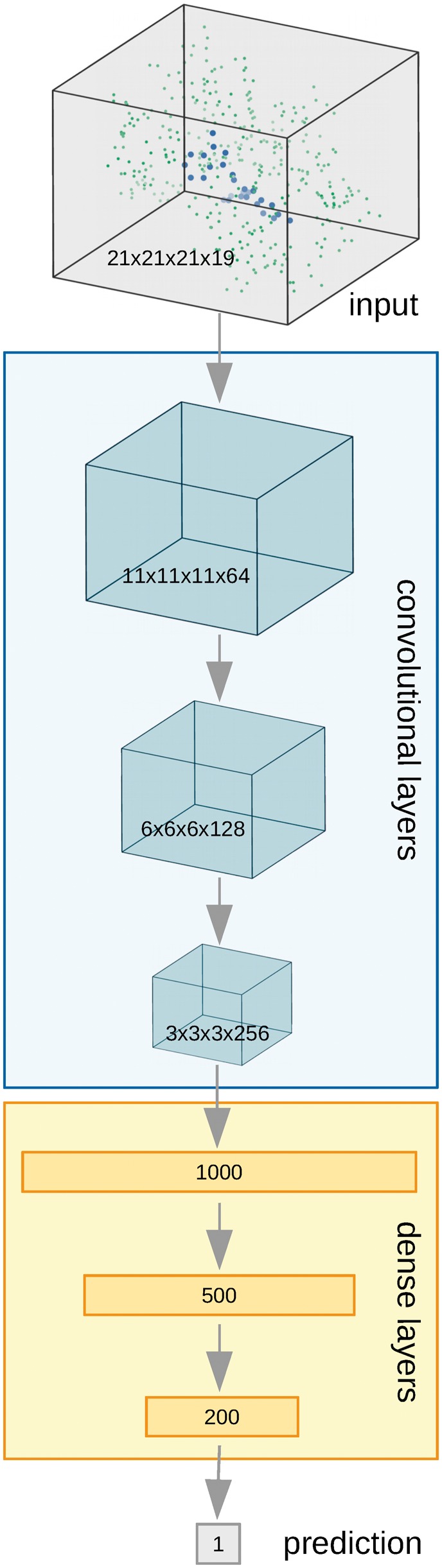
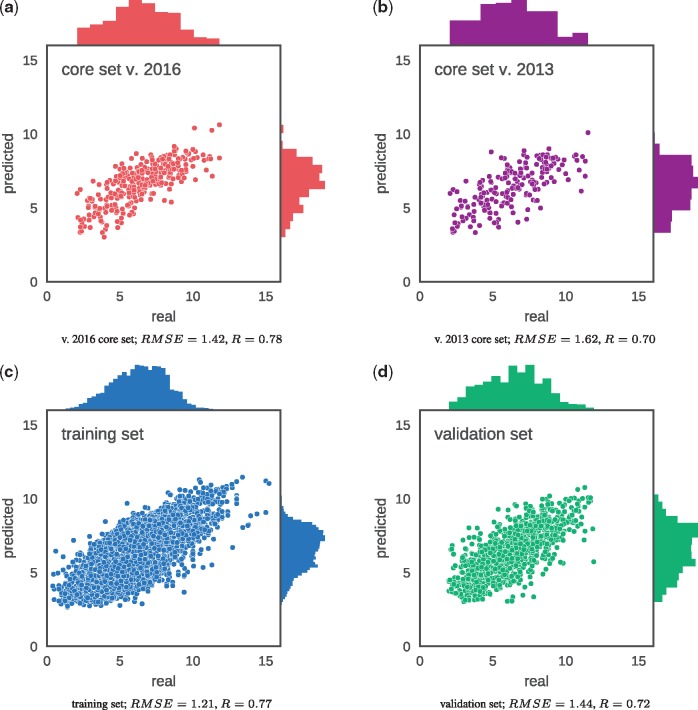
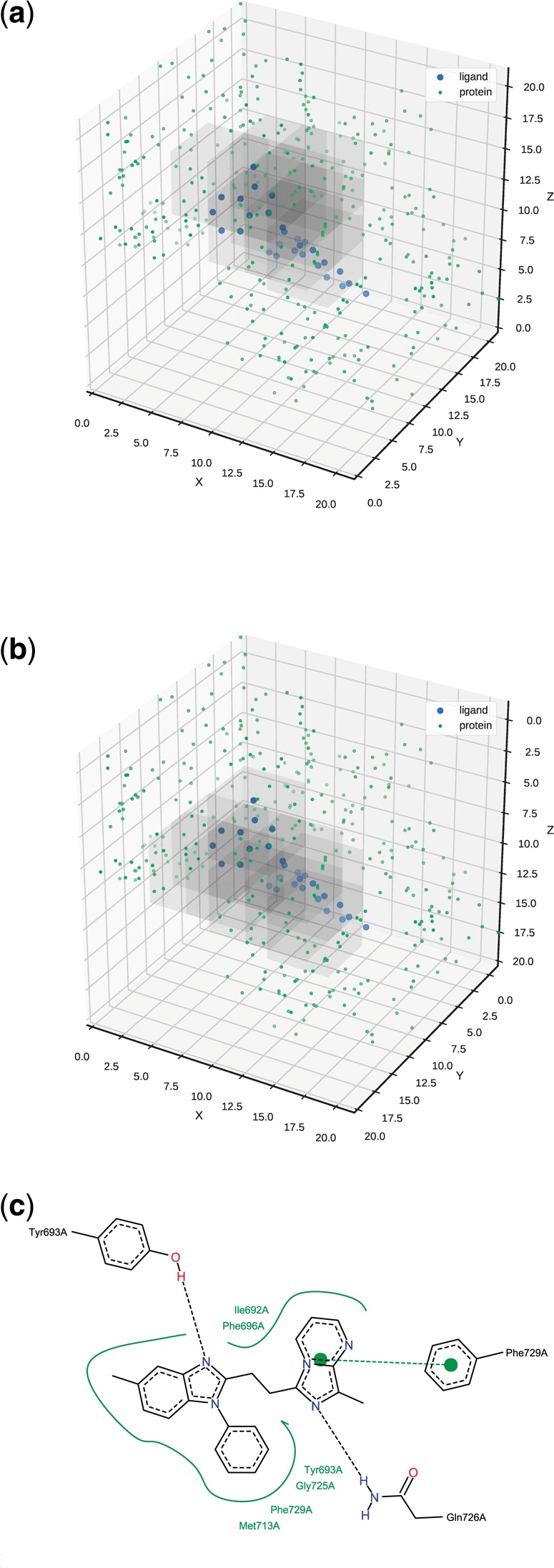
We have developed a novel deep neural network estimating the binding affinity of ligand-receptor complexes. The complex is represented with a 3D grid, and the model utilizes a 3D convolution to produce a feature map of this representation, treating the atoms of both proteins and ligands in the same manner. Our network was tested on the CASF-2013 'scoring power' benchmark and Astex Diverse Set and outperformed classical scoring functions.

AVAILABILITY AND IMPLEMENTATION

The model, together with usage instructions and examples, is available as a git repository at http://gitlab.com/cheminfIBB/pafnucy.

SUPPLEMENTARY INFORMATION

Supplementary data are available at Bioinformatics online.

摘要

动机

基于结构的配体发现是增强药物发现过程最成功的方法之一。目前,机器学习 (ML) 方法在辅助这些过程方面有明显的转变。深度学习最近引起了相当大的关注,因为它允许模型“学习”提取与手头任务相关的特征。

结果

我们开发了一种新的深度神经网络,用于估计配体-受体复合物的结合亲和力。复合物用 3D 网格表示,模型利用 3D 卷积来生成此表示的特征图,以相同的方式对待蛋白质和配体的原子。我们的网络在 CASF-2013“评分能力”基准和 Astex 多样集上进行了测试,性能优于经典评分函数。

可用性和实现

该模型以及使用说明和示例可作为 git 存储库在 http://gitlab.com/cheminfIBB/pafnucy 上获得。

补充信息

补充数据可在 Bioinformatics 在线获得。

https://cdn.ncbi.nlm.nih.gov/pmc/blobs/1f74/6198856/04908f212bbf/bty374f5.jpg
https://cdn.ncbi.nlm.nih.gov/pmc/blobs/1f74/6198856/5e931ab03803/bty374f1.jpg
https://cdn.ncbi.nlm.nih.gov/pmc/blobs/1f74/6198856/137e91cb7a33/bty374f2.jpg
https://cdn.ncbi.nlm.nih.gov/pmc/blobs/1f74/6198856/4002834e8666/bty374f3.jpg
https://cdn.ncbi.nlm.nih.gov/pmc/blobs/1f74/6198856/1ff2a168fa92/bty374f4.jpg
https://cdn.ncbi.nlm.nih.gov/pmc/blobs/1f74/6198856/04908f212bbf/bty374f5.jpg
https://cdn.ncbi.nlm.nih.gov/pmc/blobs/1f74/6198856/5e931ab03803/bty374f1.jpg
https://cdn.ncbi.nlm.nih.gov/pmc/blobs/1f74/6198856/137e91cb7a33/bty374f2.jpg
https://cdn.ncbi.nlm.nih.gov/pmc/blobs/1f74/6198856/4002834e8666/bty374f3.jpg
https://cdn.ncbi.nlm.nih.gov/pmc/blobs/1f74/6198856/1ff2a168fa92/bty374f4.jpg
https://cdn.ncbi.nlm.nih.gov/pmc/blobs/1f74/6198856/04908f212bbf/bty374f5.jpg

相似文献

1
Development and evaluation of a deep learning model for protein-ligand binding affinity prediction.开发和评估用于预测蛋白质-配体结合亲和力的深度学习模型。
Bioinformatics. 2018 Nov 1;34(21):3666-3674. doi: 10.1093/bioinformatics/bty374.
2
Learning from the ligand: using ligand-based features to improve binding affinity prediction.从配体中学习:利用基于配体的特征来提高结合亲和力预测。
Bioinformatics. 2020 Feb 1;36(3):758-764. doi: 10.1093/bioinformatics/btz665.
3
Sfcnn: a novel scoring function based on 3D convolutional neural network for accurate and stable protein-ligand affinity prediction.Sfcnn:一种基于 3D 卷积神经网络的新型评分函数,用于准确稳定的蛋白质-配体亲和力预测。
BMC Bioinformatics. 2022 Jun 8;23(1):222. doi: 10.1186/s12859-022-04762-3.
4
Extended connectivity interaction features: improving binding affinity prediction through chemical description.扩展连接相互作用特征:通过化学描述提高结合亲和力预测。
Bioinformatics. 2021 Jun 16;37(10):1376-1382. doi: 10.1093/bioinformatics/btaa982.
5
Improving detection of protein-ligand binding sites with 3D segmentation.利用 3D 分割提高蛋白配体结合位点检测。
Sci Rep. 2020 Mar 19;10(1):5035. doi: 10.1038/s41598-020-61860-z.
6
Predicting protein-ligand binding residues with deep convolutional neural networks.使用深度卷积神经网络预测蛋白质-配体结合残基。
BMC Bioinformatics. 2019 Feb 26;20(1):93. doi: 10.1186/s12859-019-2672-1.
7
GB-score: Minimally designed machine learning scoring function based on distance-weighted interatomic contact features.GB评分:基于距离加权原子间接触特征的最小化设计机器学习评分函数。
Mol Inform. 2023 Mar;42(3):e2200135. doi: 10.1002/minf.202200135. Epub 2023 Feb 1.
8
Binding affinity prediction for protein-ligand complex using deep attention mechanism based on intermolecular interactions.基于分子间相互作用的深度学习注意力机制的蛋白-配体复合物结合亲和力预测。
BMC Bioinformatics. 2021 Nov 8;22(1):542. doi: 10.1186/s12859-021-04466-0.
9
Protein-ligand binding affinity prediction model based on graph attention network.基于图注意力网络的蛋白质配体结合亲和力预测模型。
Math Biosci Eng. 2021 Oct 25;18(6):9148-9162. doi: 10.3934/mbe.2021451.
10
Compound-protein interaction prediction with end-to-end learning of neural networks for graphs and sequences.基于图和序列神经网络端到端学习的化合物-蛋白质相互作用预测。
Bioinformatics. 2019 Jan 15;35(2):309-318. doi: 10.1093/bioinformatics/bty535.

引用本文的文献

1
Spatio-temporal learning from molecular dynamics simulations for protein-ligand binding affinity prediction.基于分子动力学模拟的时空学习用于蛋白质-配体结合亲和力预测。
Bioinformatics. 2025 Aug 2;41(8). doi: 10.1093/bioinformatics/btaf429.
2
Multiscale topology-enabled structure-to-sequence transformer for protein-ligand interaction predictions.用于蛋白质-配体相互作用预测的多尺度拓扑结构到序列变压器
Nat Mach Intell. 2024 Jul;6(7):799-810. doi: 10.1038/s42256-024-00855-1. Epub 2024 Jun 21.
3
Comparative Analysis of Quantum-Mechanical and Standard Single-Structure Protein-Ligand Scoring Functions with MD-Based Free Energy Calculations.

本文引用的文献

1
Automatic Chemical Design Using a Data-Driven Continuous Representation of Molecules.使用数据驱动的分子连续表示法进行自动化学设计。
ACS Cent Sci. 2018 Feb 28;4(2):268-276. doi: 10.1021/acscentsci.7b00572. Epub 2018 Jan 12.
2
Generating Focused Molecule Libraries for Drug Discovery with Recurrent Neural Networks.使用递归神经网络生成用于药物发现的聚焦分子库。
ACS Cent Sci. 2018 Jan 24;4(1):120-131. doi: 10.1021/acscentsci.7b00512. Epub 2017 Dec 28.
3
Beyond the hype: deep neural networks outperform established methods using a ChEMBL bioactivity benchmark set.
基于分子动力学的自由能计算对量子力学和标准单结构蛋白质-配体评分函数的比较分析
J Chem Inf Model. 2025 Aug 11;65(15):8127-8136. doi: 10.1021/acs.jcim.5c00604. Epub 2025 Jul 19.
4
ColdstartCPI: Induced-fit theory-guided DTI predictive model with improved generalization performance.ColdstartCPI:基于诱导契合理论指导的具有改进泛化性能的DTI预测模型。
Nat Commun. 2025 Jul 11;16(1):6436. doi: 10.1038/s41467-025-61745-7.
5
Predicting Affinity Through Homology (PATH): Interpretable binding affinity prediction with persistent homology.通过同源性预测亲和力(PATH):利用持久同源性进行可解释的结合亲和力预测。
PLoS Comput Biol. 2025 Jun 27;21(6):e1013216. doi: 10.1371/journal.pcbi.1013216. eCollection 2025 Jun.
6
PLAIG: Protein-Ligand Binding Affinity Prediction Using a Novel Interaction-Based Graph Neural Network Framework.PLAIG:使用基于新型相互作用的图神经网络框架进行蛋白质-配体结合亲和力预测。
ACS Bio Med Chem Au. 2025 Apr 29;5(3):447-463. doi: 10.1021/acsbiomedchemau.5c00053. eCollection 2025 Jun 18.
7
DynamicDTA: Drug-Target Binding Affinity Prediction Using Dynamic Descriptors and Graph Representation.动态DTA:使用动态描述符和图形表示法预测药物-靶点结合亲和力
Interdiscip Sci. 2025 Jun 6. doi: 10.1007/s12539-025-00729-z.
8
Nearl: extracting dynamic features from molecular dynamics trajectories for machine learning tasks.Nearl:从分子动力学轨迹中提取用于机器学习任务的动态特征。
Bioinformatics. 2025 Jul 1;41(7). doi: 10.1093/bioinformatics/btaf321.
9
StructureNet: Physics-Informed Hybridized Deep Learning Framework for Protein-Ligand Binding Affinity Prediction.结构网络:用于蛋白质-配体结合亲和力预测的物理信息混合深度学习框架
Bioengineering (Basel). 2025 May 10;12(5):505. doi: 10.3390/bioengineering12050505.
10
EM-PLA: environment-aware heterogeneous graph-based multimodal protein-ligand binding affinity prediction.EM-PLA:基于环境感知异构图的多模态蛋白质-配体结合亲和力预测
Bioinformatics. 2025 Jul 1;41(7). doi: 10.1093/bioinformatics/btaf298.
超越炒作:使用ChEMBL生物活性基准集,深度神经网络优于现有方法。
J Cheminform. 2017 Aug 14;9(1):45. doi: 10.1186/s13321-017-0232-0.
4
Molecular de-novo design through deep reinforcement learning.通过深度强化学习进行分子从头设计。
J Cheminform. 2017 Sep 4;9(1):48. doi: 10.1186/s13321-017-0235-x.
5
An introduction to deep learning on biological sequence data: examples and solutions.深度学习在生物序列数据上的应用:实例与解决方案。
Bioinformatics. 2017 Nov 15;33(22):3685-3690. doi: 10.1093/bioinformatics/btx531.
6
Overview of Methods and Strategies for Conducting Virtual Small Molecule Screening.进行虚拟小分子筛选的方法与策略概述
Curr Protoc Chem Biol. 2017 Sep 14;9(3):196-212. doi: 10.1002/cpch.27.
7
From machine learning to deep learning: progress in machine intelligence for rational drug discovery.从机器学习到深度学习:用于理性药物发现的机器智能的进展。
Drug Discov Today. 2017 Nov;22(11):1680-1685. doi: 10.1016/j.drudis.2017.08.010. Epub 2017 Sep 4.
8
Demystifying Multitask Deep Neural Networks for Quantitative Structure-Activity Relationships.揭开用于定量构效关系的多任务深度神经网络的神秘面纱。
J Chem Inf Model. 2017 Oct 23;57(10):2490-2504. doi: 10.1021/acs.jcim.7b00087. Epub 2017 Oct 2.
9
Is Multitask Deep Learning Practical for Pharma?多任务深度学习对制药行业是否实用?
J Chem Inf Model. 2017 Aug 28;57(8):2068-2076. doi: 10.1021/acs.jcim.7b00146. Epub 2017 Aug 1.
10
DeCAF-Discrimination, Comparison, Alignment Tool for 2D PHarmacophores.用于二维药效团的DeCAF鉴别、比较与比对工具
Molecules. 2017 Jul 6;22(7):1128. doi: 10.3390/molecules22071128.