Gerard Macda, Chimowitz Hannah, Fossa Alan, Bourgeois Fabienne, Fernandez Leonor, Bell Sigall K
Wayne State University School of Medicine, Detroit, MI, United States.
Department of Medicine, Beth Israel Deaconess Medical Center, Boston, MA, United States.
J Med Internet Res. 2018 May 24;20(5):e191. doi: 10.2196/jmir.9196.
OpenNotes, a national initiative to share clinicians' visit notes with patients, can improve patient engagement, but effects on vulnerable populations are not known very well.
Our aim is to examine the importance of visit notes to nonwhite and less educated patients.
Patients at an urban academic medical center with an active patient portal account and ≥1 available ambulatory visit note over the prior year were surveyed during June 2016 until September 2016. The survey was designed with patients and families and assessed importance of reading notes (scale 0-10) for (1) understanding health conditions, (2) feeling informed about care, (3) understanding the provider's thought process, (4) remembering the plan of care, and (5) making decisions about care. We compared the proportion of patients reporting 9-10 (extremely important) for each item stratified by education level, race/ethnicity, and self-reported health. Principal component analysis and correlation measures supported a summary score for the 5 items (Cronbach alpha=.93). We examined factors associated with rating notes as extremely important to engage in care using logistic regression.
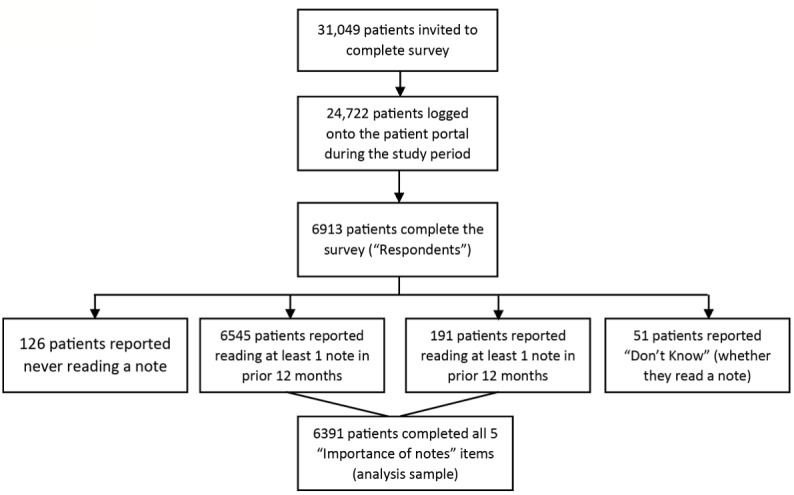
Of 24,722 patients, 6913 (27.96%) completed the survey. The majority (6736/6913, 97.44%) read at least one note. Among note readers, 74.0% (727/982) of patients with ≤high school education, 70.7% (130/184) of black patients, and 69.9% (153/219) of Hispanic/Latino patients reported that notes are extremely important to feel informed about their care. The majority of less educated and nonwhite patients reported notes as extremely important to remember the care plan (62.4%, 613/982 ≤high school education; 62.0%, 114/184 black patients; and 61.6%, 135/219 Hispanic/Latino patients) and to make care decisions (62.3%, 612/982; 59.8%, 110/184; and 58.5%, 128/219, respectively, and P<.003 for all comparisons to more educated and white patients, respectively). Among patients with the poorest self-reported health, 65.9% (499/757) found notes extremely important to be informed and to understand the provider. On multivariable modeling, less educated patients were nearly three times as likely to report notes were extremely important to engage in care compared with the most educated patients (odds ratio [OR] 2.9, 95% CI 2.4-3.3). Nonwhite patients were twice as likely to report the same compared with white patients (OR 2.0, 95% CI 1.5-2.7 [black] and OR 2.2, 95% CI 1.6-2.9 [Hispanic/Latino and Asian], P<.001 for each comparison). Healthier patients, women, older patients, and those who read more notes were more likely to find notes extremely important to engage in care.
Less educated and nonwhite patients using the portal each assigned higher importance to reading notes for several health behaviors than highly educated and white patients, and may find transparent notes especially valuable for understanding their health and engaging in their care. Facilitating access to notes may improve engagement in health care for some vulnerable populations who have historically been more challenging to reach.
“开放病历”是一项让临床医生与患者共享就诊记录的全国性倡议,它可以提高患者的参与度,但对弱势群体的影响尚不清楚。
我们的目的是研究就诊记录对非白人和受教育程度较低患者的重要性。
2016年6月至2016年9月期间,对一家城市学术医疗中心拥有活跃患者门户网站账户且上一年至少有1份门诊就诊记录的患者进行了调查。该调查是与患者及其家属共同设计的,评估了阅读记录对于(1)了解健康状况、(2)了解护理情况、(3)理解医生的思维过程、(4)记住护理计划以及(5)做出护理决策的重要性(0-10分制)。我们比较了按教育程度、种族/民族和自我报告的健康状况分层的患者中,对每个项目报告9-10分(极其重要)的比例。主成分分析和相关性测量支持了这5个项目的综合得分(Cronbach α = 0.93)。我们使用逻辑回归分析了与将记录评为对参与护理极其重要相关的因素。
在24722名患者中,6913名(27.96%)完成了调查。大多数(6736/6913,97.44%)阅读了至少一份记录。在阅读记录的患者中,高中及以下学历患者中有74.0%(727/982)、黑人患者中有70.7%(130/184)、西班牙裔/拉丁裔患者中有69.9%(153/219)表示记录对于了解他们的护理情况极其重要。大多数受教育程度较低和非白人患者表示记录对于记住护理计划(62.4%,613/982高中及以下学历;62.0%,114/184黑人患者;61.6%,135/219西班牙裔/拉丁裔患者)和做出护理决策(分别为62.3%,612/982;59.8%,110/184;58.5%,128/219,与受教育程度较高和白人患者的所有比较P<0.003)极其重要。在自我报告健康状况最差的患者中,65.9%(499/757)认为记录对于了解情况和理解医生极其重要。在多变量模型中,与受教育程度最高的患者相比,受教育程度较低的患者报告记录对于参与护理极其重要的可能性几乎是其三倍(优势比[OR]2.9,95%可信区间2.4-3.3)。与白人患者相比,非白人患者报告同样情况的可能性是其两倍(OR 2.0,95%可信区间1.5-2.7[黑人]和OR 2.2,95%可信区间1.6-2.9[西班牙裔/拉丁裔和亚裔],每次比较P<0.001)。健康状况较好的患者、女性、老年患者以及阅读记录较多的患者更有可能认为记录对于参与护理极其重要。
使用门户网站的受教育程度较低和非白人患者在几种健康行为方面对阅读记录的重视程度高于受教育程度较高和白人患者,并且可能发现透明的记录对于了解他们的健康状况和参与护理特别有价值。促进获取记录可能会提高一些历史上更难接触到的弱势群体对医疗保健的参与度。