Department of Psychology, University of California, Berkeley, CA, USA
Graduate School of Human and Environmental Studies, Kyoto University, Kyoto, Japan.
Proc Biol Sci. 2018 May 30;285(1879). doi: 10.1098/rspb.2017.2770.
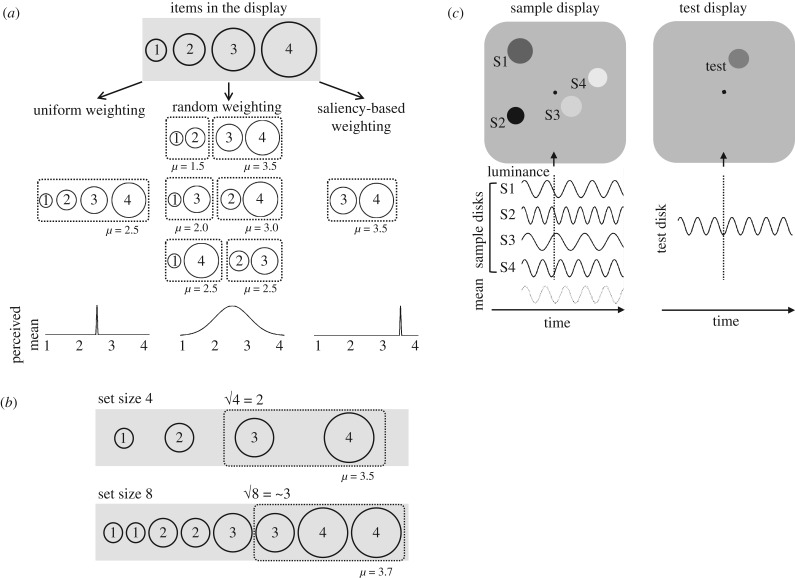
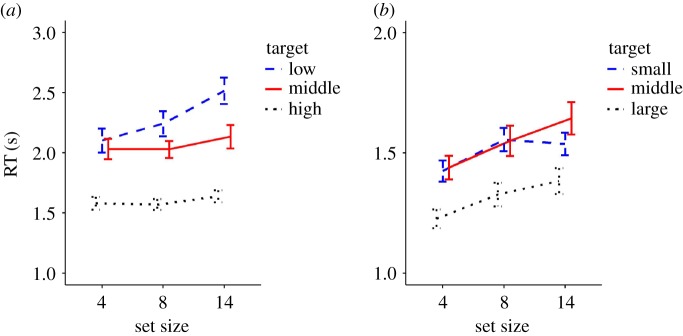
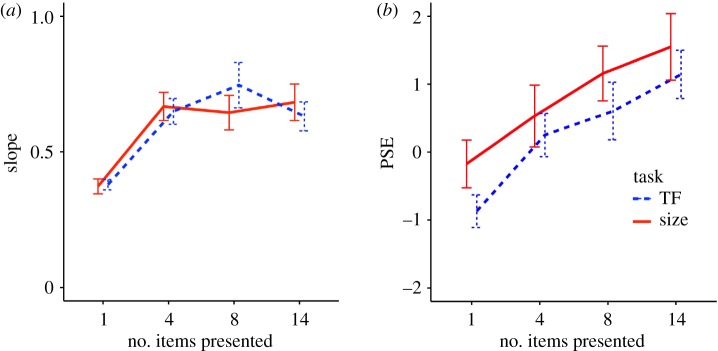
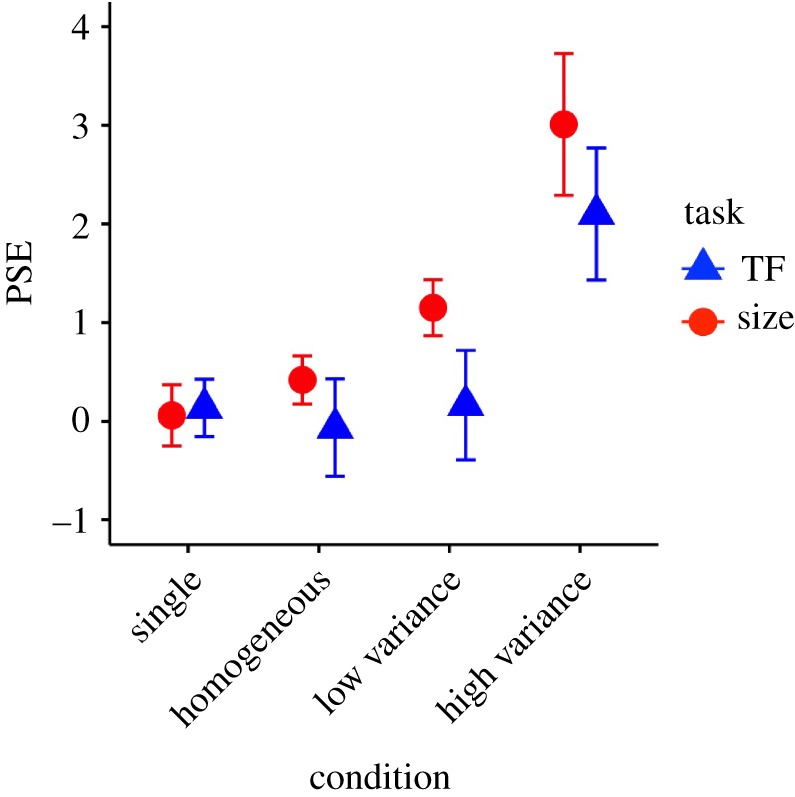
The human visual system represents summary statistical information (e.g. average) along many visual dimensions efficiently. While studies have indicated that approximately the square root of the number of items in a set are effectively integrated through this ensemble coding, how those samples are determined is still unknown. Here, we report that salient items are preferentially weighted over the other less salient items, by demonstrating that the perceived means of spatial (i.e. size) and temporal (i.e. flickering temporal frequency (TF)) features of the group of items are positively biased as the number of items in the group increases. This illusory 'amplification effect' was not the product of decision bias but of perceptual bias. Moreover, our visual search experiments with similar stimuli suggested that this amplification effect was due to attraction of visual attention to the salient items (i.e. large or high TF items). These results support the idea that summary statistical information is extracted from sets with an implicit preferential weighting towards salient items. Our study suggests that this saliency-based weighting may reflect a more optimal and efficient integration strategy for the extraction of spatio-temporal statistical information from the environment, and may thus be a basic principle of ensemble coding.
人类视觉系统能够有效地在许多视觉维度上表示总结性的统计信息(例如平均值)。虽然研究表明,通过这种整体编码,可以有效地整合一个集合中大约平方根数量的项目,但这些样本是如何确定的仍然未知。在这里,我们通过证明群体中项目的空间(即大小)和时间(即闪烁时间频率(TF))特征的感知均值随着群体中项目数量的增加而呈正偏,表明显著项目比其他不太显著的项目受到优先加权。这种虚幻的“放大效应”不是决策偏差的产物,而是感知偏差的产物。此外,我们使用类似刺激的视觉搜索实验表明,这种放大效应是由于视觉注意力被吸引到显著项目(即大或高 TF 项目)上。这些结果支持这样一种观点,即从集合中提取总结性统计信息是通过对显著项目的隐含优先加权来实现的。我们的研究表明,这种基于显著度的加权可能反映了从环境中提取时空统计信息的更优和更有效的集成策略,因此可能是整体编码的基本原则。