Department of Anesthesiology and Critical Care, University of Pennsylvania, Perelman School of Medicine, Philadelphia, Pennsylvania 19104.
Department of Biological Sciences and the Center for Biotechnology and Interdisciplinary Studies, Rensselaer Polytechnic Institute, Troy, New York 12180.
J Biol Chem. 2018 Jul 20;293(29):11283-11295. doi: 10.1074/jbc.RA118.002182. Epub 2018 May 29.
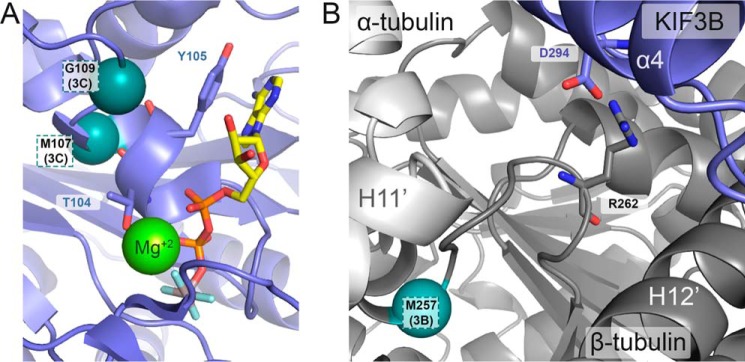
Microtubule-based molecular motors mediate transport of intracellular cargo to subdomains in neurons. Previous evidence has suggested that the anesthetic propofol decreases the average run-length potential of the major anterograde transporters kinesin-1 and kinesin-2 without altering their velocity. This effect on kinesin has not been observed with other inhibitors, stimulating considerable interest in the underlying mechanism. Here, we used a photoactive derivative of propofol, -azipropofol (AziP), to search for potential propofol-binding sites in kinesin. Single-molecule motility assays confirmed that AziP and propofol similarly inhibit kinesin-1 and kinesin-2. We then applied AziP in semiquantitative radiolabeling and MS microsequencing assays to identify propofol-binding sites within microtubule-kinesin complexes. The radiolabeling experiments suggested preferential AziP binding to the ATP-bound microtubule-kinesin complex. The photolabeled residues were contained within the kinesin motor domain rather than at the motor domain-β-tubulin interface. No residues within the P-loop of kinesin were photolabeled, indicating an inhibitory mechanism that does not directly affect ATPase activity and has an effect on run length without changing velocity. Our results also indicated that when the kinesin motor interacts with the microtubule during its processive run, a site forms in kinesin to which propofol can then bind and allosterically disrupt the kinesin-microtubule interaction, resulting in kinesin detachment and run termination. The discovery of the propofol-binding allosteric site in kinesin may improve our understanding of the strict coordination of the motor heads during the processive run. We hypothesize that propofol's potent effect on intracellular transport contributes to various components of its anesthetic action.
基于微管的分子马达介导细胞内货物向神经元亚域的运输。先前的证据表明,麻醉剂异丙酚降低了主要的正向转运体驱动蛋白-1 和驱动蛋白-2 的平均运行长度潜力,而不改变它们的速度。这种对驱动蛋白的作用在其他抑制剂中并未观察到,这激发了人们对潜在机制的极大兴趣。在这里,我们使用异丙酚的光活性衍生物 - 叠氮异丙酚(AziP),在驱动蛋白中寻找潜在的异丙酚结合位点。单分子运动分析证实,AziP 和异丙酚相似地抑制驱动蛋白-1 和驱动蛋白-2。然后,我们应用 AziP 进行半定量放射性标记和 MS 微测序分析,以确定微管-驱动蛋白复合物内的异丙酚结合位点。放射性标记实验表明 AziP 优先结合于 ATP 结合的微管-驱动蛋白复合物。光标记的残基位于驱动蛋白马达结构域内,而不是在马达结构域-β-微管界面内。驱动蛋白的 P 环内没有残基被光标记,这表明抑制机制不会直接影响 ATP 酶活性,并且对运行长度有影响,而不改变速度。我们的结果还表明,当驱动蛋白马达在其连续运行过程中与微管相互作用时,在驱动蛋白中形成一个位点,异丙酚可以结合到该位点,并通过变构破坏驱动蛋白-微管相互作用,导致驱动蛋白脱离和运行终止。在驱动蛋白中发现异丙酚结合变构位点可能会提高我们对马达头部在连续运行过程中严格协调的理解。我们假设异丙酚对细胞内运输的强烈影响有助于其麻醉作用的各个组成部分。