Zabłocka-Godlewska Ewa, Przystaś Wioletta, Grabińska-Sota Elżbieta
1Faculty of Energy and Environmental Engineering, The Silesian University of Technology, Akademicka 2A, 44-100 Gliwice, Poland.
2Biotechnology Center, The Silesian University of Technology, B. Krzywoustego 8, 44-100 Gliwice, Poland.
Water Air Soil Pollut. 2018;229(6):176. doi: 10.1007/s11270-018-3829-7. Epub 2018 May 21.
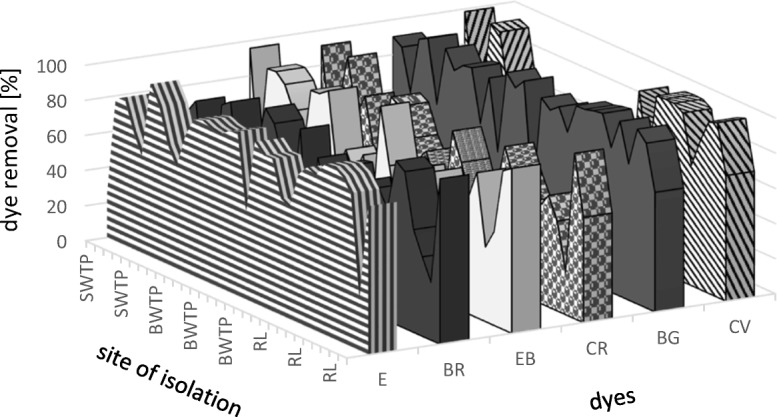
The aim of this study was the isolation of bacterial strains which have the ability to decolorize synthetic dyes belonging to different chemical groups. The samples for bacterial isolation were collected from aqueous environments-two activated sludges and polluted local river. At the first stage of screening (performed on the solid media supplemented with two dyes-azo Evans blue or triphenylmethane brilliant green), 67 bacterial strains were isolated capable to decolorize the used dyes. In the further study, six dyes with different chemical structures were used: fluorone dyes (Bengal rose, erythrosine), triphenylmethane dyes (brilliant green, crystal violet), azo dyes (Evans blue, Congo red). Initial concentration of each of these chemicals in samples was 0.1 g/l. Obtained results showed that only 31 isolates were able to decolorize all six used dyes (with different efficiencies). Among them, 11 strains were isolated from the river (55% of isolates from this site) and 20 from activated sludges collected from two different treatment plants (15 from the first water treatment plant and 5 from the second which were 42 and 43% of isolated cultures respectively). The decolorizing microorganisms are mostly isolated from different industrial sewages (e.g., textile industry), but results of the study showed that water from polluted river as well as municipal wastewaters may be a precious source for isolation of bacterial strains with the wide spectrum and high decolorization potential. In general, there were no statistically significant differences between decolorization abilities of strains isolated from different sites. The group of dyes that was removed with the highest yield was triphenylmethanes (75.6%), followed by fluorones (70.0%) and azo group (60.9%). The analysis of decolorization efficiency of the individual dyes revealed the best removal results in case of triphenylmethane brilliant green (average removal 85.7%), followed by fluorone erythrosine (average removal 78.9%), triphenylmethane crystal violet (average removal 65.5%), azo Evans blue (average removal 64.4%), fluorone Bengal rose (average removal 61.0%), and azo Congo red (average removal 57.4%). Obtained results revealed that the dye susceptibility to decolorization depends on the characteristic chemical structure of given dye groups but more important is chemical structure of strictly given dye within the group.
本研究的目的是分离出能够使属于不同化学基团的合成染料脱色的细菌菌株。用于细菌分离的样品取自水环境——两种活性污泥和受污染的当地河流。在筛选的第一阶段(在添加了两种染料——偶氮伊文思蓝或三苯甲烷亮绿的固体培养基上进行),分离出了67株能够使所用染料脱色的细菌菌株。在进一步的研究中,使用了六种具有不同化学结构的染料:荧光染料(孟加拉玫瑰红、赤藓红)、三苯甲烷染料(亮绿、结晶紫)、偶氮染料(伊文思蓝、刚果红)。样品中每种这些化学物质的初始浓度为0.1 g/l。获得的结果表明,只有31株分离菌能够使所有六种使用的染料脱色(效率不同)。其中,11株菌株从河流中分离得到(占该地点分离菌株的55%),20株从两个不同处理厂收集的活性污泥中分离得到(15株来自第一个水处理厂,5株来自第二个水处理厂,分别占分离培养物的42%和43%)。脱色微生物大多从不同的工业污水(如纺织工业)中分离得到,但研究结果表明,受污染河流的水以及城市污水可能是分离具有广谱和高脱色潜力细菌菌株的宝贵来源。一般来说,从不同地点分离的菌株的脱色能力之间没有统计学上的显著差异。去除率最高的染料组是三苯甲烷类(75.6%),其次是荧光染料类(70.0%)和偶氮类(60.9%)。对各染料脱色效率分析表明,三苯甲烷亮绿的去除效果最佳(平均去除率85.7%),其次是荧光染料赤藓红(平均去除率78.9%)、三苯甲烷结晶紫(平均去除率65.5%)、偶氮伊文思蓝(平均去除率64.4%)、荧光染料孟加拉玫瑰红(平均去除率61.0%)和偶氮刚果红(平均去除率57.4%)。获得的结果表明,染料对脱色的敏感性取决于给定染料组的特征化学结构,但更重要的是该组内特定染料的化学结构。