Northwestern Feinberg School of Medicine, Chicago, IL, USA.
Harvard Medical School, Boston, MA, USA.
Int J Gynaecol Obstet. 2018 Sep;142(3):321-328. doi: 10.1002/ijgo.12542. Epub 2018 Jun 20.
To evaluate whether integration of the Opportunity-Ability-Motivation plus Supplies (OAMS) framework into coaching improved the delivery of essential birth practices in a low-resource setting.
This prospective mixed-methods study used routine coaching visit data obtained from the first eight intervention facilities of the BetterBirth trial in Uttar Pradesh, India, between December 19, 2014, and October 21, 2015. The 8-month intervention was peer coaching that integrated the OAMS framework to support uptake of the WHO Safe Childbirth Checklist. Descriptive statistics were used to measure nonadherence to essential birth practices. The frequency and accuracy of coaches' coding of barriers and the appropriateness of chosen resolution strategies to measure feasibility, acceptability, and fidelity of using OAMS, were assessed.
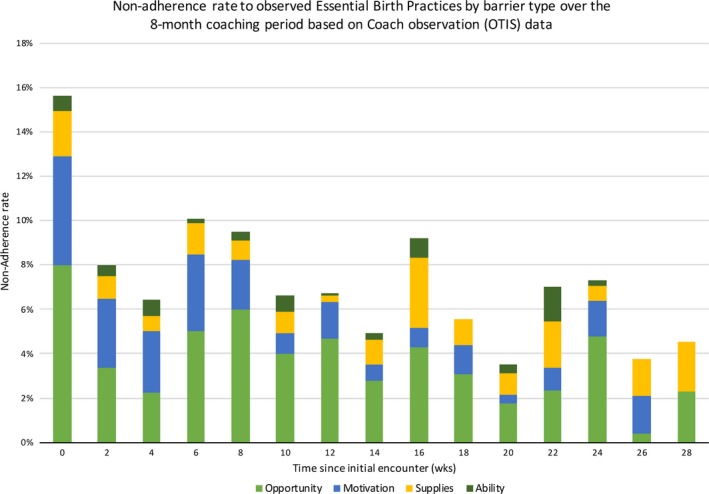
Coaches observed 666 deliveries, including 12 602 practices. Overall, essential practice nonadherence decreased from 15.6% (262/1675 practices observed) to 4.5% (4/88 practices) (P<0.001). Of the 1048 barriers identified, opportunity (556 [53.1%]) and motivation (287 [27.4%]) were the most frequently reported categories; the frequency of both decreased over time (P=0.003 and P<0.001, respectively). The coaches appropriately categorized 930 (99.8%) of 932 barriers and provided an appropriate strategy for 800 (85.8%). The commonest reason for unaddressed barriers was lack of coaching opportunities.
Successful integration of OAMS framework into delivery attendant coaching enabled coaches to rapidly diagnose barriers to practice adherence and develop responsive strategies. CLINICALTRIALS.GOV: NCT2148952 (WHO Universal Trial Number: U11111-1315-647).
评估在资源匮乏环境下,将机遇-能力-动机加供应品(OAMS)框架融入辅导中是否能改善基本分娩实践的实施情况。
本前瞻性混合方法研究使用了印度北方邦 BetterBirth 试验前 8 个干预设施于 2014 年 12 月 19 日至 2015 年 10 月 21 日期间获取的常规辅导访问数据。8 个月的干预措施是同伴辅导,融入了 OAMS 框架以支持采用世卫组织《安全分娩核对表》。采用描述性统计来衡量基本分娩实践的不依从性。评估了教练对障碍的编码频率和准确性,以及选择的解决策略的适当性,以衡量使用 OAMS 的可行性、可接受性和保真度。
教练观察了 666 次分娩,包括 12602 次操作。总体而言,基本实践不依从率从 15.6%(观察到的 1675 次操作中的 262 次)下降到 4.5%(88 次操作中的 4 次)(P<0.001)。在确定的 1048 个障碍中,机会(556[53.1%])和动机(287[27.4%])是最常报告的类别;随着时间的推移,这两个类别的频率都有所下降(P=0.003 和 P<0.001)。教练适当地对 932 个障碍中的 930 个(99.8%)进行了分类,并为 800 个障碍中的 800 个(85.8%)提供了适当的策略。未解决障碍的最常见原因是缺乏辅导机会。
将 OAMS 框架成功融入分娩助理辅导中,使教练能够快速诊断实践依从性的障碍,并制定响应策略。CLINICALTRIALS.GOV:NCT2148952(世卫组织通用试验编号:U11111-1315-647)。