Laboratory of Survival and Longevity, Max Planck Institute for Demographic Research, Rostock, Germany.
Hungarian Demographic Research Institute, Budapest, Hungary.
PLoS One. 2018 Jun 4;13(6):e0198485. doi: 10.1371/journal.pone.0198485. eCollection 2018.
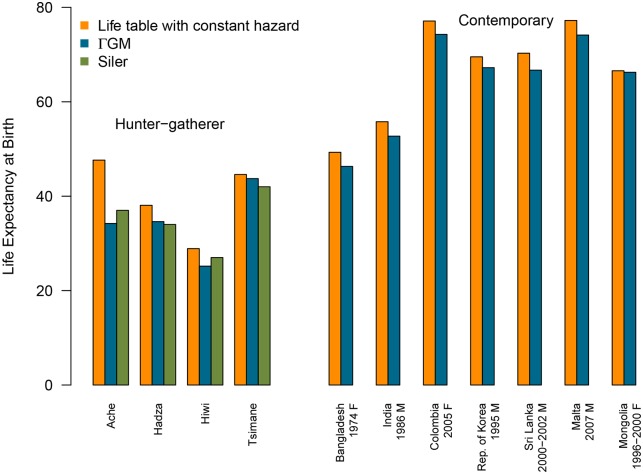
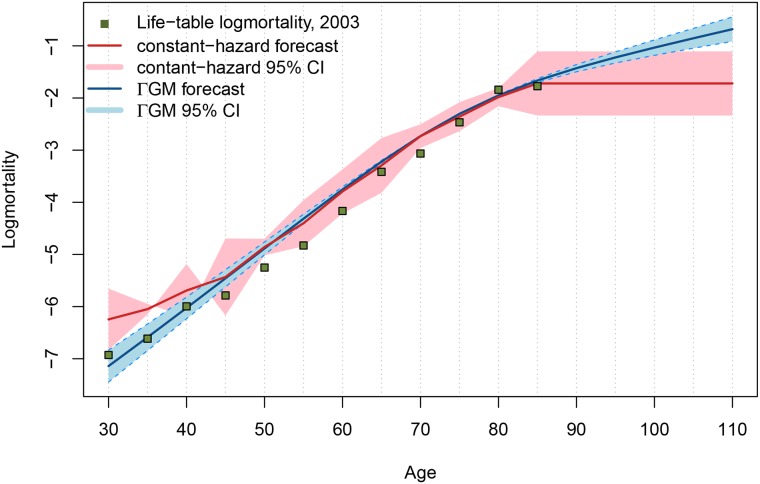
Mortality information of populations is aggregated in life tables that serve as a basis for calculation of life expectancy and various life disparity measures. Conventional life-table methods address right-censoring inadequately by assuming a constant hazard in the last open-ended age group. As a result, life expectancy can be substantially distorted, especially in the case when the last age group in a life table contains a large proportion of the population. Previous research suggests addressing censoring in a gamma-Gompertz-Makeham model setting as this framework incorporates all major features of adult mortality. In this article, we quantify the difference between gamma-Gompertz-Makeham life expectancy values and those published in the largest publicly available high-quality life-table databases for human populations, drawing attention to populations for which life expectancy values should be reconsidered. We also advocate the use of gamma-Gompertz-Makeham life expectancy for three reasons. First, model-based life-expectancy calculation successfully handles the problem of data quality or availability, resulting in severe censoring due to the unification of a substantial number of deaths in the last open-end age group. Second, model-based life expectancies are preferable in the case of data scarcity, i.e. when data contain numerous age groups with zero death counts: here, we provide an example of hunter-gatherer populations. Third, gamma-Gompertz-Makeham-based life expectancy values are almost identical to the ones provided by the major high-quality human mortality databases that use more complicated procedures. Applying a gamma-Gompertz-Makeham model to adult mortality data can be used to revise life-expectancy trends for historical populations that usually serve as input for mortality forecasts.
人口死亡率信息汇总在生命表中,这些生命表是计算预期寿命和各种生命差异指标的基础。传统的生命表方法通过假设最后一个开放式年龄组的风险不变来充分解决右删失问题。因此,预期寿命可能会受到很大影响,特别是在生命表的最后一个年龄组包含大量人口的情况下。先前的研究表明,在伽马-戈珀兹-马凯姆模型框架中解决删失问题,因为该框架包含了成人死亡率的所有主要特征。在本文中,我们量化了伽马-戈珀兹-马凯姆预期寿命值与最大的公开可得的高质量人口生命表数据库中公布的预期寿命值之间的差异,提请注意应该重新考虑预期寿命值的人群。我们还主张使用伽马-戈珀兹-马凯姆预期寿命,原因有三。首先,基于模型的预期寿命计算成功地处理了数据质量或可用性的问题,由于大量死亡人数在最后一个开放式年龄组中统一,导致严重的删失。其次,在数据稀缺的情况下,基于模型的预期寿命更可取,即当数据包含大量死亡人数为零的年龄组时:在这里,我们提供了一个狩猎采集人群的例子。第三,基于伽马-戈珀兹-马凯姆的预期寿命值几乎与使用更复杂程序的主要高质量人类死亡率数据库提供的预期寿命值相同。将伽马-戈珀兹-马凯姆模型应用于成人死亡率数据可以用于修正通常作为死亡率预测输入的历史人口的预期寿命趋势。