National Institute of High Security Animal Diseases, Anand Nagar, Bhopal, Madhya Pradesh, India.
Present Address: Department of Veterinary Epidemiology and Preventive Medicine, COVAS, Udgir, Latur, Maharashtra, India.
BMC Complement Altern Med. 2018 Jun 5;18(1):174. doi: 10.1186/s12906-018-2238-1.
In the view of endemic avian influenza H9N2 infection in poultry, its zoonotic potential and emergence of antiviral resistance, two herbal plants, Ocimum sanctum and Acacia arabica, which are easily available throughout various geographical locations in India were taken up to study their antiviral activity against H9N2 virus. We evaluated antiviral efficacy of three different extracts each from leaves of O. sanctum (crude extract, terpenoid and polyphenol) and A. arabica (crude extract, flavonoid and polyphenol) against H9N2 virus using in ovo model.
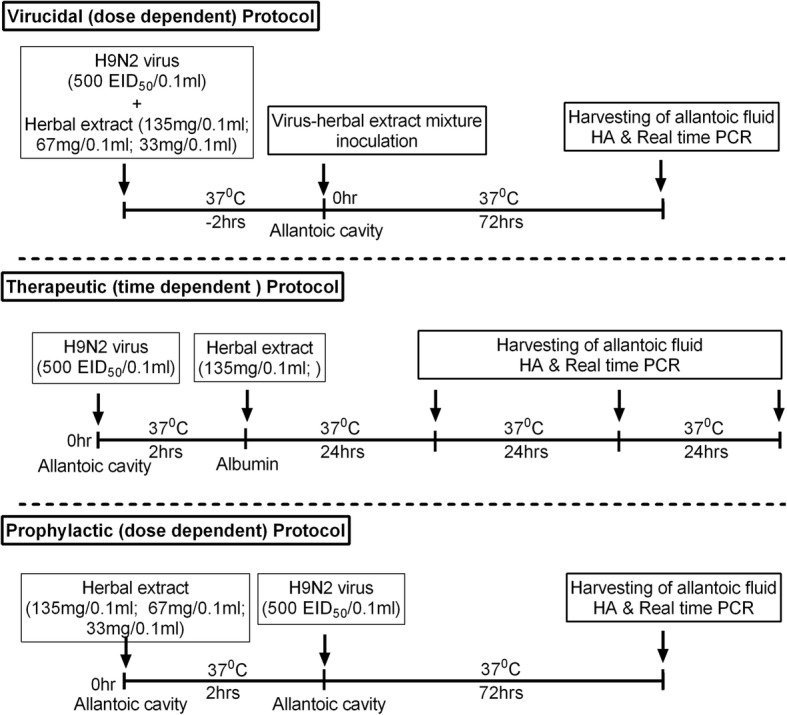
The antiviral efficacy of different leaves extracts was systematically studied in three experimental protocols viz. virucidal (dose-dependent), therapeutic (time-dependent) and prophylactic (dose-dependent) activity employing in ovo model. The maximum non-toxic concentration of each herbal extracts of O. sanctum and A. arabica in the specific pathogen free embryonated chicken eggs was estimated and their antiviral efficacy was determined in terms of reduction in viral titres, measured by Haemagglutination (HA) and real time quantitative reverse transcription polymerase chain reaction (RT-qPCR) assays.
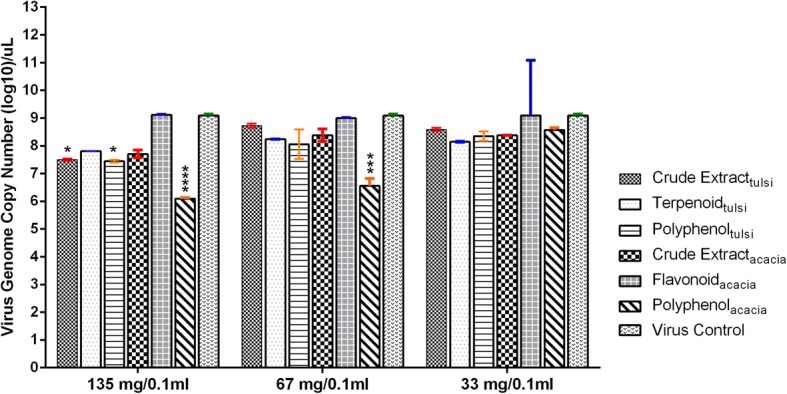
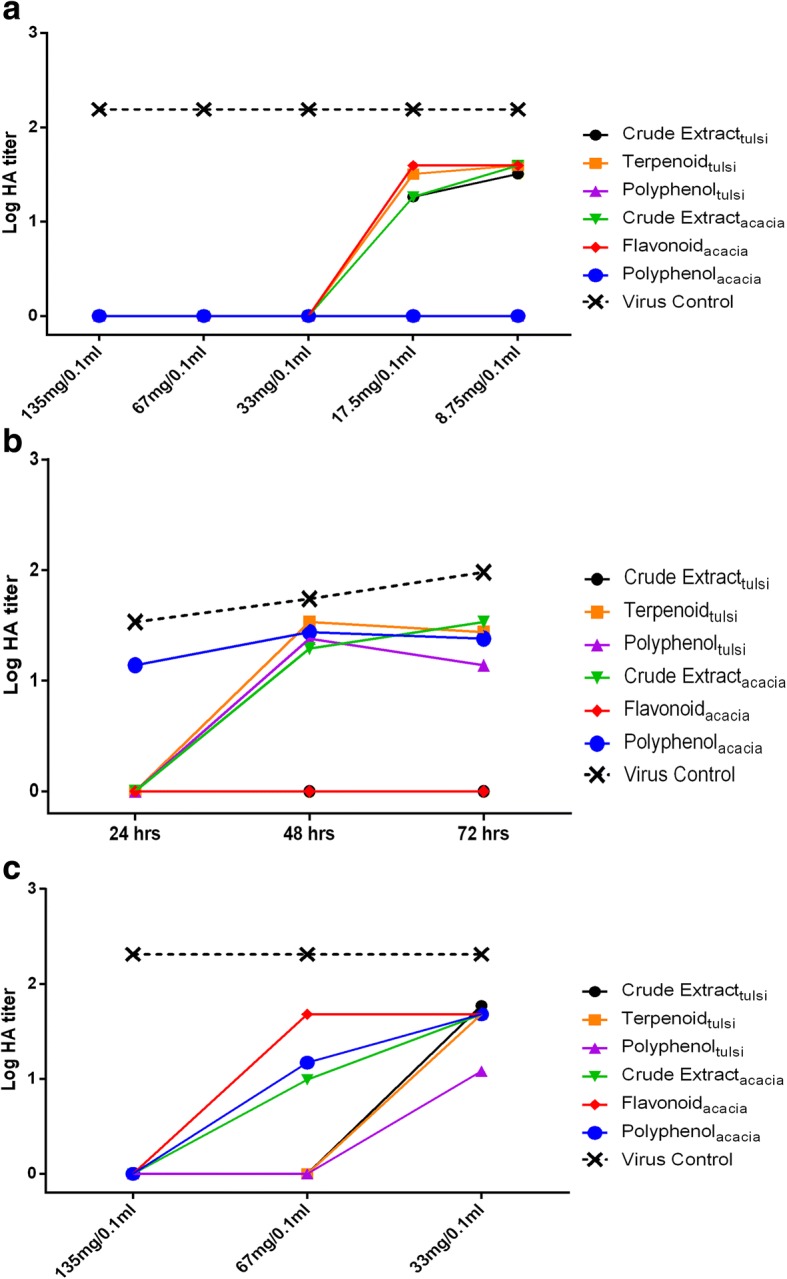
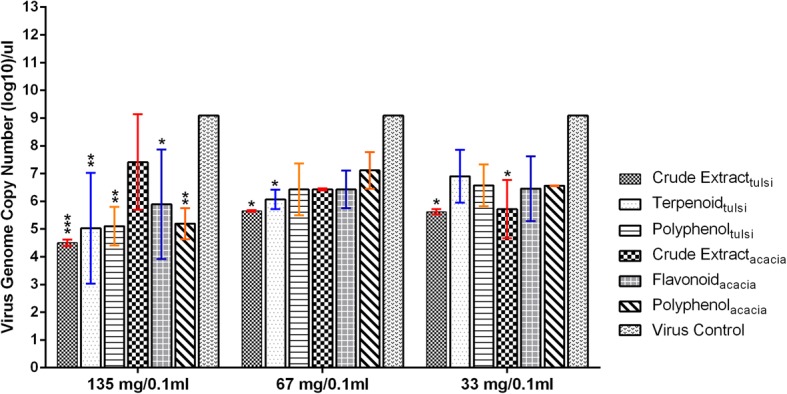
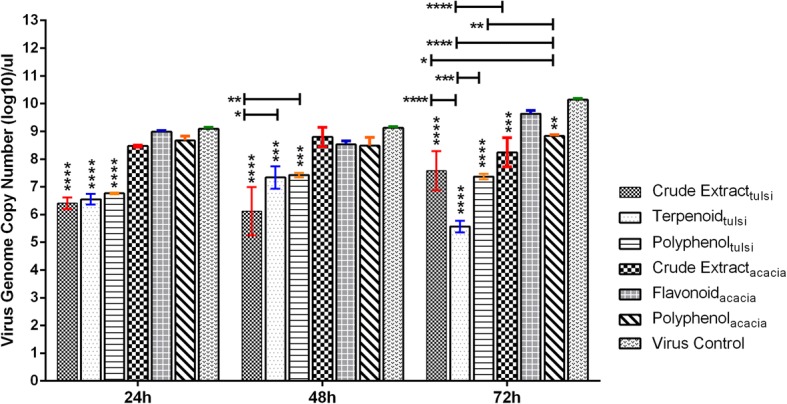
All the extracts of O. sanctum (crude extract, terpenoid and polyphenol) and A. arabica (crude extract, flavonoid and polyphenol) showed significant virucidal activity, however, crude extract and terpenoid showed highly significant to significant (p < 0.001-0.01) decrease in virus genome copy numbers with lowest dose tested. Similarly, therapeutic effect was observed in all three extracts of O. sanctum in comparison to the virus control, nevertheless, crude extract and terpenoid maintained this effect for longer period of time (up to 72 h post-incubation). None of the leaves extracts of A. arabica had therapeutic effect at 24 and 48 h post-incubation, however, only the crude extract and polyphenol showed delayed therapeutic effect (72 h post-inoculation). Prophylactic potential was observed in polyphenol with highly significant antiviral activity compared to virus control (p < 0.001).
The crude extract and terpenoid isolated from the leaves of O. sanctum and polyphenol from A. arabica has shown promising antiviral properties against H9N2 virus. Future investigations are necessary to formulate combinations of these compounds for the broader antiviral activity against H9N2 viruses and evaluate them in chickens.
鉴于禽流感 H9N2 在禽类中的地方性感染、其人畜共患潜力和抗病毒药物耐药性的出现,我们选择了两种在印度各地都很容易获得的草药植物——圣罗勒(Ocimum sanctum)和阿拉伯金合欢(Acacia arabica),来研究它们对 H9N2 病毒的抗病毒活性。我们使用鸡胚模型评估了来自圣罗勒叶(粗提取物、萜类化合物和多酚)和阿拉伯金合欢叶(粗提取物、类黄酮和多酚)的三种不同提取物对 H9N2 病毒的抗病毒功效。
我们在三个实验方案中系统地研究了不同叶片提取物的抗病毒功效,即病毒杀灭(剂量依赖性)、治疗(时间依赖性)和预防(剂量依赖性)活性,使用鸡胚模型。我们估计了圣罗勒和阿拉伯金合欢的每种草药提取物在特定无病原体鸡胚卵中的最大无毒浓度,并根据血凝(HA)和实时定量逆转录聚合酶链反应(RT-qPCR)测定的病毒滴度降低来确定其抗病毒功效。
圣罗勒的所有提取物(粗提取物、萜类化合物和多酚)和阿拉伯金合欢的所有提取物(粗提取物、类黄酮和多酚)均表现出显著的病毒杀灭活性,然而,粗提取物和萜类化合物显示出对病毒基因组拷贝数有高度显著到显著的降低(p<0.001-0.01),最低剂量测试。同样,与病毒对照组相比,圣罗勒的三种提取物均显示出治疗效果,但粗提取物和萜类化合物保持这种效果的时间更长(孵育后长达 72 小时)。阿拉伯金合欢的叶片提取物在孵育后 24 和 48 小时均无治疗效果,但粗提取物和多酚仅显示出延迟的治疗效果(接种后 72 小时)。多酚显示出对 H9N2 病毒有显著的预防潜力,与病毒对照组相比具有高度显著的抗病毒活性(p<0.001)。
从圣罗勒叶中分离出的粗提取物和萜类化合物以及从阿拉伯金合欢叶中分离出的多酚对 H9N2 病毒表现出有前景的抗病毒特性。未来的研究有必要将这些化合物组合起来,以获得对 H9N2 病毒更广泛的抗病毒活性,并在鸡中进行评估。