Department of Molecular Biology, College of Natural Sciences, Dongeui University, Busan 47340, Korea.
Department of Biochemistry, Dongeui University College of Korean Medicine, Busan 47227, Korea.
Int J Environ Res Public Health. 2018 Jun 5;15(6):1173. doi: 10.3390/ijerph15061173.
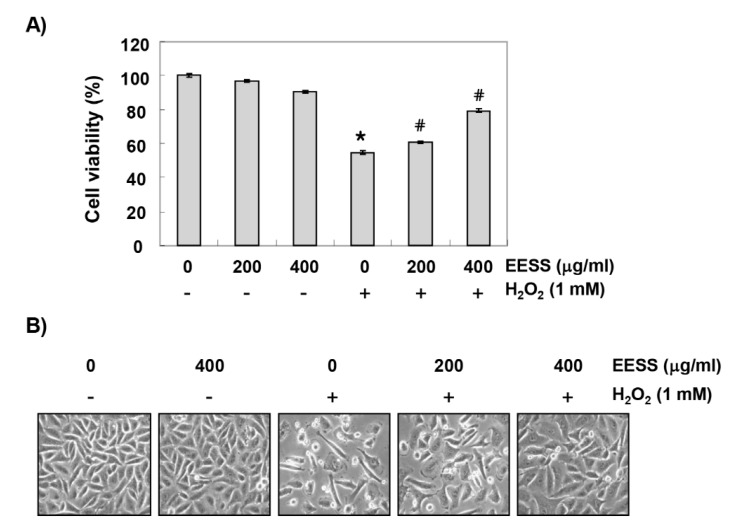
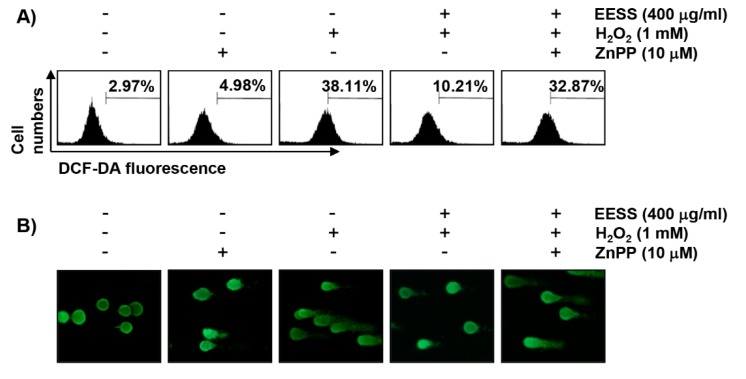
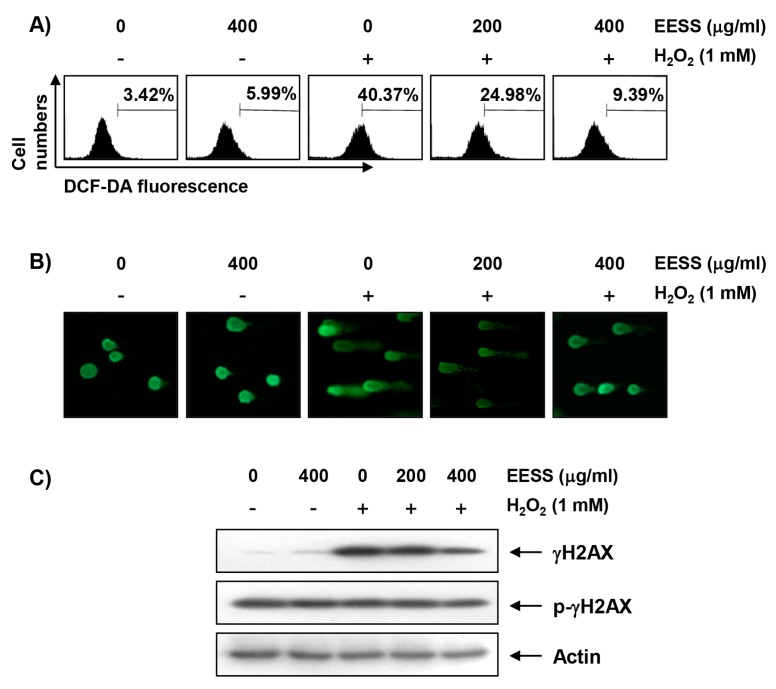
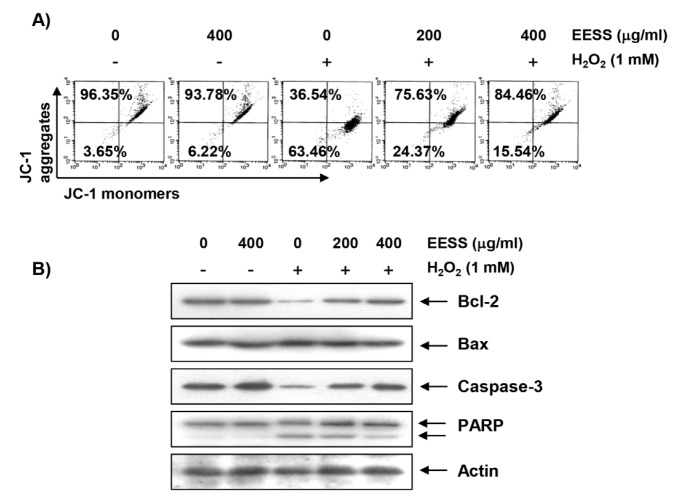
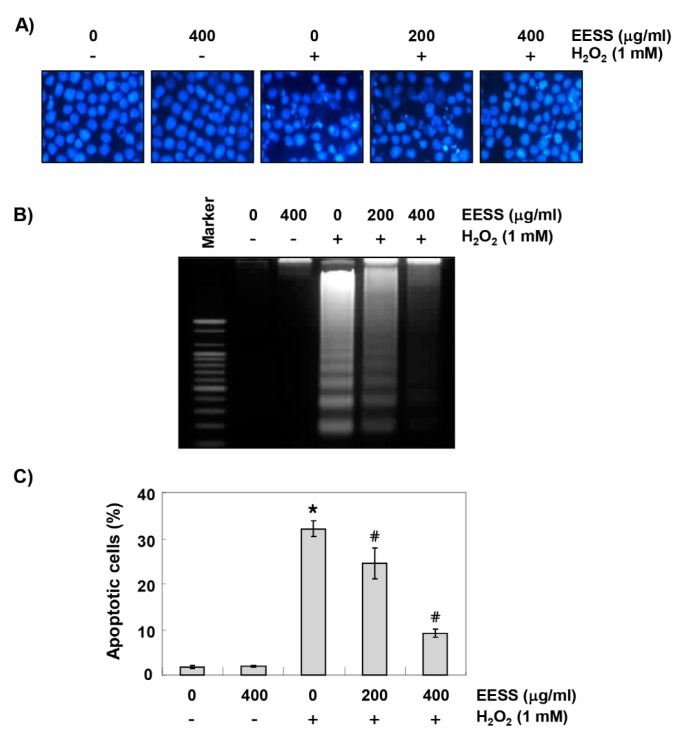
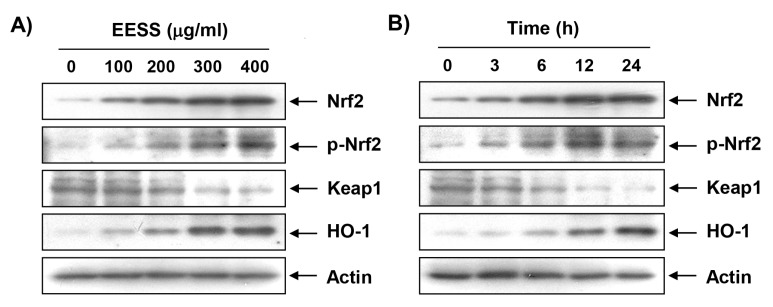
Oxidative stress in chondrocytes plays a critical role in the pathogenesis of osteoarthritis as an important cause of articular cartilage degradation. C. Agardh, a marine brown algae, is known to have potent antioxidant activity. Nevertheless, no study has been conducted yet on the protective efficacy against oxidative stress in chondrocytes. Therefore, the aim of the current study is to investigate the mechanism of the antioxidative effect of ethanol extract of (EESS) on DNA damage and apoptosis induced by hydrogen peroxide (H₂O₂) in SW1353 human chondrocytes. For this purpose, SW1353 cells exposed to H₂O₂ in the presence or absence of EESS were applied to cell viability assay, comet assay, immunoblotting and flow cytometry analyses. Our results showed that EESS effectively attenuated H₂O₂-induced cytotoxicity and DNA damage associated with the inhibition of reactive oxygen species (ROS) accumulation. EESS also weakened the mitochondria membrane permeabilization by H₂O₂, and recovered H₂O₂-induced decreased expression of anti-apoptotic Bcl-2 and pro-caspase-3, and degradation of poly (ADP-ribose) polymerase. In addition, EESS increased not only expression, but also phosphorylation of nuclear factor-erythroid 2 related factor 2 (Nrf2), and promoted the expression of heme oxygenase-1 (HO-1), a critical target enzyme of Nrf2, but decreased the expression of kelch-like ECH-associated protein-1; however, the inhibition of HO-1 activity by zinc protoporphyrin abolished the antioxidant potential induced by EESS against H₂O₂-mediated oxidative stress. Therefore, the results of this study suggest that the antioxidant efficacy of EESS in chondrocytes is at least involved in the Nrf2/HO-1 signaling pathway-dependent mechanism.
软骨细胞中的氧化应激在骨关节炎的发病机制中起着关键作用,是关节软骨降解的重要原因。海洋褐藻 C. Agardh 已知具有很强的抗氧化活性。然而,目前尚未有研究探讨其对软骨细胞氧化应激的保护作用。因此,本研究旨在探讨乙醇提取物(EESS)对过氧化氢(H₂O₂)诱导的 SW1353 人软骨细胞 DNA 损伤和凋亡的抗氧化作用机制。为此,将暴露于 H₂O₂的 SW1353 细胞与或不与 EESS 一起进行细胞活力测定、彗星试验、免疫印迹和流式细胞术分析。我们的结果表明,EESS 可有效减轻 H₂O₂诱导的细胞毒性和 DNA 损伤,同时抑制活性氧(ROS)的积累。EESS 还减弱了 H₂O₂引起的线粒体膜通透性的破坏,并恢复了 H₂O₂诱导的抗凋亡 Bcl-2 和 pro-caspase-3 表达降低以及多聚(ADP-核糖)聚合酶降解。此外,EESS 不仅增加了核因子-红细胞 2 相关因子 2(Nrf2)的表达和磷酸化,还促进了血红素加氧酶-1(HO-1)的表达,这是 Nrf2 的关键靶酶,同时降低了 kelch 样 ECH 相关蛋白-1 的表达;然而,锌原卟啉 IX 抑制 HO-1 活性会消除 EESS 对 H₂O₂介导的氧化应激引起的抗氧化潜力。因此,本研究结果表明,EESS 在软骨细胞中的抗氧化作用至少涉及 Nrf2/HO-1 信号通路依赖的机制。