Parr Thomas, Friston Karl J
Wellcome Trust Centre for Neuroimaging, Institute of Neurology, University College London, WC1N 3BG, U.K.
Neural Comput. 2018 Sep;30(9):2319-2347. doi: 10.1162/neco_a_01102. Epub 2018 Jun 12.
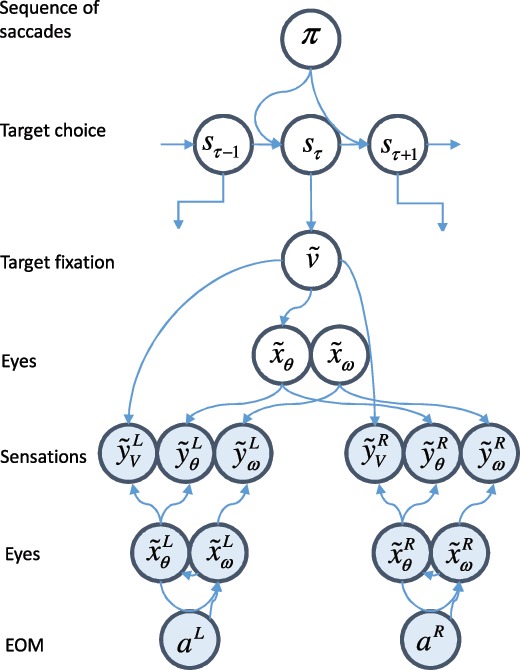
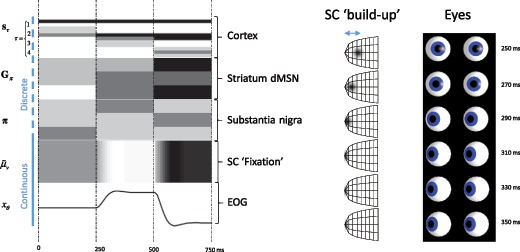
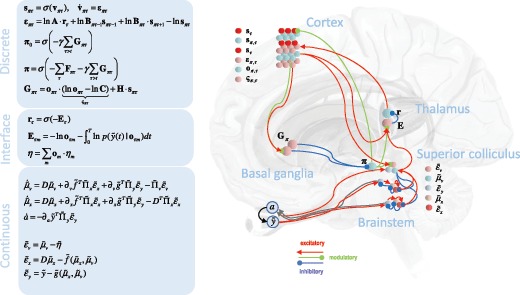
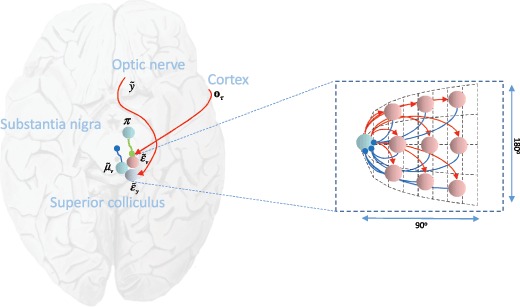
To act upon the world, creatures must change continuous variables such as muscle length or chemical concentration. In contrast, decision making is an inherently discrete process, involving the selection among alternative courses of action. In this article, we consider the interface between the discrete and continuous processes that translate our decisions into movement in a Newtonian world-and how movement informs our decisions. We do so by appealing to active inference, with a special focus on the oculomotor system. Within this exemplar system, we argue that the superior colliculus is well placed to act as a discrete-continuous interface. Interestingly, when the neuronal computations within the superior colliculus are formulated in terms of active inference, we find that many aspects of its neuroanatomy emerge from the computations it must perform in this role.
为了与外界相互作用,生物体必须改变诸如肌肉长度或化学浓度等连续变量。相比之下,决策是一个本质上离散的过程,涉及在不同行动方案之间进行选择。在本文中,我们考虑了离散过程与连续过程之间的接口,这些过程将我们的决策转化为牛顿世界中的运动——以及运动如何影响我们的决策。我们通过诉诸主动推理来做到这一点,特别关注眼动系统。在这个示例系统中,我们认为上丘非常适合作为离散-连续接口。有趣的是,当上丘内的神经元计算根据主动推理来表述时,我们发现其神经解剖学的许多方面都源于它在此角色中必须执行的计算。