Geology and Petroleum Geology, School of Geosciences, Kings College, University of Aberdeen, Aberdeen, AB24 3UE, UK.
School of GeoSciences, University of Edinburgh, James Hutton Road, Edinburgh, EH9 3FE, UK.
Nat Commun. 2018 Jun 12;9(1):2201. doi: 10.1038/s41467-018-04423-1.
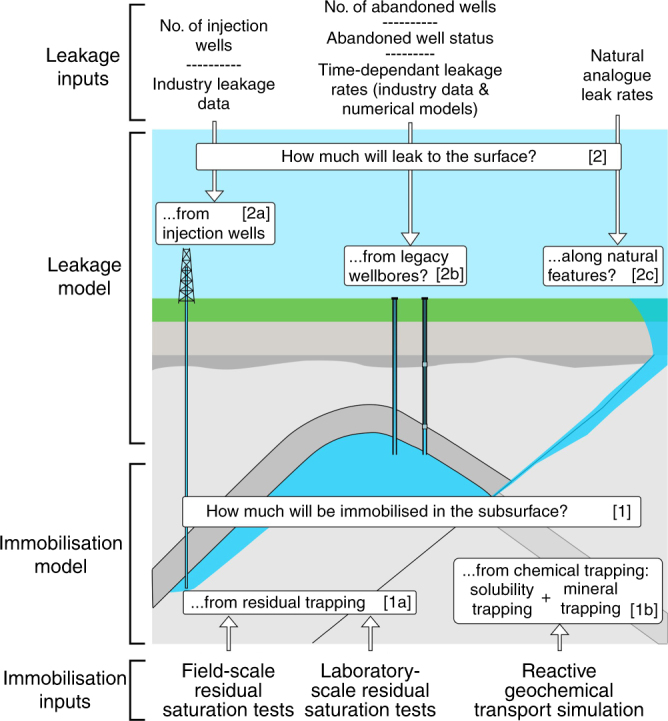
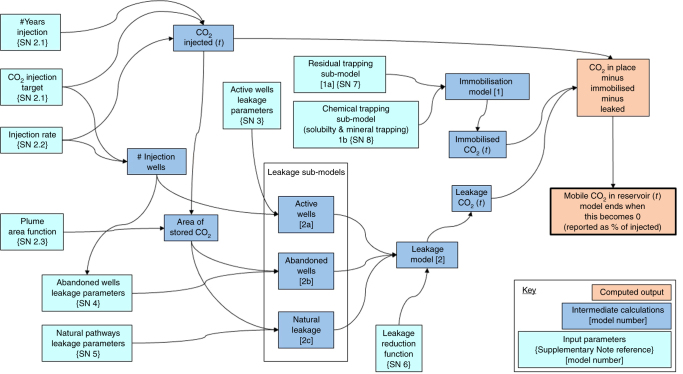
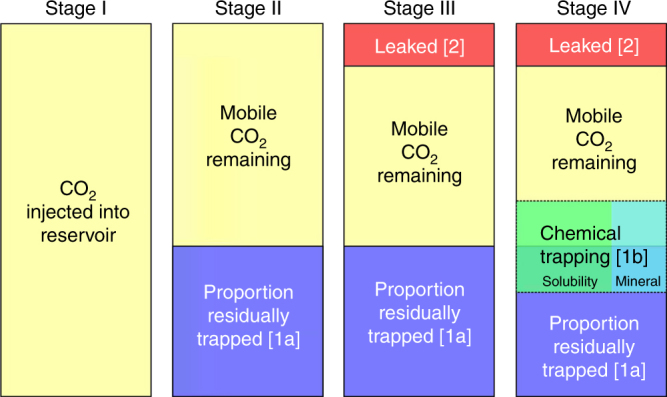
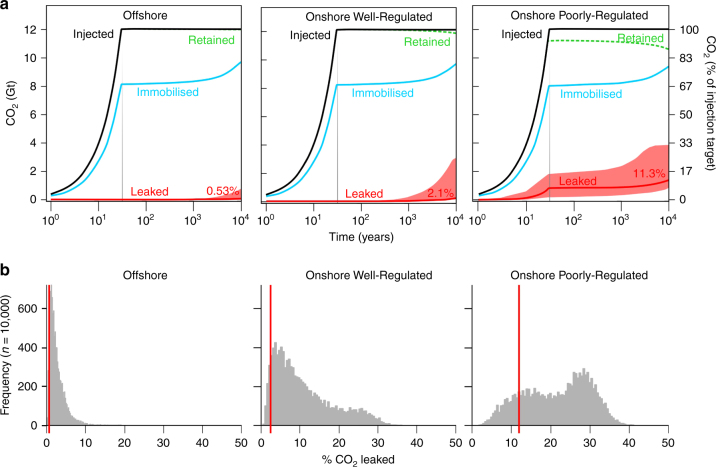
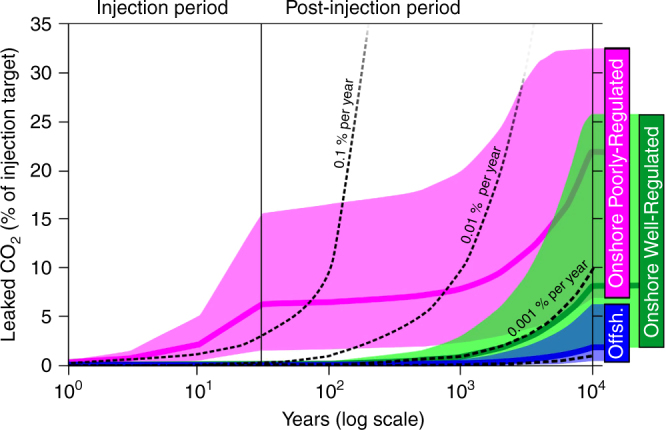
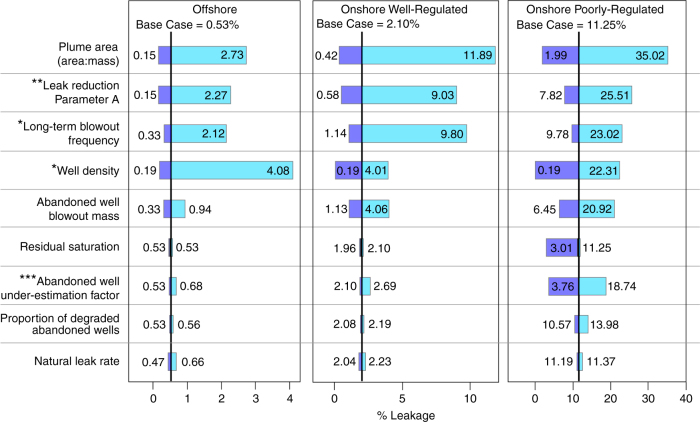
Carbon capture and storage (CCS) can help nations meet their Paris CO reduction commitments cost-effectively. However, lack of confidence in geologic CO storage security remains a barrier to CCS implementation. Here we present a numerical program that calculates CO storage security and leakage to the atmosphere over 10,000 years. This combines quantitative estimates of geological subsurface CO retention, and of surface CO leakage. We calculate that realistically well-regulated storage in regions with moderate well densities has a 50% probability that leakage remains below 0.0008% per year, with over 98% of the injected CO retained in the subsurface over 10,000 years. An unrealistic scenario, where CO storage is inadequately regulated, estimates that more than 78% will be retained over 10,000 years. Our modelling results suggest that geological storage of CO can be a secure climate change mitigation option, but we note that long-term behaviour of CO in the subsurface remains a key uncertainty.
碳捕获和封存(CCS)可以帮助各国以具有成本效益的方式实现《巴黎协定》的 CO 减排承诺。然而,对地质 CO 封存安全性的缺乏信心仍然是 CCS 实施的一个障碍。在这里,我们提出了一个数值程序,该程序可以计算 10000 年内的 CO 储存安全性和向大气中的泄漏。这结合了地质地下 CO 保留的定量估计,以及地表 CO 泄漏的定量估计。我们计算得出,在具有中等井密度的区域进行现实的、受到良好监管的储存,其泄漏率低于每年 0.0008%的概率为 50%,超过 98%的注入 CO 在 10000 年内保留在地下。在一个不现实的情景下,即 CO 储存监管不足,估计在 10000 年内,超过 78%的 CO 将被保留。我们的模型结果表明,地质储存 CO 可以是一种安全的气候变化缓解选择,但我们注意到 CO 在地下的长期行为仍然是一个关键的不确定性。