Health Promotion Policy Research Center, International Health Policy Program, Nonthaburi, Thailand.
Social Pharmacy Research Unit, Faculty of Pharmacy, Mahasarakham University, Maha Sarakham, Thailand.
Drug Alcohol Rev. 2018 Aug;37 Suppl 2(Suppl Suppl 2):S53-S62. doi: 10.1111/dar.12820. Epub 2018 Jun 13.
Gender and age patterns of drinking are important in guiding country responses to harmful use of alcohol. This study undertook cross-country analysis of drinking across gender, age groups in some high-and middle-income countries.
Surveys of drinkers were conducted in Australia, England, Scotland, New Zealand, St Kitts and Nevis (high-income), Thailand, South Africa, Mongolia and Vietnam (middle-income) as part of the International Alcohol Control Study. Drinking pattern measures were high-frequency, heavier-typical quantity and higher-risk drinking. Differences in the drinking patterns across age and gender groups were calculated. Logistic regression models were applied including a measure of country-level income.
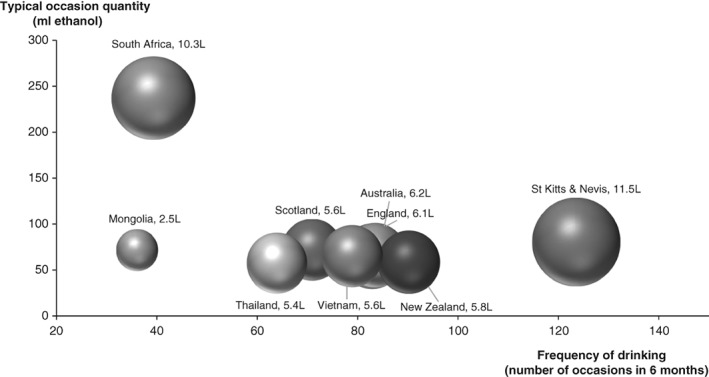
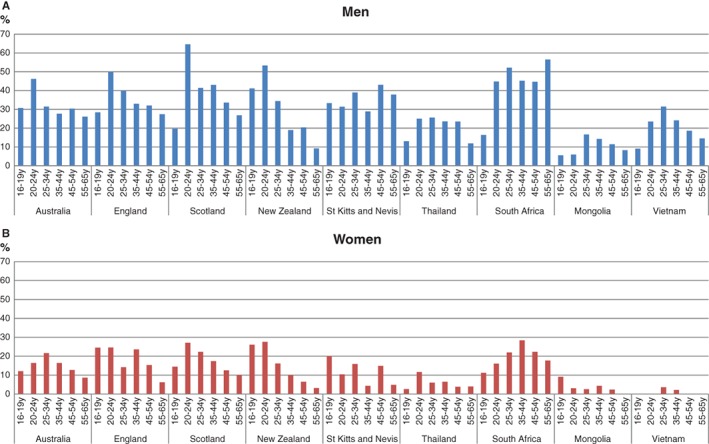
Percentages of high-frequency, heavier-typical quantity and higher-risk drinking were greater among men than in women in all countries. Older age was associated with drinking more frequently but smaller typical quantities especially in high-income countries. Middle-income countries overall showed less frequent but heavier typical quantities; however, the lower frequencies meant the percentages of higher risk drinkers were lower overall compared with high-income countries (with the exception of South Africa).
High-frequency drinking was greater in high-income countries, particularly in older age groups. Middle-income countries overall showed less frequent drinking but heavier typical quantities. As alcohol use becomes more normalised as a result of the expansion of commercial alcohol it is likely frequency of drinking will increase with a likelihood of greater numbers drinking at higher risk levels.
饮酒的性别和年龄模式对于指导各国应对有害饮酒行为非常重要。本研究对一些高收入和中等收入国家的性别和年龄组的饮酒情况进行了跨国分析。
作为国际酒精控制研究的一部分,在澳大利亚、英国、苏格兰、新西兰、圣基茨和尼维斯(高收入)、泰国、南非、蒙古和越南(中等收入)对饮酒者进行了调查。饮酒模式的衡量标准包括高频、较大典型量和高风险饮酒。计算了不同年龄和性别组之间的饮酒模式差异。应用了包括国家收入衡量标准的逻辑回归模型。
在所有国家,男性的高频、较大典型量和高风险饮酒的比例均高于女性。年龄越大,饮酒越频繁,但在高收入国家,典型量越小。与高收入国家相比,中等收入国家的饮酒频率总体较低,但典型量较大;然而,由于较低的频率,与高收入国家相比,总体上高风险饮酒者的比例较低(南非除外)。
高收入国家的高频饮酒更为普遍,尤其是在年龄较大的群体中。与高收入国家相比,中等收入国家的饮酒频率总体较低,但典型量较大。随着商业酒精的扩张,饮酒变得更加普遍,因此,饮酒频率可能会增加,高风险饮酒者的数量也可能会增加。