AgResearch Ltd., Ruakura Research Centre, Hamilton 3214, New Zealand.
AgResearch Ltd., Ruakura Research Centre, Hamilton 3214, New Zealand.
J Dairy Sci. 2018 Sep;101(9):8208-8216. doi: 10.3168/jds.2017-14207. Epub 2018 Jun 13.
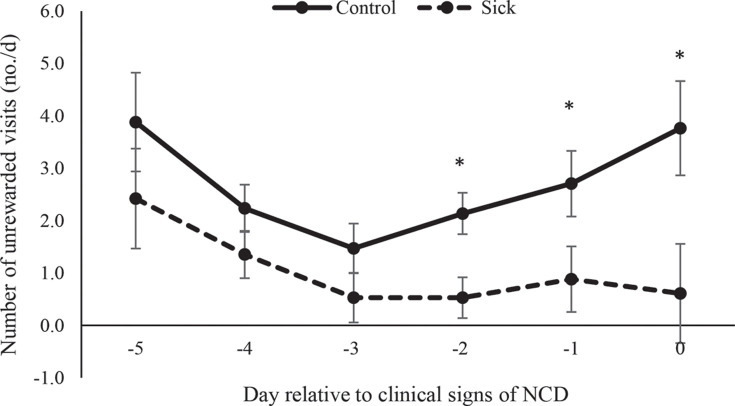
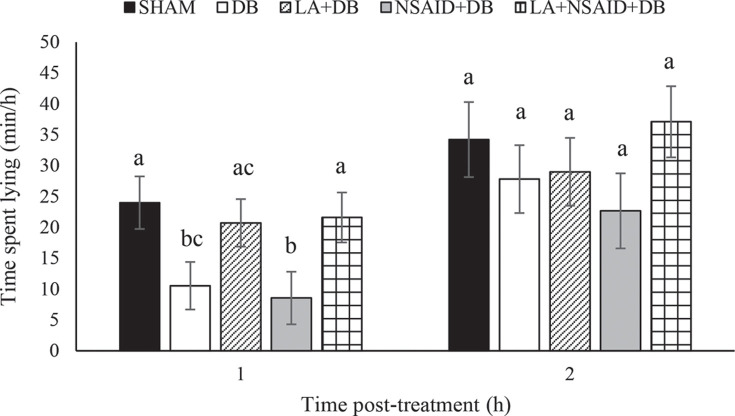
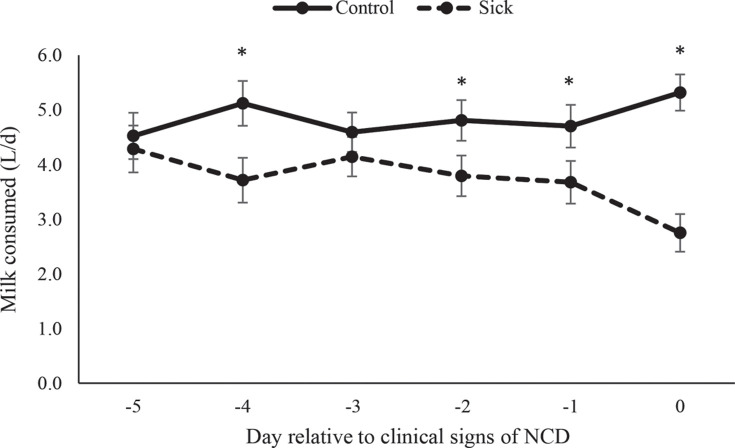
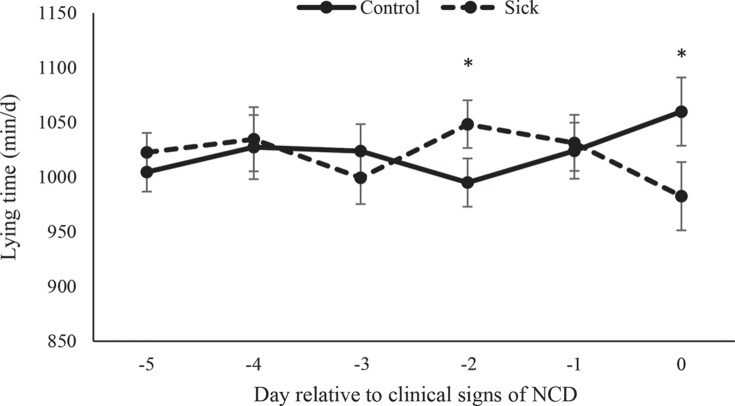
We determined if feeding and lying behavior, recorded by automatic calf feeding systems (ACFS) and accelerometers, could be used to detect changes in behavior before onset of neonatal calf diarrhea (NCD) or in response to disbudding pain in dairy calves. At 4 d of age, 112 calves had accelerometers attached to their hind leg and were housed in pens with ACFS. Calves were examined daily for signs of illness or injury. Of the 112 calves monitored, 18 were diagnosed with NCD; activities of calves with NCD were then compared with those of 18 healthy controls (calves that had no symptoms of NCD, other illnesses, or injury). Feeding (milk consumption and the number of rewarded and unrewarded visits to the feeder) and lying behavior during the 5 d leading up to calves displaying clinical signs of NCD were analyzed. Calves with NCD performed fewer unrewarded visits and consumed less milk than healthy calves during the 2- and 4-d periods before diagnosis with NCD, respectively. Calves with NCD tended to perform fewer lying bouts than healthy calves over the 5-d period before diagnosis with NCD. At 3 wk of age, a subset of 51 healthy calves were allocated to 1 of 5 treatment groups: (1) sham handling (SHAM, n = 10), (2) cautery disbudding (DB, n = 11), (3) administration of local anesthetic (LA) and DB (LA+DB, n = 11), 4) administration of a nonsteroidal anti-inflammatory drug (NSAID) and DB (NSAID+DB, n = 9), and (5) administration of LA, NSAID and DB (LA+NSAID+DB, n = 10). Feeding and lying behavior were recorded continuously for 24 h pre- and postdisbudding. We found no effect of treatment on the number of rewarded or unrewarded visits to the feeder and milk volume consumed 24 h before administration of treatments. During the 24-h postdisbudding period, SHAM calves performed more unrewarded visits than DB, LA+DB, and NSAID+DB calves, but the number of unrewarded visits did not differ between SHAM and LA+NSAID+DB calves. During the first hour of the posttreatment period we noted a difference in lying times among treatments, with DB and NSAID+DB calves spending less time lying than SHAM calves and lying times being similar between SHAM, LA+DB, and LA+NSAID+DB calves. The ACFS and accelerometers have the potential to automatically gather valuable information regarding health status and pain in calves. Therefore, it may be advantageous to combine both of these measures (ACFS and accelerometers) when evaluating NCD on farm or pain in calves in future research.
我们确定通过自动犊牛饲养系统 (ACFS) 和加速度计记录的饲养和躺卧行为是否可以用于在新生犊牛腹泻 (NCD) 发作之前或在奶牛犊牛去角疼痛时检测行为变化。在 4 日龄时,将 112 头小牛的后腿上安装了加速度计,并将它们安置在带有 ACFS 的畜栏中。每天检查小牛是否有疾病或受伤的迹象。在所监测的 112 头小牛中,有 18 头被诊断为 NCD;然后将患有 NCD 的小牛的活动与 18 头健康对照(无 NCD、其他疾病或受伤症状的小牛)的活动进行比较。分析了在出现 NCD 临床症状前的 5 天内,小牛的进食(牛奶消耗和奖励和未奖励访问饲养器的次数)和躺卧行为。在诊断为 NCD 前的 2 天和 4 天期间,患有 NCD 的小牛与健康小牛相比,未奖励访问次数较少,牛奶消耗也较少。在诊断为 NCD 前的 5 天期间,患有 NCD 的小牛的躺卧次数往往比健康小牛少。在 3 周龄时,将 51 头健康小牛分为 5 个治疗组中的 1 个:(1) 假处理 (SHAM,n = 10),(2) 烙烫去角 (DB,n = 11),(3) 局部麻醉 (LA) 和 DB(LA+DB,n = 11),(4) 非甾体抗炎药(NSAID)和 DB(NSAID+DB,n = 9),(5) LA、NSAID 和 DB(LA+NSAID+DB,n = 10)。在去角前和去角后 24 小时连续记录进食和躺卧行为。我们发现治疗对喂食器奖励和未奖励访问次数以及治疗前 24 小时牛奶摄入量没有影响。在去角后 24 小时期间,SHAM 小牛比 DB、LA+DB 和 NSAID+DB 小牛的未奖励访问次数更多,但 SHAM 和 LA+NSAID+DB 小牛之间的未奖励访问次数没有差异。在治疗后的第一个小时,我们注意到不同处理之间的躺卧时间存在差异,DB 和 NSAID+DB 小牛的躺卧时间比 SHAM 小牛短,而 SHAM、LA+DB 和 LA+NSAID+DB 小牛的躺卧时间相似。ACFS 和加速度计有可能自动收集有关小牛健康状况和疼痛的有价值信息。因此,在未来的研究中,在农场评估 NCD 或评估犊牛疼痛时,结合使用这两种措施(ACFS 和加速度计)可能是有利的。