Strege Marlene V, Swain Deanna, Bochicchio Lauren, Valdespino Andrew, Richey John A
Department of Psychology, Virginia Tech, Blacksburg, VA, United States.
Front Psychol. 2018 Jun 1;9:866. doi: 10.3389/fpsyg.2018.00866. eCollection 2018.
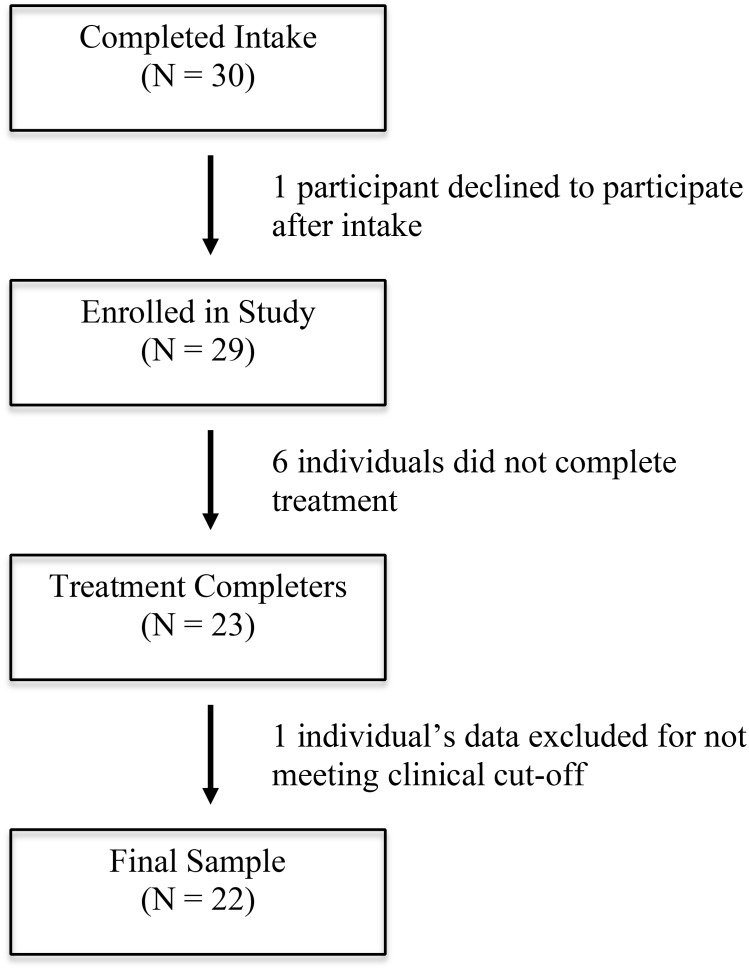
Randomized controlled trials have demonstrated that mindfulness-based cognitive therapy (MBCT) is efficacious in reducing residual depressive symptoms and preventing future depressive episodes (Kuyken et al., 2016). One potential treatment effect of MBCT may be improvement of positive affect (PA), due to improved awareness of daily positive events (Geschwind et al., 2011). Considering social anxiety disorder (SAD) is characterized by diminished PA (Brown et al., 1998; Kashdan, 2007), we sought to determine whether MBCT would reduce social anxiety symptoms, and whether this reduction would be associated with improvement of PA deficits. Adults ( = 22) who met criteria for varied anxiety disorders participated in a small, open-label trial of an 8-week manualized MBCT intervention. Most participants presented with either a diagnosis (primary, secondary, or tertiary) of generalized anxiety disorder (GAD) ( = 15) and/or SAD ( = 14) prior to treatment, with eight individuals meeting diagnostic criteria for both GAD and SAD. We hypothesized participants would demonstrate improvements in social anxiety symptoms, which would be predicted by improvements in PA, not reductions in negative affect (NA). Results of several hierarchical linear regression analyses (completed in both full and disorder-specific samples) indicated that improvements in PA but not reductions in NA predicted social anxiety improvement. This effect was not observed for symptoms of worry, which were instead predicted by decreased NA for individuals diagnosed with GAD and both decreased NA and increased PA in the entire sample. Results suggest that MBCT may be efficacious in mitigating social anxiety symptoms, and this therapeutic effect may be linked to improvements in PA. However, further work is necessary considering the small, heterogeneous sample, uncontrolled study design, and exploratory nature of the study.
随机对照试验表明,基于正念的认知疗法(MBCT)在减轻残留抑郁症状和预防未来抑郁发作方面是有效的(库伊肯等人,2016年)。MBCT的一个潜在治疗效果可能是改善积极情绪(PA),这是由于对日常积极事件的意识提高(格施温德等人,2011年)。考虑到社交焦虑障碍(SAD)的特征是积极情绪减弱(布朗等人,1998年;卡什丹,2007年),我们试图确定MBCT是否会减轻社交焦虑症状,以及这种减轻是否与积极情绪缺陷的改善有关。符合多种焦虑症标准的成年人(n = 22)参加了一项为期8周的手动MBCT干预的小型开放标签试验。大多数参与者在治疗前被诊断为广泛性焦虑症(GAD)(n = 15)和/或社交焦虑障碍(SAD)(n = 14),其中8人同时符合GAD和SAD的诊断标准。我们假设参与者的社交焦虑症状会有所改善,这将通过积极情绪的改善来预测,而不是消极情绪(NA)的减少。几个层次线性回归分析的结果(在完整样本和特定障碍样本中均完成)表明,积极情绪的改善而非消极情绪的减少预测了社交焦虑的改善。对于担忧症状未观察到这种效果,相反,对于被诊断为GAD的个体,消极情绪的减少预测了担忧症状,而在整个样本中,消极情绪的减少和积极情绪的增加都预测了担忧症状。结果表明,MBCT可能在减轻社交焦虑症状方面有效,并且这种治疗效果可能与积极情绪的改善有关。然而,考虑到样本量小、异质性大、研究设计无对照以及研究的探索性质,还需要进一步的研究。