a Sleep and Circadian Neuroscience Institute (SCNi), Nuffield Department of Clinical Neurosciences , University of Oxford , Oxford , UK.
b Centre for Observation, Impacts, Energy , MINES ParisTech, PSL Research University , Paris , France.
Chronobiol Int. 2018 Sep;35(10):1365-1374. doi: 10.1080/07420528.2018.1482556. Epub 2018 Jun 18.
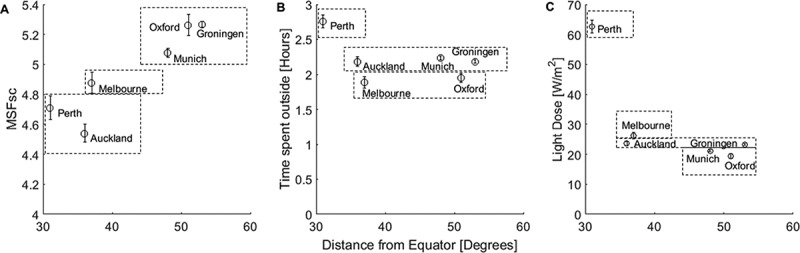
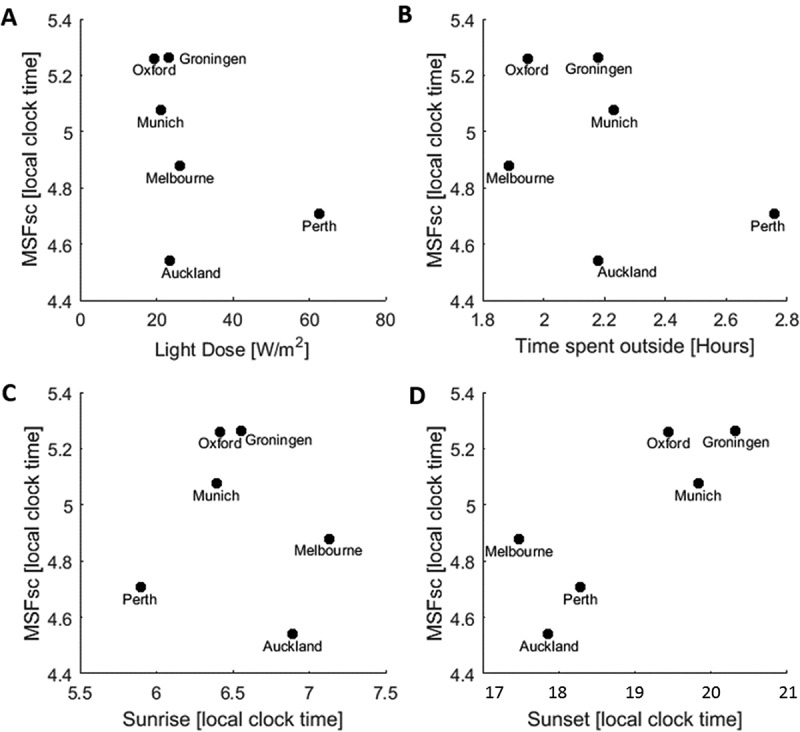
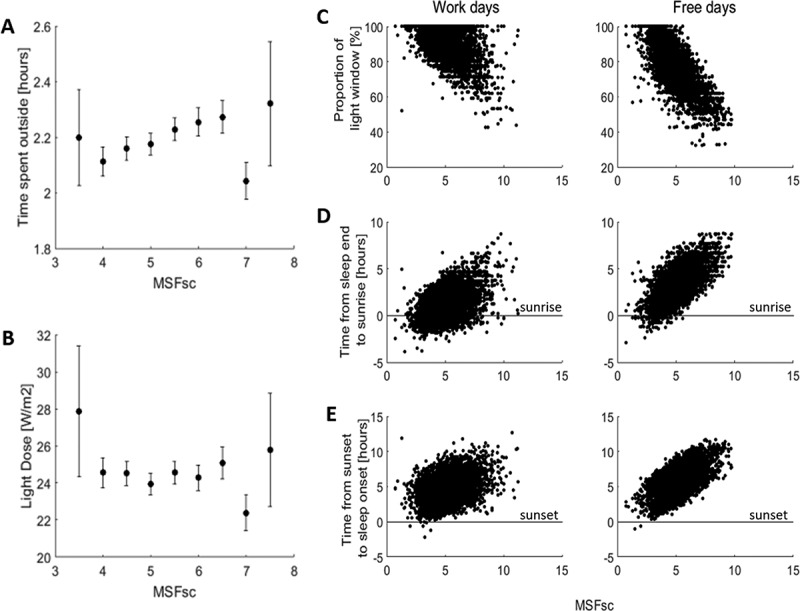
In humans and most other species, changes in the intensity and duration of light provide a critical set of signals for the synchronisation of the circadian system to the astronomical day. The timing of activity within the 24 h day defines an individual's chronotype, i.e. morning, intermediate or evening type. The aim of this study was to investigate the associations between environmental light exposure, due to geographical location, on the chronotype of university students. Over 6 000 university students from cities in the Northern Hemisphere (Oxford, Munich and Groningen) and Southern Hemisphere (Perth, Melbourne and Auckland) completed the Munich ChronoType Questionnaire. In parallel, light measures (daily irradiance, timing of sunrise and sunset) were compiled from satellite or ground stations at each of these locations. Our data shows that later mid-sleep point on free days (corrected for oversleep on weekends MFS) is associated with (i) residing further from the equator, (ii) a later sunset, (iii) spending more time outside and (iv) waking from sleep significantly after sunrise. However, surprisingly, MSF did not correlate with daily light intensity at the different geographical locations. Although these findings appear to contradict earlier studies suggesting that in the wider population increased light exposure is associated with an earlier chronotype, our findings are derived exclusively from a student population aged between 17 and 26 years. We therefore suggest that the age and occupation of our population increase the likelihood that these individuals will experience relatively little light exposure in the morning whilst encountering more light exposure later in the day, when light has a delaying effect upon the circadian system.
在人类和大多数其他物种中,光强和光时的变化为生物钟系统与天文日同步提供了一组关键信号。24 小时周期内活动的时间安排定义了个体的生物钟类型,即早晨型、中间型或晚上型。本研究旨在调查由于地理位置导致的环境光暴露与大学生生物钟类型之间的关联。来自北半球城市(牛津、慕尼黑和格罗宁根)和南半球城市(珀斯、墨尔本和奥克兰)的 6000 多名大学生完成了慕尼黑生物钟类型问卷。与此同时,从这些地点的卫星或地面站收集了光照测量值(每日辐照度、日出和日落时间)。我们的数据表明,周末补觉后自由日的晚睡点(晚睡点校正)与以下因素相关:(i)距赤道越远,(ii)日落越晚,(iii)在户外活动时间越长,(iv)日出后从睡眠中醒来的时间显著延迟。然而,令人惊讶的是,MSF 与不同地理位置的每日光照强度没有相关性。尽管这些发现似乎与早期研究相矛盾,早期研究表明在更广泛的人群中,增加光照暴露与更早的生物钟类型相关,但我们的发现仅来自 17 至 26 岁的学生人群。因此,我们认为我们人群的年龄和职业增加了这些个体在早晨经历相对较少光照暴露的可能性,而在一天中晚些时候遇到更多光照暴露时,光照对生物钟系统有延迟作用。