Van Assche Kerlijn, Nebot Giralt Ariadna, Caudron Jean Michel, Schiavetti Benedetta, Pouget Corinne, Tsoumanis Achilleas, Meessen Bruno, Ravinetto Raffaella
Public Health Department, Institute of Tropical Medicine, Antwerp, Belgium.
QUAMED Quality Medicines for All, Castres, France.
BMJ Glob Health. 2018 Jun 9;3(3):e000771. doi: 10.1136/bmjgh-2018-000771. eCollection 2018.
The rapid globalisation of the pharmaceutical production and distribution has not been supported by harmonisation of regulatory systems worldwide. Thus, the supply systems in low-income and middle-income countries (LMICs) remain exposed to the risk of poor-quality medicines. To contribute to estimating this risk in the private sector in LMICs, we assessed the quality assurance system of a convenient sample of local private pharmaceutical distributors.
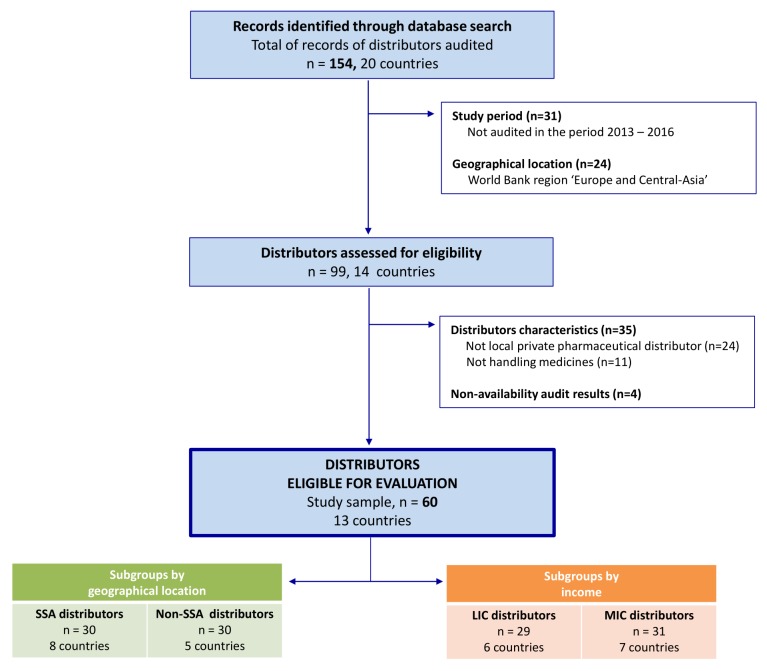
This descriptive study uses secondary data derived from the audits conducted by the QUAMED group at 60 local private pharmaceutical distributors in 13 LMICs. We assessed the distributors' compliance with good distribution practices (GDP), general quality requirements (GQR) and cold chain management (CCM), based on an evaluation tool inspired by the WHO guidelines 'Model Quality Assurance System (MQAS) for procurement agencies'. Descriptive statistics describe the compliance for the whole sample, for distributors in sub-Saharan Africa (SSA) versus those in non-SSA, and for those in low-income countries (LICs) versus middle-income countries (MICs).
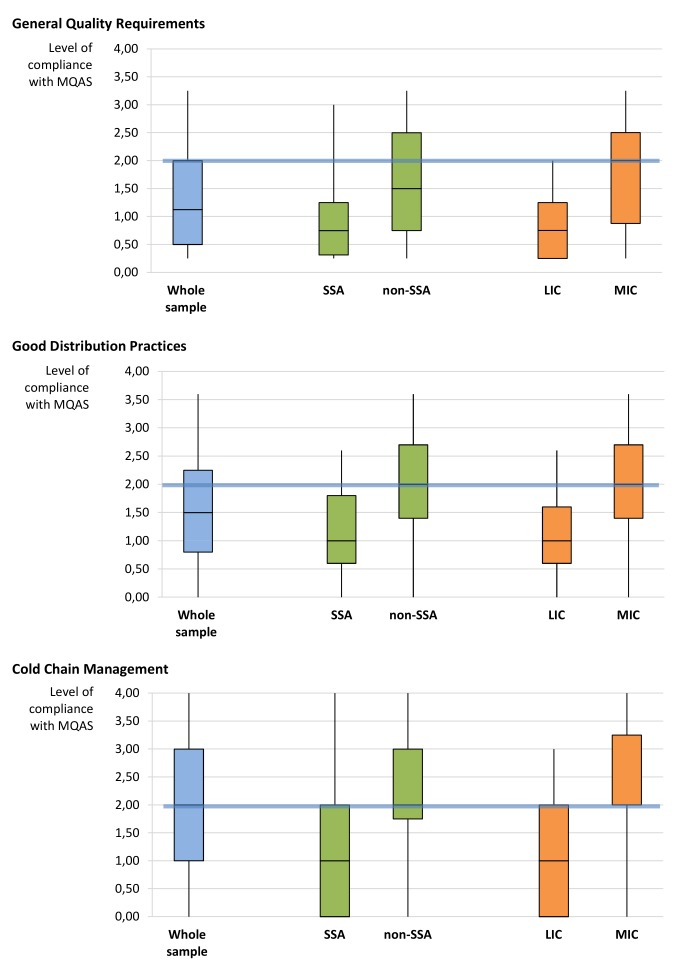
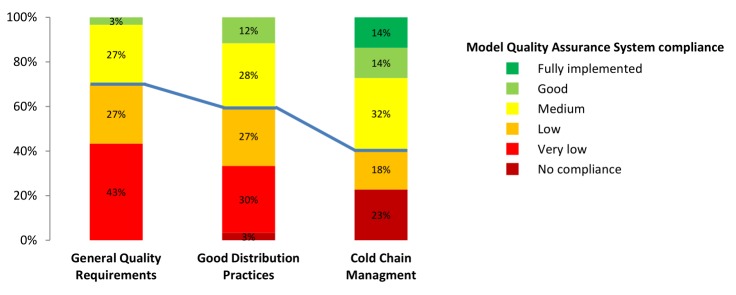
Local private pharmaceutical distributors in our sample were non-compliant, very low-compliant or low-compliant for GQR (70%), GDP (60%) and CCM (41%). Only 7/60 showed good to full compliance for at least two criteria. Observed compliance varies by geographical region and by income group: maximum values are higher in non-SSA versus SSA and in MICs versus LICs, while minimum values are the same across different groups.
The poor compliance with WHO quality standards observed in our sample indicates a concrete risk that patients in LMICs are exposed to poor-quality or degraded medicines. Significant investments are needed to strengthen the regulatory supervision, including on private pharmaceutical distributors. An adapted standardised evaluation tool inspired by the WHO MQAS would be helpful for self-evaluation, audit and inspection purposes.
制药生产与分销的快速全球化并未得到全球监管体系协调统一的支持。因此,低收入和中等收入国家(LMICs)的供应体系仍然面临劣质药品的风险。为了有助于评估LMICs私营部门的这一风险,我们评估了当地私营药品分销商的一个便利样本的质量保证体系。
这项描述性研究使用了QUAMED小组对13个LMICs的60家当地私营药品分销商进行审计得出的二手数据。我们基于受世界卫生组织指南“采购机构的标准质量保证体系(MQAS)”启发的评估工具,评估了分销商对良好分销规范(GDP)、一般质量要求(GQR)和冷链管理(CCM)的遵守情况。描述性统计描述了整个样本、撒哈拉以南非洲(SSA)地区与非SSA地区的分销商以及低收入国家(LICs)与中等收入国家(MICs)的分销商的合规情况。
我们样本中的当地私营药品分销商在GQR(70%)、GDP(60%)和CCM(41%)方面不符合规定、合规性极低或合规性较低。只有7/60的分销商至少在两个标准上表现出良好到完全合规。观察到的合规情况因地理区域和收入群体而异:非SSA地区高于SSA地区,MICs高于LICs,而不同群体的最小值相同。
我们样本中观察到的对世界卫生组织质量标准的低合规性表明,LMICs的患者面临着接触劣质或变质药品的切实风险。需要大量投资来加强监管监督,包括对私营药品分销商的监管。受世界卫生组织MQAS启发的适用标准化评估工具将有助于进行自我评估、审计和检查。