Mohapatra Ipsa, Das Sai Chandan, Samantaray Sonia
Department of Community Medicine, Kalinga Institute of Medical Sciences, Bhubaneswar, Odisha, India.
Department of Community Medicine, Gitam Institute of Medical Sciences, Vizag, Andhra Pradesh, India.
J Family Med Prim Care. 2018 Jan-Feb;7(1):11-15. doi: 10.4103/jfmpc.jfmpc_21_17.
Around 3 billion people use solid fuels (biomass and coal) for cooking and heating, and this number is expected to grow until at least 2030. Around 73.7% of households in rural Odisha use wood for cooking. This current study is an attempt to evaluate the impact of solid cooking fuels on health of rural women in age group of 20-40 years and to study the relationship between the duration of exposure to cooking fuels and various health problems.
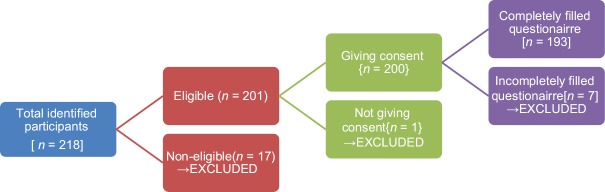
This cross-sectional study was carried out in a village which is under the field practice area of the rural health and training centre, under Department of Community Medicine, Kalinga Institute of Medical Sciences. Universal sampling technique was adopted for sample selection. Chi-square test was used to find the association between cooking fuel usage and self-reported symptoms.
Dry cough was the most common presenting symptom (15.03%), followed by eye and nose irritation present in nearly 12% each among the study participants. Headache, dry cough, and hypertension (HT) was found to associated with number of cooking years and was also found to be statistically significant ( = 0.03, 0.02 and 0.0065, respectively).
Our study clearly indicated that the exposure to biomass fuel smoke is significantly associated with the prevalence of symptoms of headache, dry cough, and HT. Further research is required for improving information on dose-response relationships between indoor air pollution and various health effects. Conclusion: The morbidities were increased with increase in duration of cooking . Knowledge related to health effects of cooking fuels seems to be poor among the participants.
约30亿人使用固体燃料(生物质和煤炭)做饭和取暖,预计这一数字至少会增长到2030年。奥里萨邦农村地区约73.7%的家庭使用木材做饭。本研究旨在评估固体烹饪燃料对20至40岁农村女性健康的影响,并研究接触烹饪燃料的时长与各种健康问题之间的关系。
这项横断面研究在一个村庄开展,该村庄属于卡林加医学科学研究所社区医学系农村健康与培训中心的实地实践区域。采用整群抽样技术进行样本选择。使用卡方检验来确定烹饪燃料使用情况与自我报告症状之间的关联。
干咳是最常见的症状(15.03%),其次是眼睛和鼻子刺激症状,在研究参与者中各占近12%。头痛、干咳和高血压被发现与烹饪年限有关,且在统计学上也具有显著性(分别为=0.03、0.02和0.0065)。
我们的研究清楚地表明,接触生物质燃料烟雾与头痛、干咳和高血压症状的患病率显著相关。需要进一步研究以完善关于室内空气污染与各种健康影响之间剂量反应关系的信息。结论:发病率随着烹饪时长的增加而上升。参与者对烹饪燃料健康影响的相关知识似乎匮乏。