Sanchez-Sanchez Javier, Ramirez-Campillo Rodrigo, Carretero Manuel, Martín Victor, Hernández Daniel, Nakamura Fabio Y
Group Planning and Assessment of Training and Athletic Performance, Pontifical University of Salamanca, Salamanca, Spain.
Department of Physical Activity Sciences, Research Nucleus in Health, Physical Activity and Sport, Universidad de Los Lagos, Osorno, Chile.
J Hum Kinet. 2018 Jun 13;62:167-175. doi: 10.1515/hukin-2017-0168. eCollection 2018 Jun.
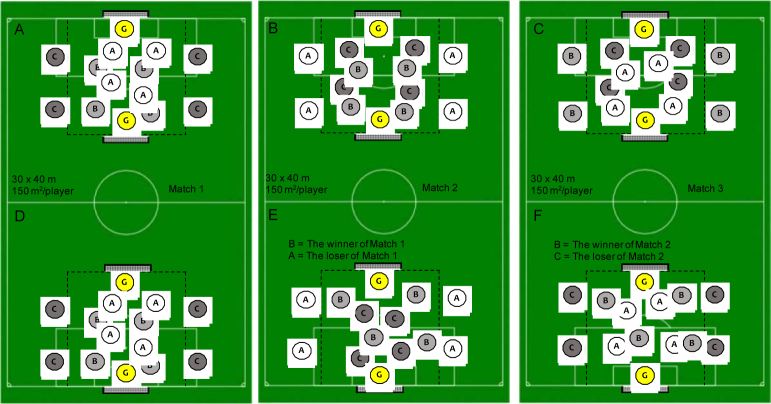
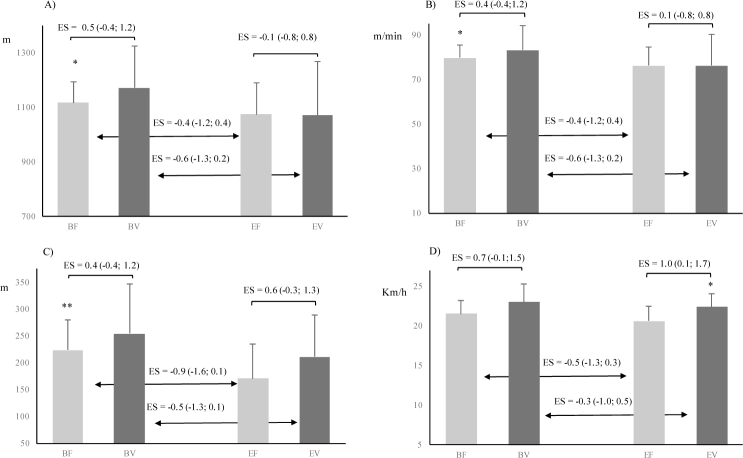
In order to investigate the physical demands of widely used in soccer small-sided games (SSGs), we compared game variations performed under different interval (fixed or variable) and timing regimens (beginning or end of a training session). Twelve male players wore GPS devices during the SSGs to record total distance, relative distance, distance at different speeds, and maximum velocity variables. Four variations of SSGs (4x4) were randomly applied: beginning of a training session with fixed and variable recovery, or end of a training session with fixed and variable recovery. During the beginning or end of a training session settings with fixed recovery duration, 2-min of playing and 2-min of recovery were provided. During the beginning and end of a training session settings with variable recovery, athletes kept playing until a goal was scored, or up to 2-min if no goals were scored. Results were analysed using MANOVA. Total distance and relative distance were higher in the beginning compared to end of training sessions for both fixed and variable recovery duration (small to moderate effect sizes). Distance at various speed ranges (i.e., 13-18 km/h and >18 km/h) was higher (p ≤ 0.01) at the beginning than at the end of training sessions with variable recovery. In addition, distance >18 km/h was higher at the beginning of a training session with variable recovery than fixed recovery and at the end of a training session with variable recovery than fixed recovery. In conclusion, several physical demand characteristics are affected by the moment of SSG application, while others respond to the recovery regime during SSGs, thus providing indications to the coaches to prescribe the intended training intensity by manipulating the context.
为了研究足球小场地比赛(SSGs)中广泛使用的身体需求,我们比较了在不同间歇(固定或可变)和计时方案(训练课开始或结束)下进行的比赛变化。12名男性球员在小场地比赛期间佩戴GPS设备,以记录总距离、相对距离、不同速度下的距离和最大速度变量。随机应用了四种小场地比赛(4x4)变化:训练课开始时采用固定和可变恢复,或训练课结束时采用固定和可变恢复。在固定恢复时间的训练课开始或结束时,提供2分钟的比赛时间和2分钟的恢复时间。在可变恢复的训练课开始和结束时,运动员持续比赛直到进球,或者如果没有进球则持续2分钟。使用多变量方差分析(MANOVA)对结果进行分析。对于固定和可变恢复时间,训练课开始时的总距离和相对距离均高于结束时(效应大小为小到中等)。在可变恢复的训练课中,不同速度范围(即13 - 18公里/小时和>18公里/小时)的距离在开始时高于结束时(p≤0.01)。此外,在可变恢复的训练课开始时,>18公里/小时的距离高于固定恢复,在可变恢复的训练课结束时也高于固定恢复。总之,小场地比赛应用的时刻会影响几个身体需求特征,而其他特征则对小场地比赛期间的恢复方案有反应,从而为教练通过操纵情境来规定预期训练强度提供了参考。